The method of images replaces induced charges or currents on a boundary by fictitious sources outside the physical region, chosen to satisfy that boundary's conditions. For example, a point charge a height above a grounded conducting plane has an image at the reflected point. The sum has zero potential on the plane, and the electrostatic uniqueness theorem identifies it with the physical solution in the upper half-space. Images do not describe a second physical charge below the metal.
For the superconducting plane, use the different boundary condition at its surface: magnetic flux cannot enter the ideal bulk. Choose the real ring moment , where , at . Its image has moment at . This superconducting plane image dipole makes the normal fields cancel at , while their tangential fields add. The image is a computational continuation; the physical field inside the plane is zero. The original sketch shows the dipole-scale field, appropriate to ; the fine field close to the ring wire is outside that approximation.
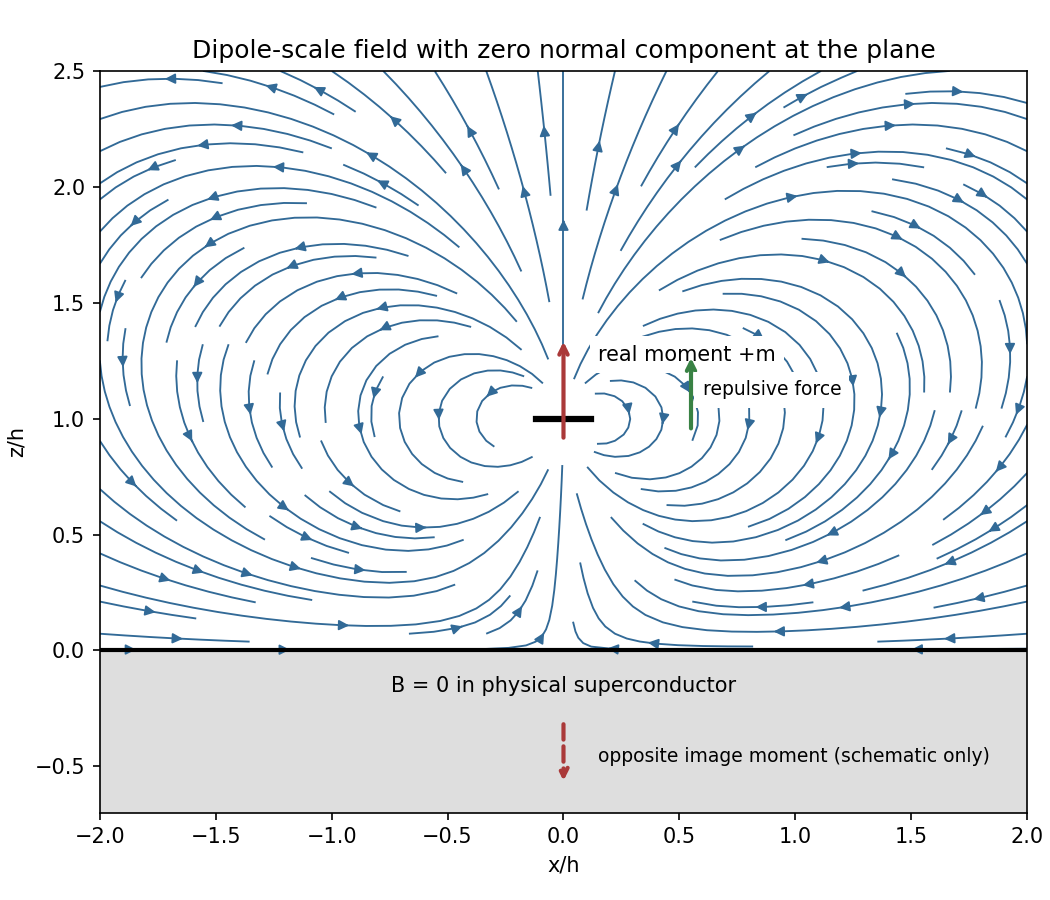
Original dipole-scale field above a flux-excluding plane, with the opposite image moment shown schematically
. Details. 
In the vacuum region the magnetic scalar potential isAt the surface , it reduces to . Its tangential derivative therefore givesBoth and vanish there; the sign is inward radially for the chosen positive moment. The expression is the leading dipole result, not an exact finite-ring formula at arbitrary .
For the force, calculate the external image field on the axis near the real dipole:Differentiate this field with the image location held fixed, then evaluate at . The dipole levitation force above a superconducting plane isdirected upward. Differentiating a substituted separation while moving both dipoles in the force derivative would incorrectly double the result.
To levitate ring mass , balance this force against :A light, thin wire and the smallest practical gap reduce current. At fixed gap and wire cross-section , gives , favouring a larger ring until the dipole-limit constraint on matters. There is no unique least current without geometric and material constraints. As a geometrically consistent order-of-magnitude example, take , , wire radius and an assumed metallic-scale density . Then and . The large value reflects the weak force in the stipulated far-field geometry. Uniformly shrinking this geometrical example reduces current as size to the power , but increases required electric current density; arbitrarily thin wire is therefore not a free optimization.
This balance estimate is not a verified superconducting design. The actual wire must carry that current without quenching, its self-field counts toward the limit, the plane must remain in its assumed flux-excluding state, and leads or supports add load. Transport critical-current measurements specify temperature, applied field and the voltage criterion rather than a material-independent limiting current.[ref]
Standard Reference Materials: Critical current measurements on an NbTi superconducting wire standard reference material by A. F. Clark and others. NBS SP 260-91, Section 7 and Table 3, field/temperature-dependent critical-current specification
Articles by others on the same topic
There are currently no matching articles.