Original solutions to the released 2016 paper. [ref]
https://www.whatdotheyknow.com/request/natural_science_tripos_physics_e_2/response/2340776/attach/2/FOI%202023%20399%20Zahid%20materials.pdf?cookie_passthrough=1#page=186. Original public PDF, physical pages 186–194; question pages 187–194
Take a long strip along , occupying in , with uniform surface current . Above the strip's centre, the contributions odd in cancel, while the Biot-Savart law gives the magnetic field of a uniformly conducting stripThe field reverses below the strip. Its field lines wrap around the longitudinal current: nearly parallel to the faces near the centre, then curving round the edges and approaching circles at large distances. The sketch is an original field integration; the conductor thickness is idealized as negligible.
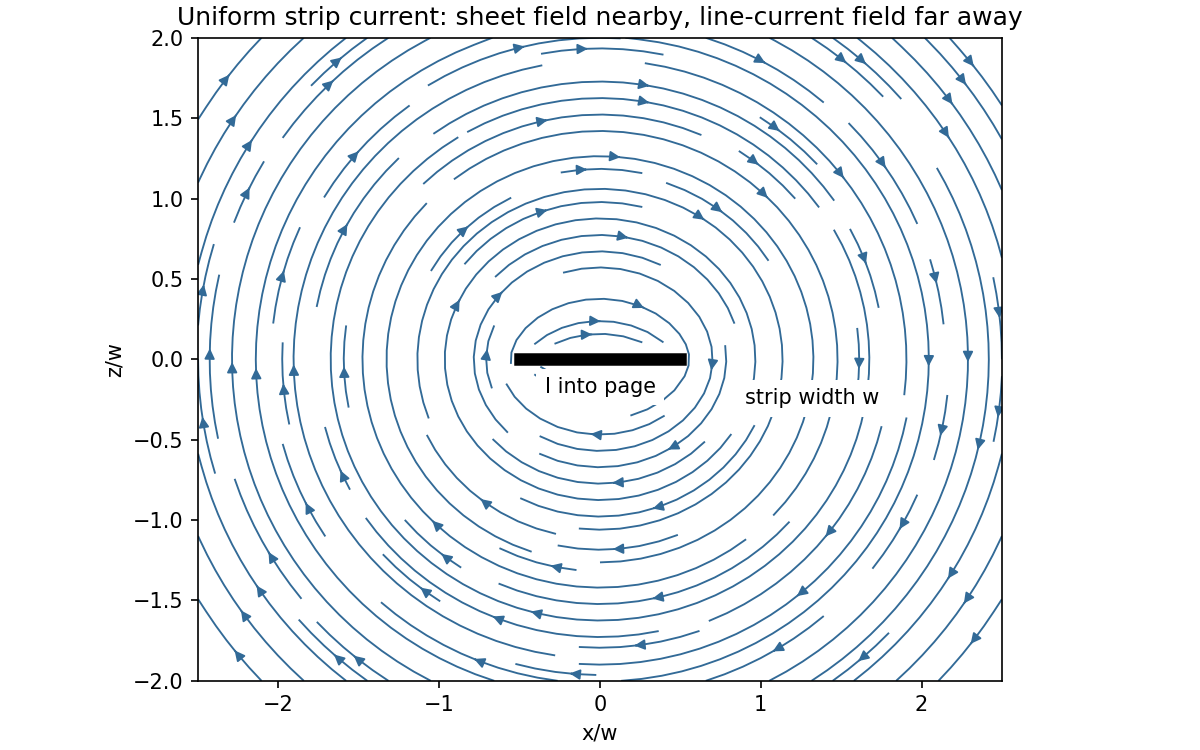
Original magnetic field-line integration for a uniformly current-carrying thin strip
. Details. At distance , the strip is indistinguishable to leading order from a straight line current. Ampère's law on a large circular contour gives , directed tangentially around the strip's longitudinal axis by the right-hand rule. On the perpendicular centreline this also follows by expanding .
At perpendicular distance from the middle of a face, but outside the conductor, the strip approximates an infinite current sheet. The tangential field jump is and symmetry gives equal opposite fields on the two sides. Hence on either side. The centreline integral gives the same limit as . Uniform current across the width and distance from the strip edges are implicit in this sheet approximation; a nonuniform surface current would require its local value instead.
Let be the initial plan area and take compression normal to the sheet. Smooth plates exert no lateral traction, so the uniaxial stress is and the two lateral strains are . To first order in strain,This area expansion under uniaxial compression is the increase of the sheet's plan area, equivalently the area of either broad face. Counting the sum of both broad faces would give twice this change; edge area would require thickness information. The cancellation of is a small-strain linear-elastic result, not a statement that arbitrarily large compressions need no geometry data.
Use a cold, unmagnetized, collisionless plasma with a sharp interface, and take the incident medium to be vacuum. Its relative permittivity is , so at the stated frequencies . Conservation of tangential wavenumber givesFor oblique total reflection at an unmagnetized plasma, require , or . Thus total reflection occurs for measured from the normal, up to grazing incidence. At the ideal critical angle the transmitted normal energy flux also vanishes, so the lossless reflectance reaches unity there. Collisions or an imposed magnetic field change this simple criterion. The constitutive response used here follows the electron-motion derivation in the cited university notes.[ref]
Oscillations and Waves by Richard Fitzpatrick. Section 9.7, equations 9.27–9.30, unmagnetized-plasma dispersion and refractive index
To obtain the maximum work from two finite heat reservoirs, operate a reversible heat engine between the bodies until their temperatures coincide. Include the work store in the isolated total system: no heat enters from outside, while the bodies can transfer energy to that store. With the stated constant heat capacities, reversibility requiresNumerically, . The decrease of the bodies' internal energy isDirect thermal equilibration without an engine would instead reach the arithmetic heat-capacity-weighted temperature and deliver no work. entropy production can only raise the final common temperature above the value for zero entropy production and reduce extractable work.
A stationary person relative to the rim has centripetal acceleration . If is a signed walking speed relative to the rim, the inertial tangential speed is , so the inward normal reaction satisfiesConsequently the support force per mass, and hence apparent weight, is for and zero for . In the latter case the walker has zero inertial speed and needs no centripetal support; ordinary weight-bearing contact cannot be assumed to persist without a restraint. For artificial gravity in a rotating ring, the centrifugal force and the Coriolis force alone are insufficient: the walker also has relative-path centripetal acceleration . Omitting it would give the wrong apparent weights at these large walking speeds.
The method of images replaces induced charges or currents on a boundary by fictitious sources outside the physical region, chosen to satisfy that boundary's conditions. For example, a point charge a height above a grounded conducting plane has an image at the reflected point. The sum has zero potential on the plane, and the electrostatic uniqueness theorem identifies it with the physical solution in the upper half-space. Images do not describe a second physical charge below the metal.
For the superconducting plane, use the different boundary condition at its surface: magnetic flux cannot enter the ideal bulk. Choose the real ring moment , where , at . Its image has moment at . This superconducting plane image dipole makes the normal fields cancel at , while their tangential fields add. The image is a computational continuation; the physical field inside the plane is zero. The original sketch shows the dipole-scale field, appropriate to ; the fine field close to the ring wire is outside that approximation.
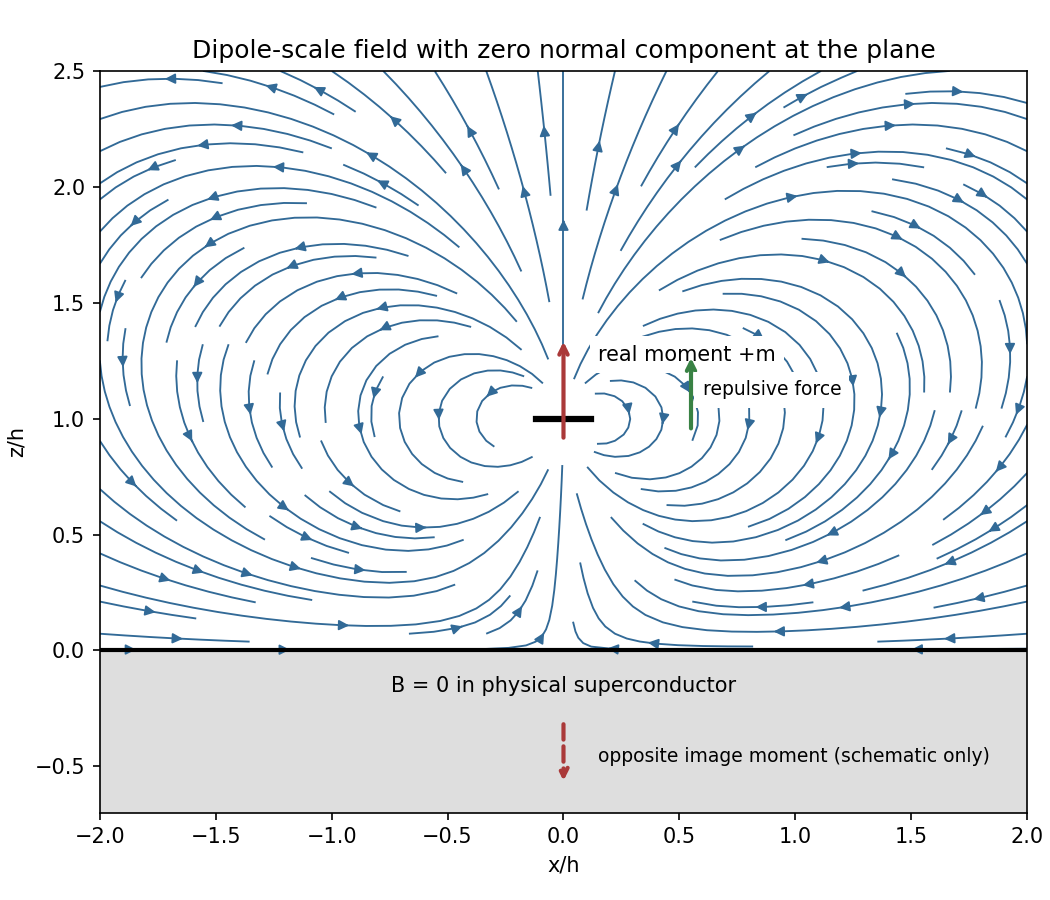
Original dipole-scale field above a flux-excluding plane, with the opposite image moment shown schematically
. Details. In the vacuum region the magnetic scalar potential isAt the surface , it reduces to . Its tangential derivative therefore givesBoth and vanish there; the sign is inward radially for the chosen positive moment. The expression is the leading dipole result, not an exact finite-ring formula at arbitrary .
For the force, calculate the external image field on the axis near the real dipole:Differentiate this field with the image location held fixed, then evaluate at . The dipole levitation force above a superconducting plane isdirected upward. Differentiating a substituted separation while moving both dipoles in the force derivative would incorrectly double the result.
To levitate ring mass , balance this force against :A light, thin wire and the smallest practical gap reduce current. At fixed gap and wire cross-section , gives , favouring a larger ring until the dipole-limit constraint on matters. There is no unique least current without geometric and material constraints. As a geometrically consistent order-of-magnitude example, take , , wire radius and an assumed metallic-scale density . Then and . The large value reflects the weak force in the stipulated far-field geometry. Uniformly shrinking this geometrical example reduces current as size to the power , but increases required electric current density; arbitrarily thin wire is therefore not a free optimization.
This balance estimate is not a verified superconducting design. The actual wire must carry that current without quenching, its self-field counts toward the limit, the plane must remain in its assumed flux-excluding state, and leads or supports add load. Transport critical-current measurements specify temperature, applied field and the voltage criterion rather than a material-independent limiting current.[ref]
Standard Reference Materials: Critical current measurements on an NbTi superconducting wire standard reference material by A. F. Clark and others. NBS SP 260-91, Section 7 and Table 3, field/temperature-dependent critical-current specification
Faraday's law for the moving loop is , equivalently for its moving circuit. Lenz's law fixes its orientation: the induced current opposes the change in linked magnetic flux. The minus sign represents this opposition, not opposition to the existing field in every phase of motion.
Unroll the small loop's motion locally into translation to the right at speed , where is the radius marked in the source figure. Take the imposed field into the page. On entry the linked into-page flux increases, so the current is counterclockwise. The leading vertical side carries current upward and feels a leftward magnetic force . The in-field parts of the horizontal sides feel equal opposite vertical forces; the trailing side is outside the field. On exit the current is clockwise. The trailing vertical side is now the one in the field and again carries upward current, producing leftward drag; the horizontal forces reverse and still cancel. When the entire loop is within the uniform region, its flux is constant, so and every side force is zero under the stated negligible-self-inductance approximation.
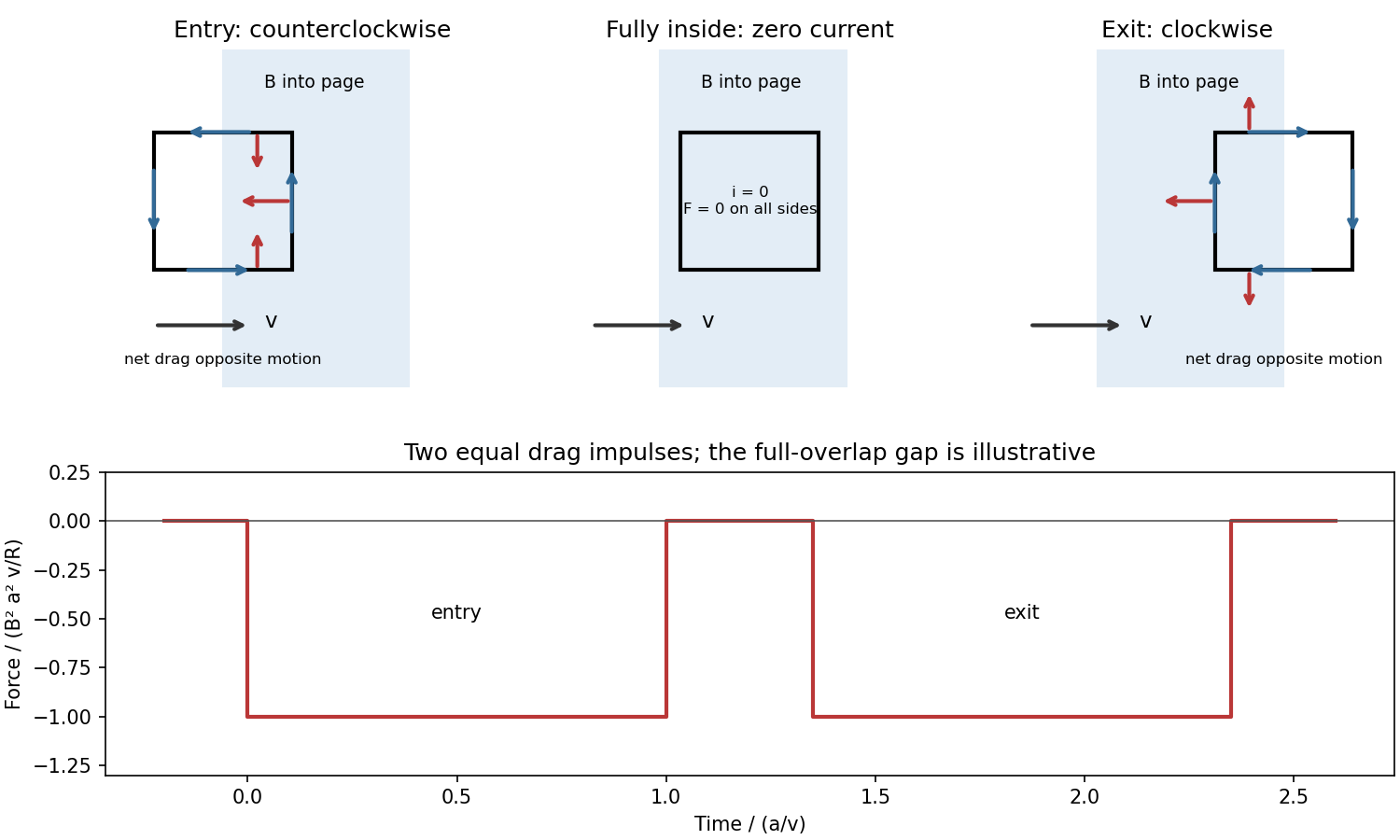
For a loop crossing a magnetic field boundary, overlap changes at rate , henceFor approximately constant speed this gives two negative rectangular force pulses of duration , separated by a short zero-force interval while the loop is fully inside. Their time integral isThe quoted impulse is its magnitude; this impulse of magnetic braking opposes the motion. In fact its independence of speed remains exact within this locally translational sharp-boundary model even if speed changes: each crossing contributes over distance .
Write the system's moment of inertia as . Since , the local energy balance during overlap isThus rotational energy lost is exactly resistive heat in this model. At nearly constant , each pass givesFor a finite speed reduction the exact relation is the integral of , rather than initial speed times impulse; the equality of work and heating still holds. Fringing fields, loop curvature and finite self-inductance smooth the ideal pulses. A practical user control is to vary the electromagnet current, hence : braking scales as .
Use peak phasors with time dependence , real positive electrical conductivity , and absolute permeability . Ampère-Maxwell equation and Faraday equations giveso . The sign of the imaginary term follows from the stated time convention. For a transverse plane wave in a homogeneous conductor,In the good-conductor limit, choose the root that decays into :The electric phasor and physical field are consequently and , as required. Tangential boundary matching sets ; it need not equal the incident amplitude.
Faraday's law fixes the magnetic field, including its phase:For real and , this means , with other components zero. The time-averaged Poynting vector isThe energy entering a thin slab exceeds that leaving it by per unit volume, givingDirectly, and at each time. Therefore is exactly this loss. The factors one half use peak rather than root mean square phasors; amplitude decays over , while intensity decays over .
For a cold collisionless unmagnetized plasma, electron inertia gives and real . Above the plasma frequency the wave propagates without this resistive attenuation. Below it, a semi-infinite plasma supports an evanescent field with electric and magnetic components in quadrature and zero mean inward energy flux: the incident energy is reflected, not absorbed as Joule heating. electron kinetic energy is reversibly stored, so the nondispersive dielectric field-energy formula alone is incomplete. Collisions introduce a real dissipative electrical conductivity and can produce absorption.[ref]
Oscillations and Waves by Richard Fitzpatrick. Section 9.7, equations 9.36–9.53, evanescence, phase quadrature and unit reflectance
For a linear nondispersive medium with real absolute permittivity and permeability , instantaneous field energy density and energy flux arewith local balance . energy stored locally and energy passing through a surface are distinct: integrating the balance relates their rates and the power given to charges.
Between the coaxial conductors, cylindrical Gauss and Ampère laws giveThe inner line charge is , so the capacitance per length is . Integrating magnetic energy over the annulus gives , hence . ThusThese are per-length parameters for ideal conductors, excluding internal magnetic penetration.
Now let the voltage and current amplitudes be and multiply both transverse fields by . Their divergences vanish in the annular dielectric. The two nontrivial curl equations reduce toConsequently both and are required for a forward wave. Arbitrary independent static and cannot acquire the same forward-wave factor and still satisfy Maxwell's equations. This TEM travelling-wave voltage-current relation and the dispersion constraint identify the transverse electromagnetic mode and its speed .
For the travelling wave, . Integrating over the dielectric annulus yieldsThis is the familiar circuit power, carried here through the dielectric rather than through the ideal metal. In root mean square notation it is for the forward lossless wave; the corresponding static fields give without a time-average factor. The average line energy is , whose product with wave speed agrees with the power.
Finite conductor resistance requires a small longitudinal electric field to drive current. Its cross product with the azimuthal magnetic field produces a radial Poynting component into each conductor: inward radially at the inner conductor and outward radially into the outer conductor. This Poynting flux into lossy coaxial conductors explains why forward power decreases along the cable as energy becomes heat in the metal. The mode is then only approximately TEM; strictly zero longitudinal electric field would be inconsistent with resistive current.
For a central potential, angular momentum is conserved and the motion lies in a plane. With , radial energy conservation becomesAllowed radii have ; equality gives radial turning points. A well with two finite turning points gives regular radially bound motion. Access to arbitrarily large radii gives an unbound branch, while access to the origin can lead to collision in a singular potential. Stationary points are circular-orbit candidates; a strict local minimum gives radial stability. For a potential tending to zero at infinity, energy relative to that asymptote is useful, but a singular inner potential and centrifugal barrier must still be examined.
Integrating the angular-momentum relation with the origin of angle at givesFor at , the effective potential is . It is exactly the Kepler effective potential with , provided that expression is real. Equal radial energy and initial radial phase therefore give identical , although the angular motion differs. Writing for the Kepler angle, . With matched periapsis origins,Here and the eccentricity is fixed by radial energy. For , and successive periapses are separated by , so there is retrograde apsidal motion relative to a closed Kepler ellipse. The radial equivalence is the relevant content of the Newton's theorem of revolving orbits.
For the pure inverse-cube central force set . The free-particle reference orbit at is a straight line, , not a finite- conic with its old held fixed. To cover attractive as well as repulsive cases completely, putwhere primes denote angle derivatives and . The inverse-cube central orbit classification gives the following physically positive-radius branches.
For , write with , so . These are scattering orbits with positive energy and an inner turning radius ; the angular interval between the two infinite-radius ends is . Repulsion () gives an interval smaller than ; weak attraction () gives a larger interval and can cause winding. The limit is the straight line.
For , . If , reciprocal-linear spirals connect an infinite-radius end to collision at infinite accumulated angle. If and , every radius admits a circular solution at zero energy: attraction exactly balances centrifugal acceleration. Each is a marginal circular orbit under an inverse-cube force, with no radial restoring force.
For , put and . Up to angle shifts and reversal, the three energy classes arewith positive-radius domains understood. The negative-energy branch is radially bounded but reaches the singular centre on either side of its outer turning point; it is not a regular closed orbit. Collision requires additional physics to continue through . Zero angular momentum gives radial trajectories and is excluded from the angular parametrization above.
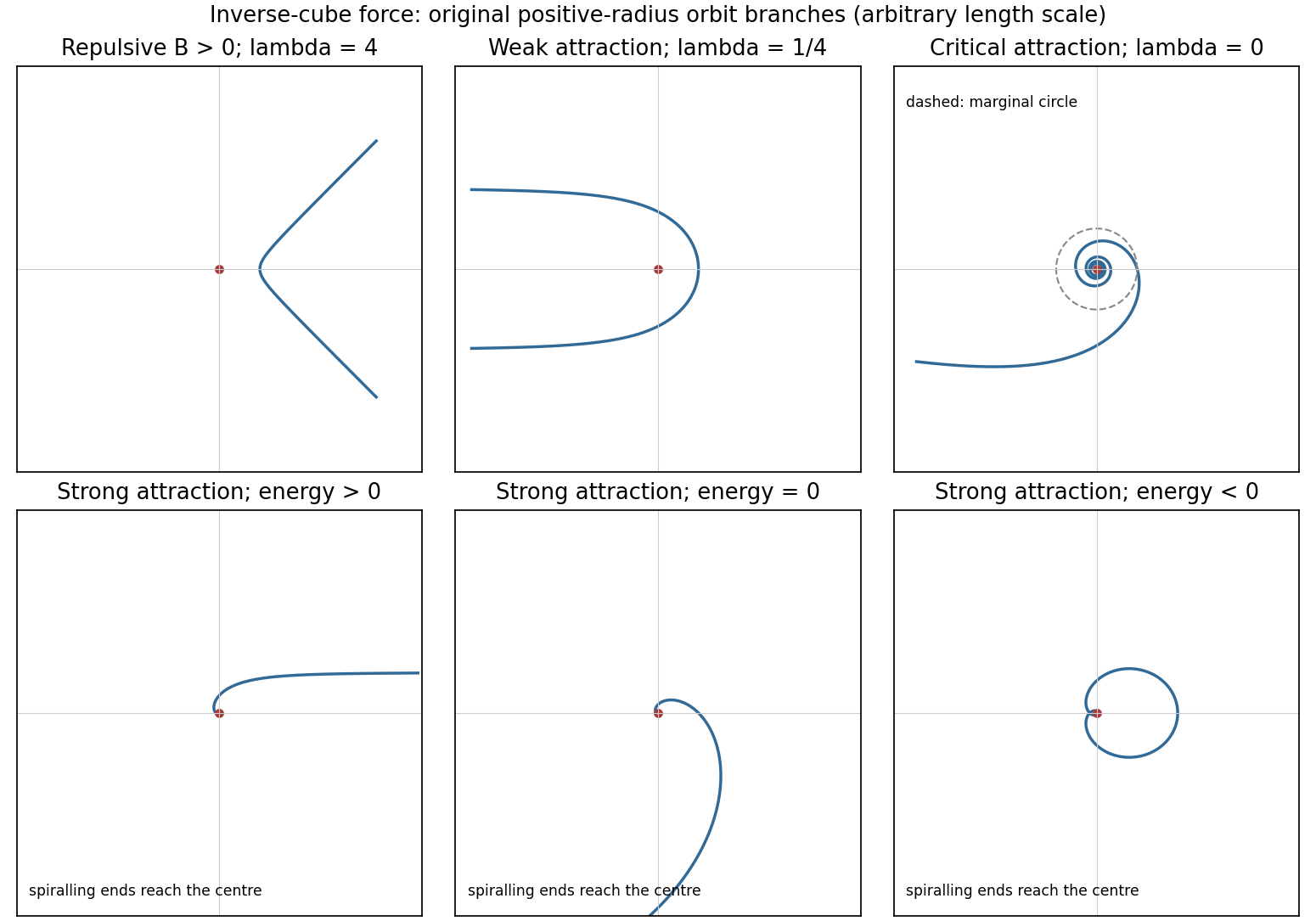
Original representative inverse-cube orbit branches, with force sign and critical attraction distinguished
. Details. For a body-fixed mass element at position relative to the fixed tip, . ThereforeThe inertia tensor is real symmetric. Its orthogonal eigenvectors define principal axes and its eigenvalues are principal moments of inertia. angular momentum is parallel to angular velocity when rotation is along a principal axis, but generally not for arbitrary rotation.
Write and . Axial symmetry gives . Since , the vector triple-product identity gives . HenceDifferentiate in the inertial frame, using constant and . The gravitational torque about the fixed tip is , yielding the symmetry-axis equation of a heavy symmetric top:The tip reaction exerts no moment about that tip.
For steady precession, . At azimuth zero, put and . Then , , and the component gives . For a nonvertical axis this becomesReal steady branches require a nonnegative discriminant. In particular, for a top pointing above the horizontal there is a spin threshold for these fixed-angle solutions. At use the quadratic's linear limit , rather than dividing by zero. For a vertical axis, azimuth does not describe a physical conical motion and the division by is inappropriate.
For rapid positive spin with , the slow and fast steady precession roots areThe approximation assumes a nonsingular fixed inclination. For , the quadratic instead gives or . The zero branch has a stationary symmetry axis and pure axial spin. On the other branch angular momentum is constant and parallel or antiparallel to the chosen axis; and . This is torque-free precession in space, not the different rate at which transverse components rotate in body coordinates.
Take as signed distance from the neutral axis within the beam cross-section. Bending into a large radius changes the length of a fibre proportionally to , so linear elasticity gives , up to the curvature sign convention. The moment magnitude isHere is the second moment of area about the neutral axis, with units of length to the fourth power, not the mass moment of inertia. A homogeneous cross-section has its neutral axis through the centroid under pure bending.
For the straight pin-ended beam, the compressive dead load produces bending moment at transverse offset . In the small-slope approximation, curvature is with the corresponding sign convention, givingThe stated endpoints fix positions rather than slopes: this interpretation is consistent with the illustrated end forces and the later sinusoidal unstressed shape. Truly clamped endpoints would have a different threshold. A nonzero solution requires . Thus the first Euler load is . Below it the perfect straight state is stable, at it the first mode is marginal in linear theory, and above it the straight state is unstable. The linear equation selects thresholds but cannot set the amplitude or describe a finite postbuckled equilibrium.
For the initially curved compressed beam, elastic stress responds to the change from its stress-free curvature. With , the moment is , so force balance givesPut and seek the branch continuously connected to the unloaded shape. Since , substitute to obtain , orAway from eigenvalues, the homogeneous solution vanishes under the two end conditions, so this particular solution is the unique linear equilibrium. For and , the maximum additional displacement is and maximum total displacement is , both at midspan.
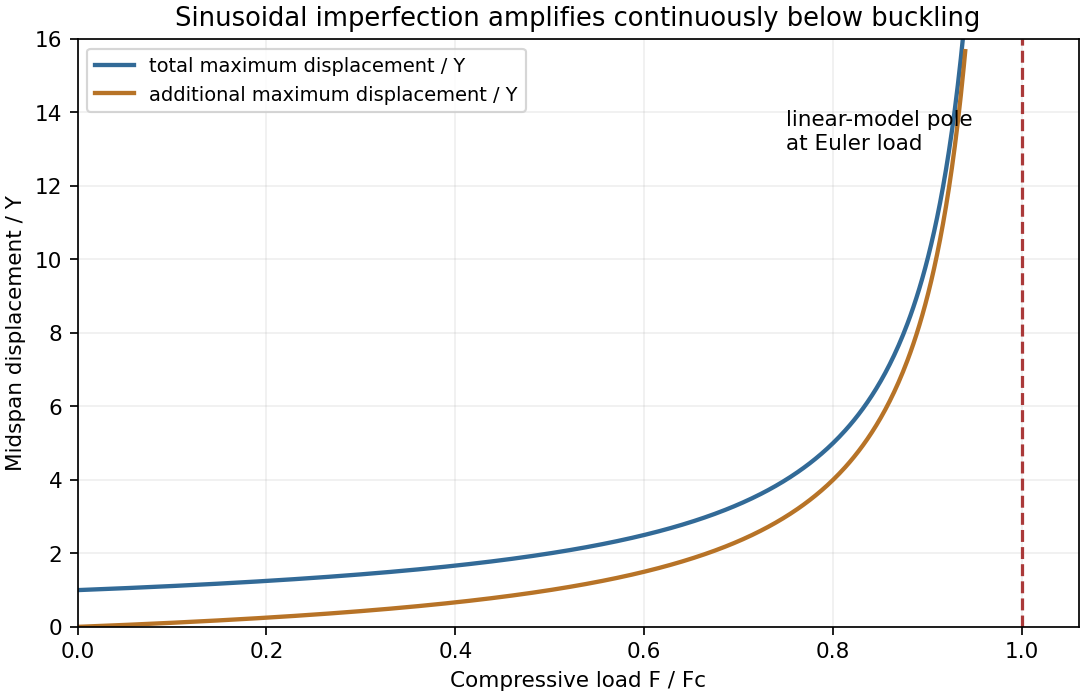


This sinusoidal imperfection amplification of a column produces deflection at every positive load and strong amplification near . The apparent divergence signals loss of the small-slope model before infinite displacement; nonlinear geometry is needed there. The formal continuation above the first threshold is not a stable physical loading branch. Both total and additional displacement are distinguished in the graph.
irrotational flow has , so locally ; the simply connected fluid domain here permits a globally single-valued velocity potential. Incompressibility gives , hence . In a multiply connected domain, zero local vorticity alone would not rule out circulation and a multivalued potential.
Take so the disturbance decays at depth. Differentiating the given candidate potential yieldsThe and second derivatives of cancel in the Laplacian. At , , so the linearized kinematic free-surface condition holds. This uses ; advection of the displaced surface is higher order.
Since , the local squared speed is . The depth integral is thereforeIt is independent of horizontal position; no further spatial average is needed for this kinetic energy. Replacing the upper boundary by zero changes it only beyond quadratic order in amplitude.
Relative to the flat surface, the gravitational energy at each horizontal position changes by . Averaging over one wavelength givesThe energy of a deep-water standing gravity wave, averaged over wavelength, is and must be constant for a free inviscid standing wave, which requires equal coefficients of the complementary squared sine and cosine:As an independent check, the linearized dynamic boundary condition at gives exactly . Infinite depth, negligible surface tension and no dissipative forcing are part of this gravity-wave model.
Articles by others on the same topic
There are currently no matching articles.