For a central potential, angular momentum is conserved and the motion lies in a plane. With , radial energy conservation becomesAllowed radii have ; equality gives radial turning points. A well with two finite turning points gives regular radially bound motion. Access to arbitrarily large radii gives an unbound branch, while access to the origin can lead to collision in a singular potential. Stationary points are circular-orbit candidates; a strict local minimum gives radial stability. For a potential tending to zero at infinity, energy relative to that asymptote is useful, but a singular inner potential and centrifugal barrier must still be examined.
Integrating the angular-momentum relation with the origin of angle at givesFor at , the effective potential is . It is exactly the Kepler effective potential with , provided that expression is real. Equal radial energy and initial radial phase therefore give identical , although the angular motion differs. Writing for the Kepler angle, . With matched periapsis origins,Here and the eccentricity is fixed by radial energy. For , and successive periapses are separated by , so there is retrograde apsidal motion relative to a closed Kepler ellipse. The radial equivalence is the relevant content of the Newton's theorem of revolving orbits.
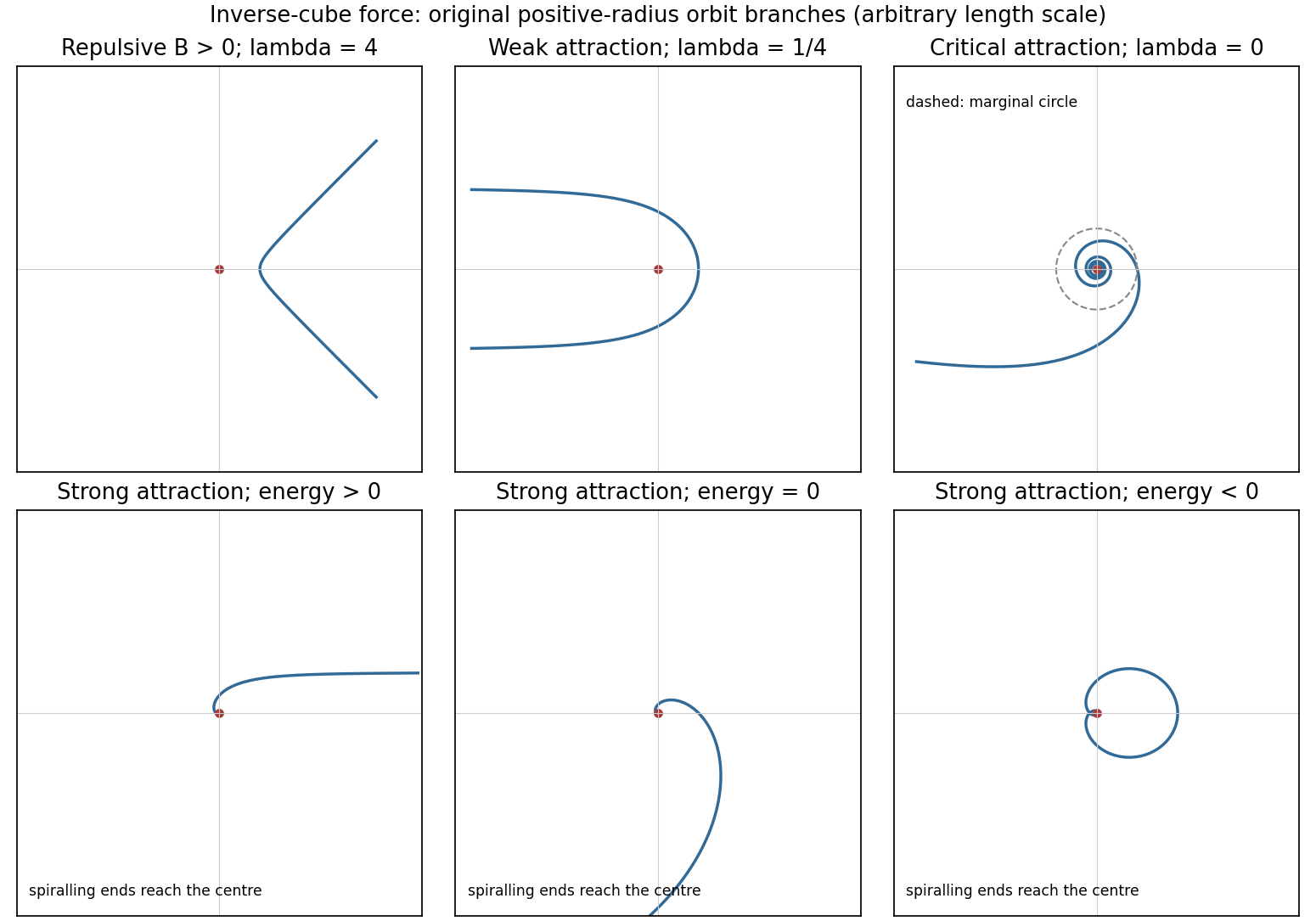
For the pure inverse-cube central force set . The free-particle reference orbit at is a straight line, , not a finite- conic with its old held fixed. To cover attractive as well as repulsive cases completely, putwhere primes denote angle derivatives and . The inverse-cube central orbit classification gives the following physically positive-radius branches.
For , write with , so . These are scattering orbits with positive energy and an inner turning radius ; the angular interval between the two infinite-radius ends is . Repulsion () gives an interval smaller than ; weak attraction () gives a larger interval and can cause winding. The limit is the straight line.
For , . If , reciprocal-linear spirals connect an infinite-radius end to collision at infinite accumulated angle. If and , every radius admits a circular solution at zero energy: attraction exactly balances centrifugal acceleration. Each is a marginal circular orbit under an inverse-cube force, with no radial restoring force.
For , put and . Up to angle shifts and reversal, the three energy classes arewith positive-radius domains understood. The negative-energy branch is radially bounded but reaches the singular centre on either side of its outer turning point; it is not a regular closed orbit. Collision requires additional physics to continue through . Zero angular momentum gives radial trajectories and is excluded from the angular parametrization above.

Articles by others on the same topic
There are currently no matching articles.