For a central potential, angular momentum is conserved and the motion lies in a plane. With , radial energy conservation becomesAllowed radii have ; equality gives radial turning points. A well with two finite turning points gives regular radially bound motion. Access to arbitrarily large radii gives an unbound branch, while access to the origin can lead to collision in a singular potential. Stationary points are circular-orbit candidates; a strict local minimum gives radial stability. For a potential tending to zero at infinity, energy relative to that asymptote is useful, but a singular inner potential and centrifugal barrier must still be examined.
Integrating the angular-momentum relation with the origin of angle at givesFor at , the effective potential is . It is exactly the Kepler effective potential with , provided that expression is real. Equal radial energy and initial radial phase therefore give identical , although the angular motion differs. Writing for the Kepler angle, . With matched periapsis origins,Here and the eccentricity is fixed by radial energy. For , and successive periapses are separated by , so there is retrograde apsidal motion relative to a closed Kepler ellipse. The radial equivalence is the relevant content of the Newton's theorem of revolving orbits.
For the pure inverse-cube central force set . The free-particle reference orbit at is a straight line, , not a finite- conic with its old held fixed. To cover attractive as well as repulsive cases completely, putwhere primes denote angle derivatives and . The inverse-cube central orbit classification gives the following physically positive-radius branches.
For , write with , so . These are scattering orbits with positive energy and an inner turning radius ; the angular interval between the two infinite-radius ends is . Repulsion () gives an interval smaller than ; weak attraction () gives a larger interval and can cause winding. The limit is the straight line.
For , . If , reciprocal-linear spirals connect an infinite-radius end to collision at infinite accumulated angle. If and , every radius admits a circular solution at zero energy: attraction exactly balances centrifugal acceleration. Each is a marginal circular orbit under an inverse-cube force, with no radial restoring force.
For , put and . Up to angle shifts and reversal, the three energy classes arewith positive-radius domains understood. The negative-energy branch is radially bounded but reaches the singular centre on either side of its outer turning point; it is not a regular closed orbit. Collision requires additional physics to continue through . Zero angular momentum gives radial trajectories and is excluded from the angular parametrization above.
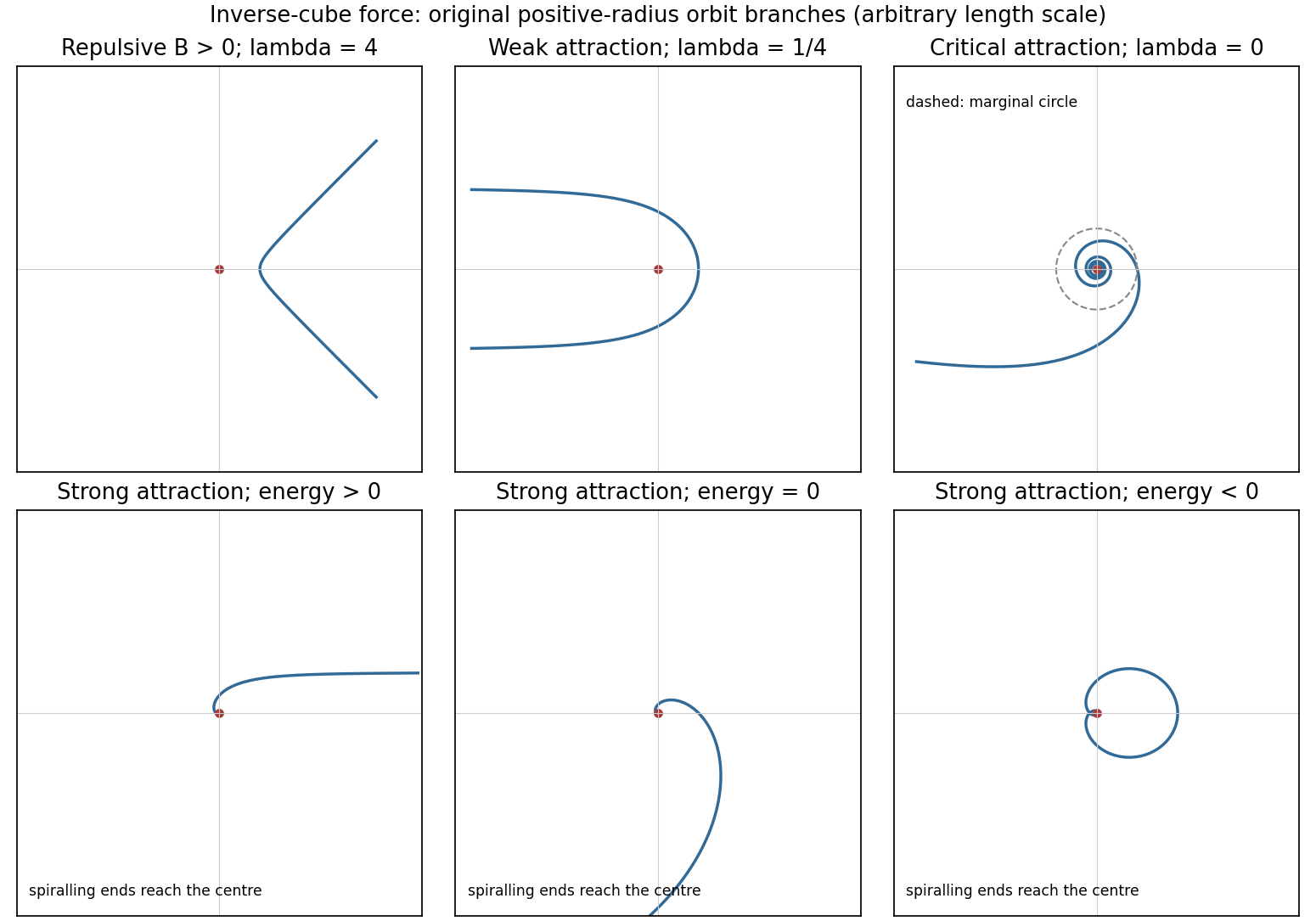
Original representative inverse-cube orbit branches, with force sign and critical attraction distinguished
. Details. For a body-fixed mass element at position relative to the fixed tip, . ThereforeThe inertia tensor is real symmetric. Its orthogonal eigenvectors define principal axes and its eigenvalues are principal moments of inertia. angular momentum is parallel to angular velocity when rotation is along a principal axis, but generally not for arbitrary rotation.
Write and . Axial symmetry gives . Since , the vector triple-product identity gives . HenceDifferentiate in the inertial frame, using constant and . The gravitational torque about the fixed tip is , yielding the symmetry-axis equation of a heavy symmetric top:The tip reaction exerts no moment about that tip.
For steady precession, . At azimuth zero, put and . Then , , and the component gives . For a nonvertical axis this becomesReal steady branches require a nonnegative discriminant. In particular, for a top pointing above the horizontal there is a spin threshold for these fixed-angle solutions. At use the quadratic's linear limit , rather than dividing by zero. For a vertical axis, azimuth does not describe a physical conical motion and the division by is inappropriate.
For rapid positive spin with , the slow and fast steady precession roots areThe approximation assumes a nonsingular fixed inclination. For , the quadratic instead gives or . The zero branch has a stationary symmetry axis and pure axial spin. On the other branch angular momentum is constant and parallel or antiparallel to the chosen axis; and . This is torque-free precession in space, not the different rate at which transverse components rotate in body coordinates.
Take as signed distance from the neutral axis within the beam cross-section. Bending into a large radius changes the length of a fibre proportionally to , so linear elasticity gives , up to the curvature sign convention. The moment magnitude isHere is the second moment of area about the neutral axis, with units of length to the fourth power, not the mass moment of inertia. A homogeneous cross-section has its neutral axis through the centroid under pure bending.
For the straight pin-ended beam, the compressive dead load produces bending moment at transverse offset . In the small-slope approximation, curvature is with the corresponding sign convention, givingThe stated endpoints fix positions rather than slopes: this interpretation is consistent with the illustrated end forces and the later sinusoidal unstressed shape. Truly clamped endpoints would have a different threshold. A nonzero solution requires . Thus the first Euler load is . Below it the perfect straight state is stable, at it the first mode is marginal in linear theory, and above it the straight state is unstable. The linear equation selects thresholds but cannot set the amplitude or describe a finite postbuckled equilibrium.
For the initially curved compressed beam, elastic stress responds to the change from its stress-free curvature. With , the moment is , so force balance givesPut and seek the branch continuously connected to the unloaded shape. Since , substitute to obtain , orAway from eigenvalues, the homogeneous solution vanishes under the two end conditions, so this particular solution is the unique linear equilibrium. For and , the maximum additional displacement is and maximum total displacement is , both at midspan.
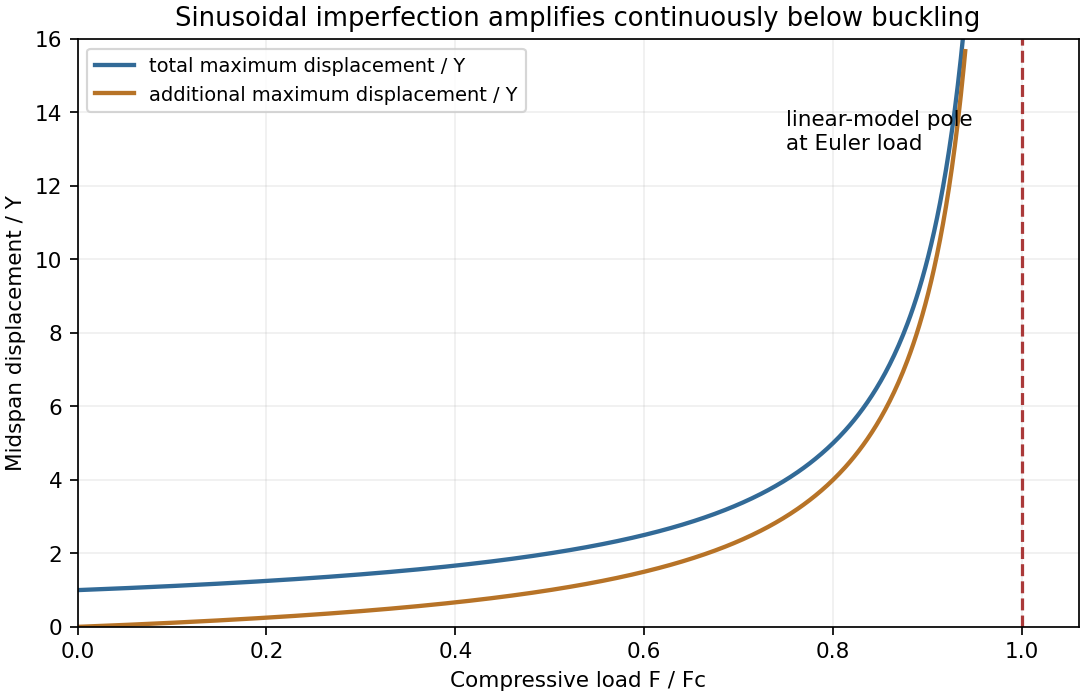


This sinusoidal imperfection amplification of a column produces deflection at every positive load and strong amplification near . The apparent divergence signals loss of the small-slope model before infinite displacement; nonlinear geometry is needed there. The formal continuation above the first threshold is not a stable physical loading branch. Both total and additional displacement are distinguished in the graph.
irrotational flow has , so locally ; the simply connected fluid domain here permits a globally single-valued velocity potential. Incompressibility gives , hence . In a multiply connected domain, zero local vorticity alone would not rule out circulation and a multivalued potential.
Take so the disturbance decays at depth. Differentiating the given candidate potential yieldsThe and second derivatives of cancel in the Laplacian. At , , so the linearized kinematic free-surface condition holds. This uses ; advection of the displaced surface is higher order.
Since , the local squared speed is . The depth integral is thereforeIt is independent of horizontal position; no further spatial average is needed for this kinetic energy. Replacing the upper boundary by zero changes it only beyond quadratic order in amplitude.
Relative to the flat surface, the gravitational energy at each horizontal position changes by . Averaging over one wavelength givesThe energy of a deep-water standing gravity wave, averaged over wavelength, is and must be constant for a free inviscid standing wave, which requires equal coefficients of the complementary squared sine and cosine:As an independent check, the linearized dynamic boundary condition at gives exactly . Infinite depth, negligible surface tension and no dissipative forcing are part of this gravity-wave model.
Articles by others on the same topic
There are currently no matching articles.