Modes, stability and symmetry. A normal mode of the linearized system has a fixed displacement pattern multiplied by one temporal oscillation. For independent generalized coordinates, a conservative small-disturbance system hasWhen the mass matrix is positive definite and the stiffness is a symmetric matrix, the generalized eigenvalue problem for small oscillations has independent mode directions, counting degeneracy. Positive gives stable oscillation, negative an exponentially growing and decaying pair, and zero a neutral direction whose nonlinear stability needs further analysis. An arbitrary linear motion is a superposition of these modes.
If a symmetry preserves both kinetic and potential energies, it maps modes to modes of the same frequency. Mode patterns can be classified by that symmetry, for example reflection-even and reflection-odd patterns. Degenerate eigenspaces admit different bases, so a mode shape need not be uniquely selected inside such a subspace.
Two pendulums free to swing in any direction. Let be the small horizontal displacement along the line joining the supports and the perpendicular horizontal displacement. Put and . To quadratic order,The spring is unstretched at equilibrium. Its first-order length change is only ; a transverse difference changes its length at second order and produces no quadratic transverse restoring energy. Consequently the four modes areThis is the transverse degeneracy of unstretched spring-coupled pendulums: has a three-dimensional eigenspace. Independent transverse motions form an equally valid basis for two of those directions. A pre-tensioned spring would change the transverse result.
The open three-pendulum chain. Restrict motion to the vertical plane containing the supports, with horizontal coordinates . There are springs between neighbours and no wall springs. The equations areThe spring matrix has eigenvalues , with respective eigenvectors , and . The normal modes of three freely ended coupled pendulums are thereforeThe lowest mode stretches neither spring. In the middle mode the outer masses oppose each other and the central mass is stationary. The highest mode has the central mass moving oppositely with twice the outer amplitude. Reflection about the middle support makes the first and last patterns even and the middle pattern odd.
An even ring. For a large ring, use tangential displacement and periodic indexing . The locally straight nearest-neighbour equations areCyclic translation symmetry selects Fourier modes , with . HenceFor even , the lowest pattern has equal tangential displacements, while the highest alternates signs around the ring. Thus
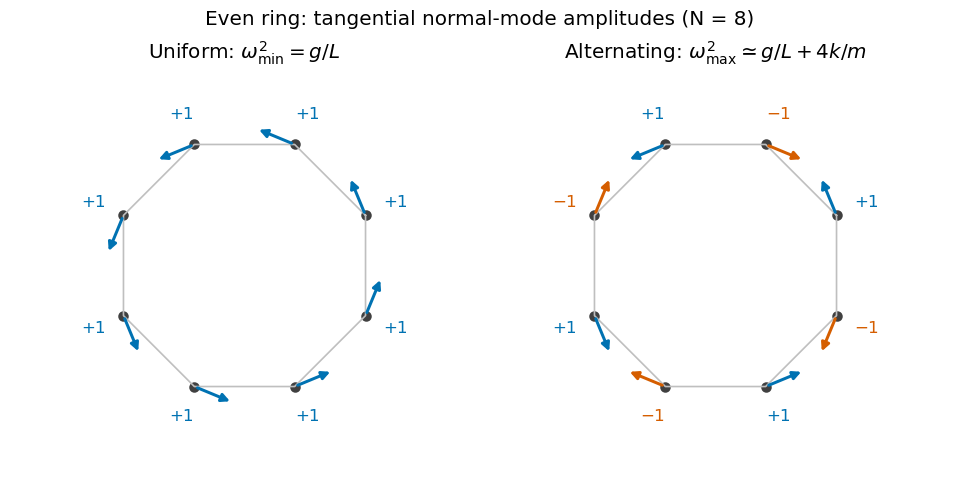
Original amplitude sketches for the lowest and highest modes of an even pendulum ring; arrows denote tangential displacements, not static positions
. Details. 
These are the even and odd pendulum-ring modes. For exact finite regular-polygon geometry with straight chord springs, the first-order spring extension includes a factor , so its squared contribution is multiplied by . That correction tends to one in the requested large- limit.
An odd ring. Perfect alternation cannot close after an odd number of steps. The two highest wave indices are instead and . They give a degenerate pair, represented by real sine and cosine standing patterns, withThe maximum is slightly below the even-ring limiting value, and the sign pattern must contain a gradual phase mismatch rather than exact alternation. The uniform lowest mode is unchanged, and there are still independent tangential mode directions.
Articles by others on the same topic
There are currently no matching articles.