Flow visualization and the idealization. A streamline is everywhere tangent to the instantaneous velocity field at one fixed time. A streakline is the locus, at one observation time, of particles that previously passed through a specified injection point. A marked particle's own trajectory is a pathline. These coincide geometrically in steady flow, but need not do so in an unsteady draining flow.
The intended ideal liquid is approximately incompressible and inviscid: viscosity and associated shear stresses are negligible on the scales and times being considered, the Mach number is small, and the density is effectively constant. This does not require zero vorticity; the initially rotating state is already a counterexample. It also does not justify ignoring viscosity in an arbitrarily thin boundary layer or at a real drain.
Spiralling flow and angular momentum. In an axisymmetric inviscid flow, pressure and gravity exert no torque about the vertical axis. A parcel therefore conserves axial specific angular momentum,The late, shallow remnant in the intended draining picture is supplied by parcels initially near the outer rim, so . The slow-drain angular-momentum amplification then givesThe assumption about the parcels' origin is necessary: torque conservation by itself does not assign to every parcel at every time.
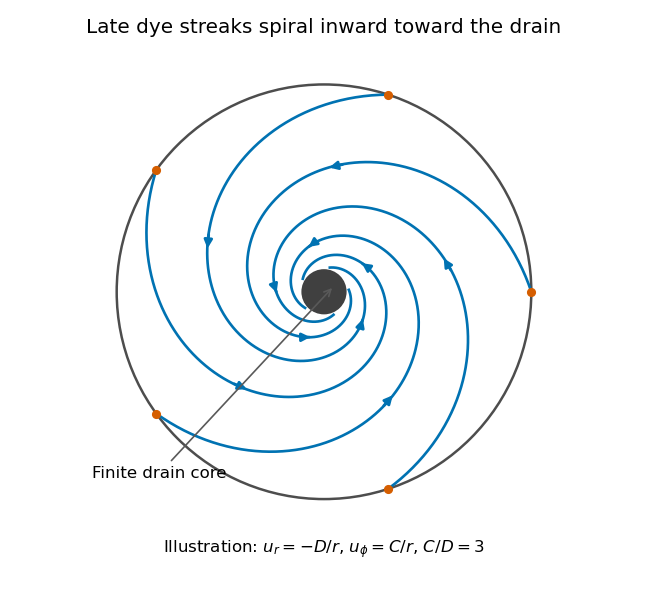
Original quasisteady illustration of inward-spiralling dye streaks outside a finite drain core; the azimuthal speed increases as the radius decreases
. Details. 
A continuous dye feed near the outer free surface produces inward spirals that wind increasingly rapidly near the drain. The figure uses a late quasisteady model, and with positive constants , giving . Its streaklines and streamlines approximately coincide over an observation interval short compared with the overall draining time. Strictly, individually marked particles at the initial surface trace pathlines, not a continuously injected streakline.
The free-surface depression. Let be the surface. Slow radial draining makes radial inertial corrections small compared with the azimuthal centripetal acceleration. The radial Euler equation and vertical hydrostatic equilibrium giveThus , with . Integrating from to the rim givesFor this becomesThe surface rises outward because the inward pressure gradient force must sustain the circular motion. The dimensions are metres, and the profile is not valid inside the finite drain or vortex core.
The terrestrial estimate. Use the vertical component of Earth's rotation as the ideal initial angular speed, . At Cambridge, taking and , this gives . Hence, for , and ,Taking the whole terrestrial angular speed rather than its local vertical projection would give about . The Cambridge estimate uses the projection appropriate to the vertical vortex. This very small head assumes terrestrial rotation supplies the only initial swirl; imposed residual rotation would change it quadratically.
Curl of the azimuthal velocity. For axisymmetric with no vertical dependence, the rotational part of the vorticity is vertical:The ideal quasisteady radial sink has no curl outside its core. The source's symbol denotes this vertical vorticity component, not the fluid's angular velocity. In general its magnitude is the absolute value of the bracket.
The two limiting states. For initial uniform rotation, , whereas the late approximation has . ThereforeThe late flow can have large angular velocity and nonzero circulation while being locally irrotational. The drain core is excluded from the domain of the velocity field.
What is actually conserved. Inviscid does not mean that each parcel's vorticity magnitude is fixed in three dimensions. For an incompressible barotropic liquid with conservative body forces, the vorticity equation isVertical compression of a material column changes its vorticity through vortex stretching, even while its volume is conserved by horizontal expansion. In the columnar shallow-layer limit, vorticity dilution in a shallow draining layer givesThus a remnant much shallower than its original column can have much smaller vertical vorticity. At finite depth there is generally a residual value; the exactly irrotational late profile is a leading limiting approximation, not an exact parcelwise conversion of nonzero vorticity to zero in finite time.
Kelvin's circulation theorem conserves circulation around a material loop, not around a fixed spatial circle. A loop whose original radius is near has circulation about , consistent with the late field. Fluid also leaves through the drain, so the remaining tank contents are not a fixed material system. If the calculation is expressed explicitly in the Earth-fixed rotating frame, the corresponding shallow-water potential vorticity is , with ; the conserved quantity involves absolute vorticity.
Articles by others on the same topic
There are currently no matching articles.