The bob experiences weight vertically downward and a rod force towards the pivot. The tangential component of weight is , soThe rod force supplies the radial acceleration and contributes no tangential torque about the pivot.
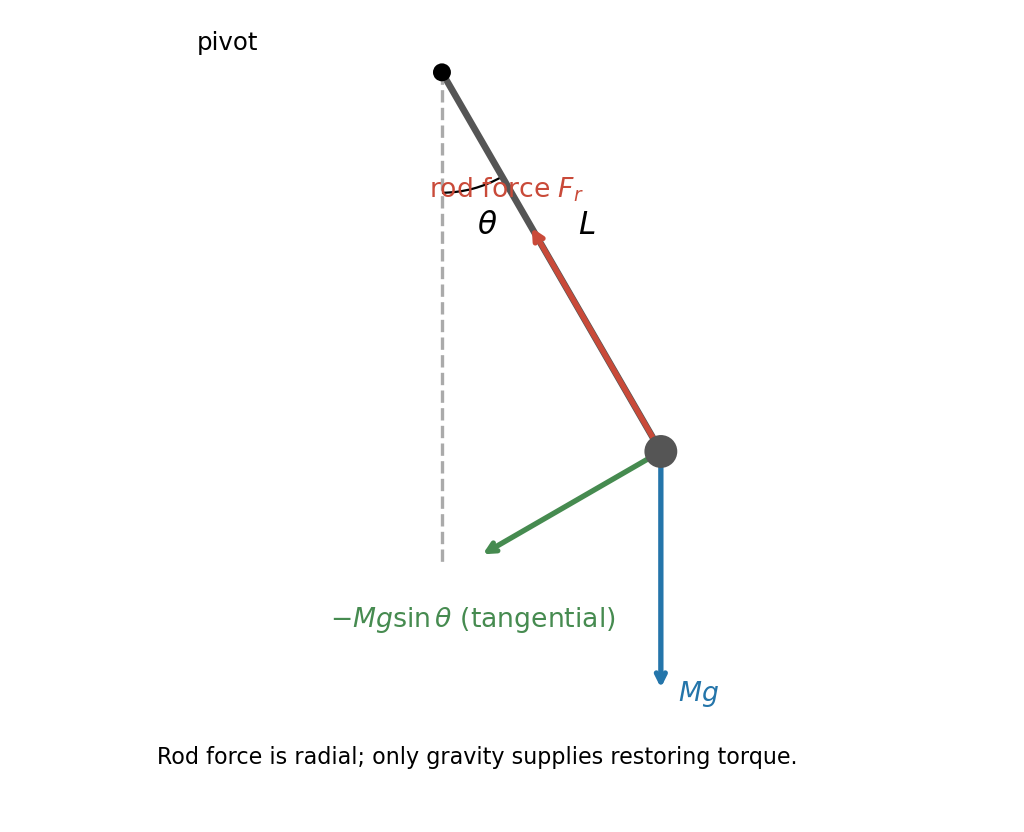

To the same small-angle order, writing ,Thus is constant. Put , a signed angular velocity. ThenIf the printed angular speed is intended as the signed rate, set . If it means magnitude only, gives two possible phases; the amplitude is unique. At zero amplitude the phase is arbitrary.
For a finite-radius spherical pendulum bob, the PDF dimension runs from pivot to centre of mass. The parallel axis theorem gives . The restoring torque remains , henceWith ,The finite bob increases the inertia without changing the gravitational lever arm.
In sinusoidal steady state, complex impedance is the voltage phasor divided by the current phasor. Its modulus is the amplitude ratio and its argument is the voltage lead. With the convention, , so .
The PDF labels across , not across the complete driven network. If is the current through , then and , whereThe resistor-referenced parallel-resonator response isWriting ,The maximum occurs at , where and the phase is zero. Below resonance the phase is positive, tending to ; above it the phase is negative, tending to . The amplitude tends to zero at both extremes: the inductor shorts the parallel network at low frequency, and the capacitor does so at high frequency. At resonance their reactive currents cancel, leaving only the resistor current.
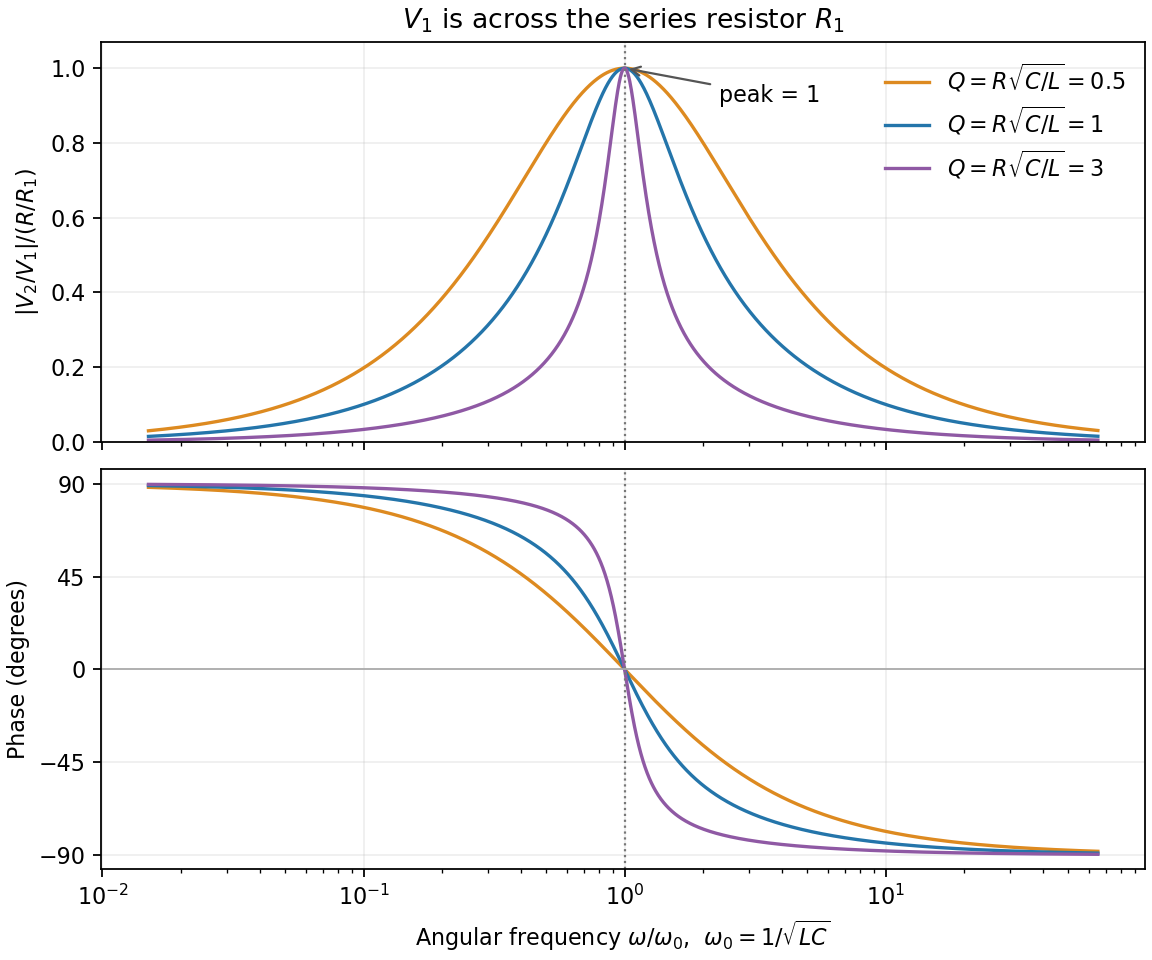
Resistor-referenced parallel-resonator amplitude and phase, normalized without choosing circuit component values
. Details. 
If instead denotes the voltage across the complete circuit, its different transfer ratio is , with peak . This distinction follows directly from the printed voltage endpoints.
For free parallel RLC voltage decay, measure and branch currents from A to B. ThenThere is no external current, so Kirchhoff's current law gives . Differentiating yieldsFor the characteristic equation is . Its underdamped roots giveThe supplied inequality makes real. A real physical voltage has the general form , the real part of the printed complex expression. A general complex-valued solution uses both roots, . The inductor's initial current is fixed consistently by the undifferentiated current balance; it is not an arbitrary additional voltage-mode constant.
Articles by others on the same topic
There are currently no matching articles.