An impulse is , giving . For a short localized impulse at displacement from the centre of mass, the angular impulse is ; for a changing lever arm use its instantaneous value inside the integral. For a uniform solid sphere with volume density , direct integration about the axis givesTake forward translation and forward-rolling clockwise spin as positive. Neglect the table's tangential impulse during the much shorter cue impact. Immediately afterwards,The bottom contact point has slip velocity . The cue height for immediate rolling is therefore .
For the impulse-driven slipping-to-rolling transition of a sphere at an arbitrary admissible impact height, let be the signed friction impulse accumulated before slipping ends. Translation and spin then obey and . Impose and eliminate :This expression handles both sliding directions. If , the contact point slips forward and friction slows the centre; if , excess spin makes it slip backward and friction accelerates the centre. friction still dissipates total mechanical energy. For , , so the slipping time is . Its duration depends on friction, while the final speed does not. With zero friction no slipping-to-rolling transition occurs unless rolling was present from the outset.
Newton's first law identifies inertial frames in which a force-free body maintains constant velocity. The second is for a closed system; for fixed mass it becomes . The third gives equal and opposite pair forces. Summing the second law over a closed collection cancels internal force pairs, so total momentum is conserved when the resultant external force vanishes. A rocket alone is an open variable-mass subsystem, so one must include the momentum carried by exhaust before applying this reasoning.
Choose downward velocity as positive and write . During , exhaust mass leaves downward with speed in the surface frame. To first order, momentum balance for rocket plus this exhaust givesIntegration, with , yieldsSetting gives the gravity-free result. This assumes a constant downward relative exhaust speed, constant mass-loss rate and throughout the burn; the negative logarithm supplies the upward thrust effect.
Height satisfies . Put . Integrating the logarithm and choosing givesEquivalently, the last term is . Differentiating either form recovers and checks the sign.
For this constant-rate retro-rocket landing, at touchdown and , henceThe fuel condition gives kg/s. Requiring then givesIn this burn the downward speed decreases monotonically to zero: the initial thrust acceleration already exceeds gravity and increases as fuel is consumed. The result is the idealized vertical landing, without atmospheric drag, changing gravity or a separate terminal burn phase.
For a particle of rest mass , and , with . The low-speed expansion is , separating invariant rest energy from the nonrelativistic kinetic energy term.
Conserve the total laboratory energy and momentum at coalescence: and . Since , the combined particle moves at . Its rest mass is . The incident particle is not of mass : its stated energy and momentum imply . ThusThe extra is internal rest energy retained by the composite after a perfectly inelastic collision; total energy and four-momentum are conserved, while the sum of individual rest masses need not be.
The composite's Lorentz factor is . For a rest-frame lifetime , the corresponding laboratory time is and its travel distance isIf denotes a mean radioactive lifetime, this is the mean flight distance, not a fixed distance for every decay. The separate frame diagrams below use the common positive collision axis.
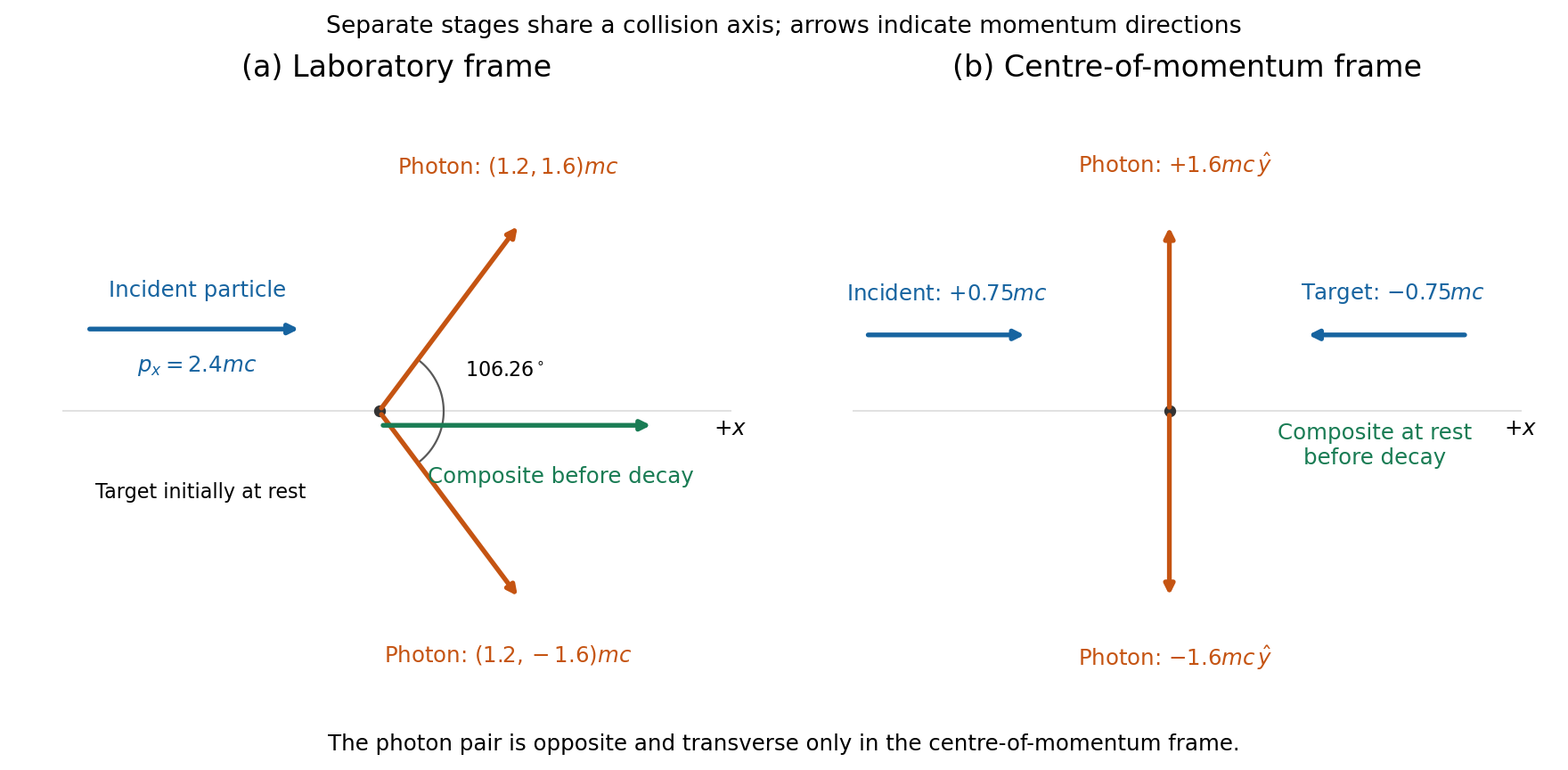
Original momentum-direction diagrams for the laboratory and centre-of-momentum frames, with equal-energy photons and the composite at rest in its own frame
. Details. 
In the laboratory frame the incoming particle and the composite move along , while the target is initially at rest. In the equal-energy two-photon decay of a moving particle, zero total transverse momentum makes the two photon directions symmetric about . Each photon has energy and momentum magnitude , so longitudinal momentum conservation gives . ThereforeTheir momenta can be written . The opening angle is not in this frame, because the parent carried nonzero total momentum.
Boost along at into the centre-of-momentum frame. The composite is stationary. The incoming particle has , while the target has . After decay the two photons have energies and opposite momenta.
Equal laboratory photon energies require the rest-frame photons to have zero momentum component along the boost: must be equal for two opposite photons. Their directions are therefore and in the centre-of-momentum diagram, perpendicular to the incoming collision axis. Boosting those transverse photons gives exactly the laboratory momenta in part (a). A stationary composite has no direction-of-travel arrow in this frame.
Articles by others on the same topic
There are currently no matching articles.