Powered vertical flight. Take upward velocity as positive, and let be the downward exhaust speed relative to the rocket. During the rocket's mass changes by , and exhaust mass leaves with Earth-frame velocity . Compare the momentum of the rocket plus this newly expelled exhaust before and after the interval:Discard the second-order product . The result is , orThe positive rocket thrust is . Integrating with and gives the rocket equation with gravitational loss:Using for the rocket alone without the exhaust momentum flux would give the wrong equation for this open system.
Orbital speed under the stated gravity assumption. A circular orbit of radius requires centripetal acceleration . If the magnitude of gravitational acceleration is the stipulated constant even at the orbit,This treats gravity as centrally directed for the orbital calculation, while retaining its constant magnitude. The subsequent flat-surface approximation treats its direction as locally vertical.
Burnout height. During the unpowered projectile motion, horizontal velocity is constant. At the top of the trajectory the vertical component vanishes, so the horizontal component must equal the orbital speed . At burnout, therefore,These follow either by integrating or by the vertical work-energy theorem. Substituting the preceding constant- orbital result givesThe vertical component is initially positive, as required to reach the orbit after burnout.
Alternative inverse-square interpretation. A real Earth's exterior Newtonian gravitational field is not constant over a altitude change. If instead means the surface value , then Newton's law of universal gravitation gives andUsing this orbital speed but the paper's constant- flat projectile motion approximation for the coast would giveThis alternative changes the global constant-gravity assumption; it is not the same model as the result. An exact curved Kepler orbit coast would also abandon the prescribed flat trajectory. The printed assumptions support the constant-magnitude answers above, while the inverse-square values explain the different answer obtained from the usual physical Earth-orbit formula.
Directions. Choose along the horizontal spindle from the pivot to the disk, and vertically upward. With lever arm and weight , the torque about the pivot isClockwise precession viewed from above has . The relation therefore requires the spin angular momentum to point along , from the disk toward the pivot. The disk spins clockwise when viewed from its outer face looking along the spindle toward the pivot. Looking from the pivot reverses that apparent rotation. The right-hand rule fixes these signs unambiguously.
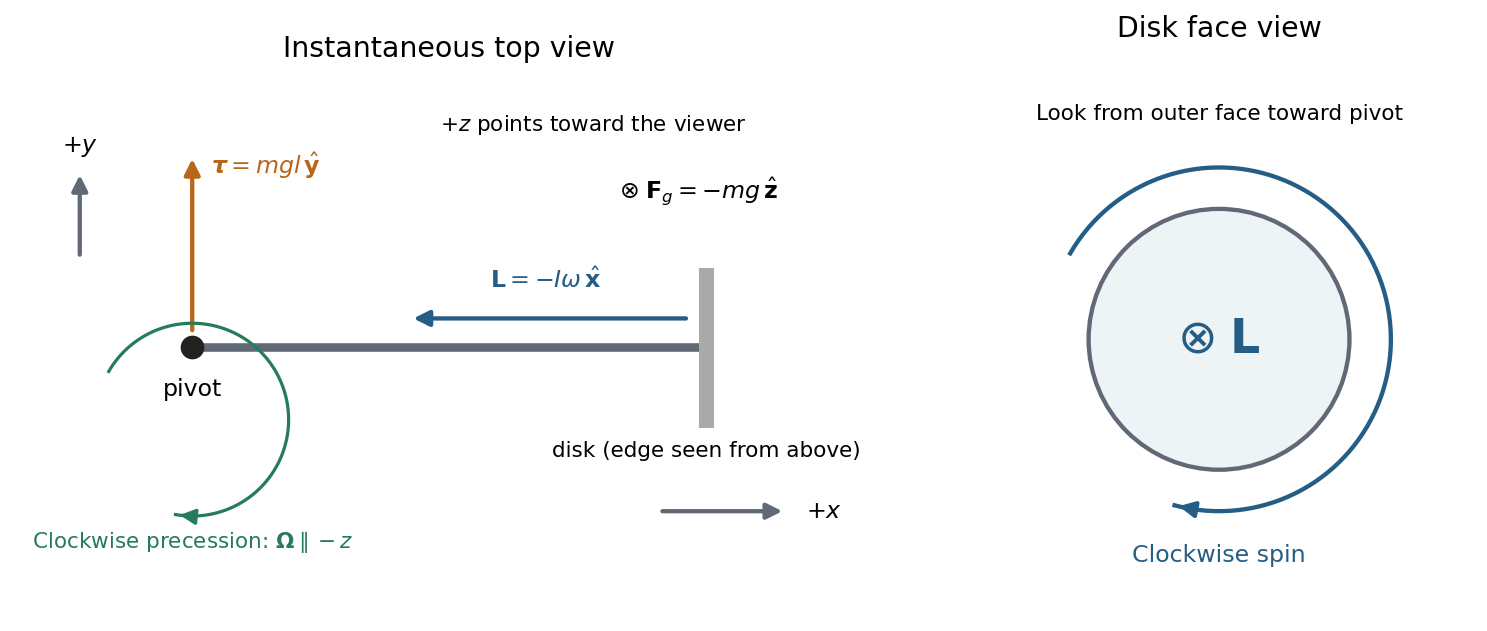

The drawing shows an instantaneous top view; the disk's angular momentum and the horizontal spindle turn clockwise together. The pivot force has zero torque about the pivot.
Rate of precession. For steady horizontal motion the spin contribution has magnitude and turns through in time . Its change is perpendicular to itself and has magnitude . HenceThis is the usual slow steady gyroscope precession relation. Any constant vertical angular momentum associated with steady precession has zero time derivative; the horizontal spin contribution supplies the changing component here. Transient nutation is excluded by the prescribed horizontal steady motion.
Clock design. Convert both rotation rates to angular frequencies:For the moment of inertia of a uniform disc, , so the mass cancels:
Spin friction. At fixed geometry, reducing increases . The precession period, , therefore decreases. This trend holds while slow steady precession remains a suitable description; it cannot be extrapolated to a stopped disk.
Counterweight. To oppose the disk's gravitational torque, place the counterweight on the other side of the pivot, at . The net torque isA horizontal axle can remain fixed when this vanishes, givingFor the fixed spin direction already found, counterbalanced gyroscope precession has signed rateMoving the counterweight outward from the pivot first slows the clockwise motion, eliminates its driving torque at balance, and then reverses the steady motion to counterclockwise. A counterweight on the disk's side would add to the gravitational torque. These statements neglect axial spin moment of inertia of the counterweight and assume the stated horizontal motion, without a separately imposed precession at balance.
Momentum identity. From the Lorentz factor, . The relativistic three-momentum therefore satisfiesTogether with relativistic energy , this gives the energy–momentum relation .
Parent in the laboratory. The rest energy is , while the total relativistic energy is . ConsequentlyIts momentum magnitude is .
Daughters in the zero-momentum frame. The centre-of-momentum frame is initially the parent's rest frame. Conservation of momentum gives . Equal daughter rest masses then imply equal relativistic energies. Conservation of relativistic energy givesTheir speeds are thereforeThe two velocities are opposite, and . Their total kinetic energy is .
Invariant of the complete system. Before the decay, in the centre-of-momentum frame,After the relativistic two-body decay,In the laboratory, four-momentum conservation fixes the summed daughter energy to and their summed momentum to the parent's . Thus the same calculation isThe invariant is formed after summing the daughter four-momenta; adding their separate squared rest energies would omit the relative-motion contribution to the invariant mass of the pair.
Articles by others on the same topic
There are currently no matching articles.