By dimensional analysis, power has dimensions , mass density has dimensions , and angular velocity has dimensions ; radians are dimensionless. ThusMatching the three independent dimensions gives , and , henceWith unchanged mass density, angular velocity and the same performance coefficient (a dimensionless quantity), the pump power affinity law givesThe required power therefore increases by . This uses the stipulated dependence on only these three quantities, with comparable pump geometry and performance; dimensional analysis alone does not guarantee that unrelated pumps have the same performance coefficient.
The relativistic kinetic energy is the total energy minus the rest energy:Here is the Lorentz factor and the speed of light. The binomial series, with , givesFor , the leading term is the classical kinetic energy . The ratio of the fourth-order term to that leading term is . ConsequentlyThe condition concerns one term of the binomial series; it is not the condition that the entire relativistic correction be exactly .
Let be signed displacement along the rails, measured from the centre. The diagram in the original paper shows a guide extending across the centre, so the signed coordinate can pass through zero. Hooke's law gives the radial force . In the rotating reference frame, the radial centrifugal force is . The Coriolis force is perpendicular to the rails and is balanced by their reaction; it has no radial component. Therefore Newton's second law givesEquivalently, the radial component of acceleration in polar coordinates in the inertial frame is . The radial spring oscillator on a rotating guide has simple harmonic motion only when , withThe angular frequency is in and the frequency in . The critical angular speed isStrictly this is an upper bound, not an attained maximum for oscillations: at equality , so a displaced object released from rest stays at its displaced position relative to the rails; above it, the central equilibrium is unstable.
Take the thin lens at , with the object on the left and light rays travelling to the right. The positive object distance is and the focal length is . The thin lens equation givesThe transverse magnification and signed image height areThus the real image is beyond the lens, inverted and high. For the ray tracing, a light ray parallel to the optical axis emerges through the far optical focus; a light ray through the optical centre continues straight in the ideal thin lens model. They intersect at , independently reading off both answers from the diagram.
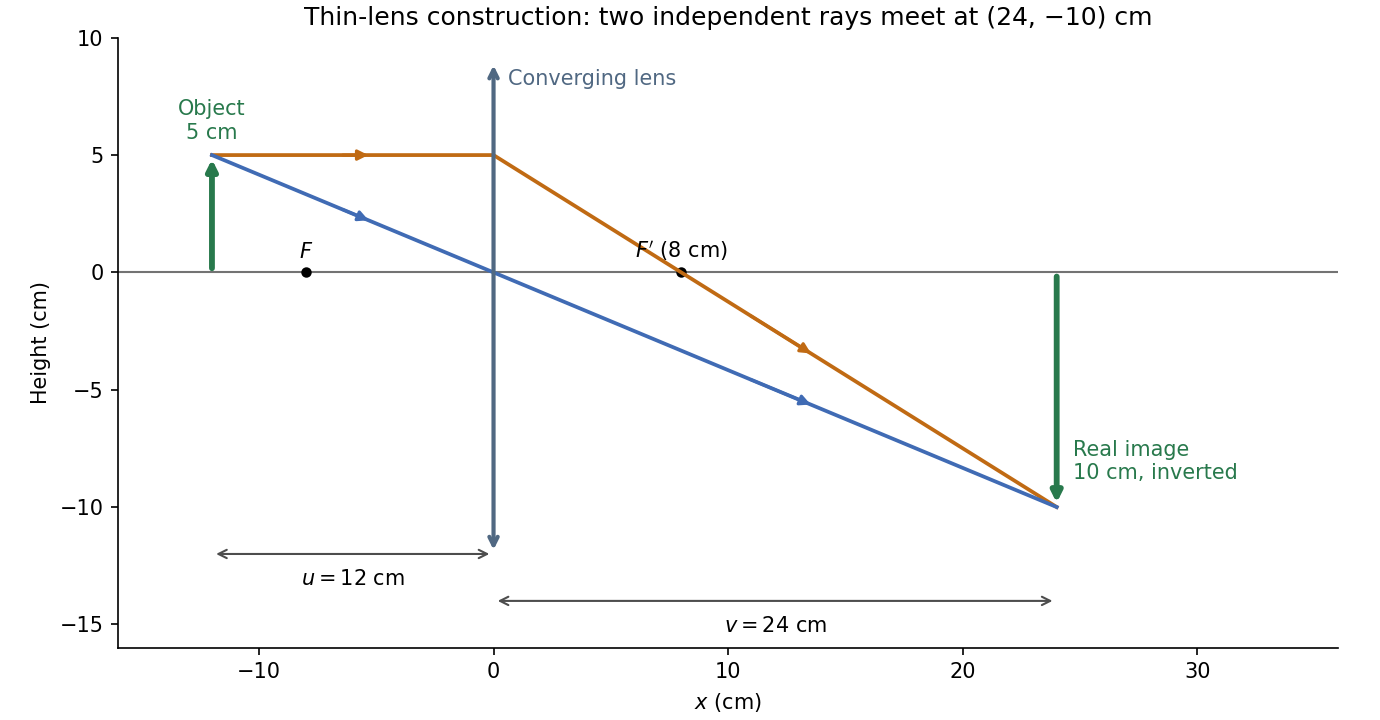

The calculation and diagram use the ideal paraxial approximation implicit in the thin lens equation. The comparatively large object height does not supply enough information to calculate optical aberrations of a real lens.
Write for the side length. In an equilateral triangle, the distance from centre to a vertex is ; it is two thirds of the altitude . By the superposition principle, the electric potential at the centre due to the three fixed Electrons isHere is the elementary charge and the vacuum permittivity. The approaching Electron has electric charge , so its potential energy, measured relative to infinity, is positive:The fixed sources do not move, and radiation is excluded. Hence conservation of mechanical energy givesUsing , for the electron mass, and givesThis speed is small enough to justify classical kinetic energy. There is an idealization in the word “stops”: along the line normal to the triangle through its centre, this threshold energy makes the Electron approach the central equilibrium asymptotically. A smooth, conservative trajectory cannot reach an equilibrium with exactly zero velocity in finite time unless it was already there. The energy threshold, and therefore the requested initial speed, is nevertheless unambiguous.
Articles by others on the same topic
There are currently no matching articles.