After the push, the forces are weight downward, normal reaction upward and sliding friction opposite the velocity. There is no continuing applied push. The table has constant slopeVertical balance gives , and horizontal motion gives . ThusThe friction magnitude is .
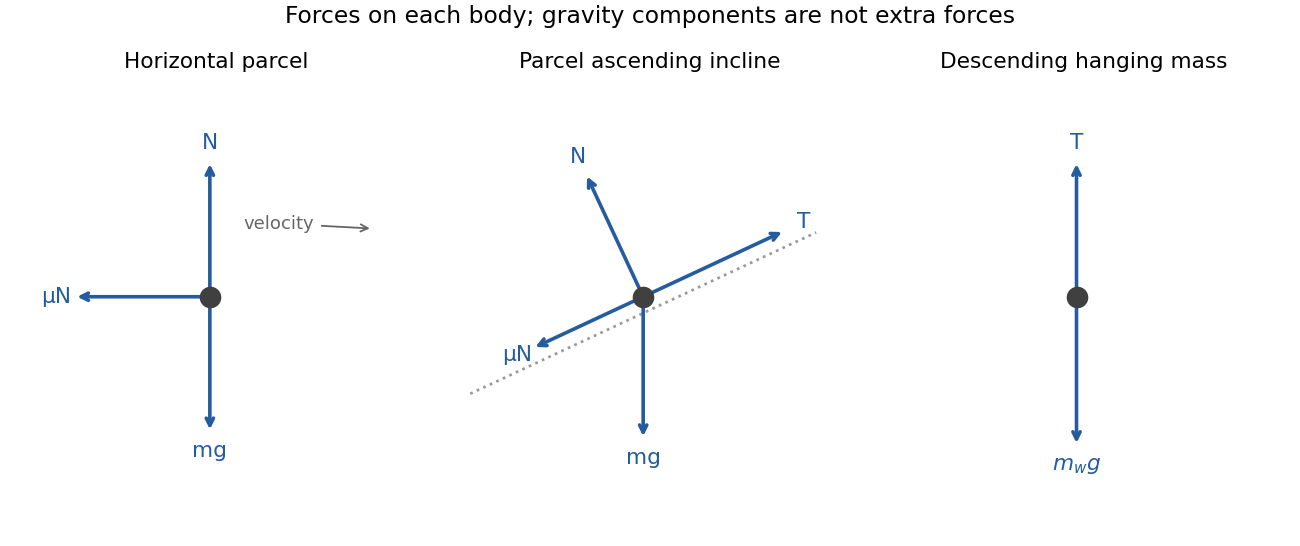
Free-body diagrams for horizontal sliding, the inclined parcel and the hanging weight
. Details. 
The inclined parcel has tension up the slope, weight vertically downward, normal reaction and friction down the slope. The hanging mass has weight downward and tension upward. The ideal string makes the two acceleration magnitudes equal.
The velocity slope is , up the track for the parcel and downward for the hanging mass. The free-body diagrams show gravity itself as one vector; its slope-parallel and normal components are used in the equations rather than counted as additional forces.
Let and let be the hanging mass. Taking up-slope and downward respectively as positive,Eliminate the common tension to obtainHere , and . The pulley changes the direction of the string force; in the ideal model it does not change its magnitude.
The required constant deceleration follows from :Both gravity and sliding friction oppose ascent, so . WriteThe physical incline solution is more precisely . The combined mass cancels from the equation. The top of the track is consequently above its base.
Let be the compression and the combined mass. Starting from rest at the top, it falls through before maximum compression. HenceThe gravitational drop during compression must be included. Equating to the weight would instead describe a static equilibrium, not the turning point after a fall.
Immediately after the parcel leaves, the spring still stores , but only the sledge is launched. Choose gravitational potential zero at the ramp base. Its initial position is , so conservation of energy to the apex givesThereforeabove the ramp base. Its upward travel from the compressed position is , a different distance from the height above the base.
For actual complete bounce distances and , the geometric series givesA natural intended estimate compares the observed first round trip with the loss-free round trip from the initially compressed position,If the reduction factor is taken to be , the answer is . The first term is the actual 4 m, not the hypothetical loss-free distance.
This numerical inference needs the stated comparison assumption. Strictly, knowing the first actual bounce distance and saying subsequent distances share a ratio does not independently specify that ratio. A change in spring compression also means that an energy-loss fraction is not automatically the same as a vertical-distance ratio.
Articles by others on the same topic
There are currently no matching articles.