Take as the integrated line mass absorption coefficient, and as the absorber mass fraction, assumed constant; for a pure absorbing gas set . All spectral intervals below use the paper's wavenumber coordinate. The normalized Lorentz line shape isIf instead an absorption coefficient per length is wanted, multiply by absorber density. Neglecting temperature dependence, pressure broadening gives . In the line wings, with ,Define the line-opacity parameter and characteristic wavenumber widthAt an emitting level , the wing estimate implies . Thus the strong-line limit relevant to outgoing radiation isIt ensures that the opaque-to-transparent transition lies in the Lorentz wings, rather than the narrow central core, and the characteristic absorption width is much larger than . At a grazing ray angle the criterion is even easier to satisfy because of the larger optical depth. This is a criterion for the radiatively important wings, not a claim that collision broadening remains physical at arbitrarily small pressure.
For a vertical ray, the transmittance from to space is . Direct integration of the full pressure-dependent Lorentz line shape gives, for ,The exact Lorentz-model transmittance and its strong-line limit are thereforeThe approximation is justified at the radiating level by . At zenith-angle cosine , replace by ; if a hemispheric flux transmission is desired, its normalized value is . The pure Lorentz model formally gives infinite line-centre optical depth from every nonzero to , because . This is an unphysical central-core singularity, addressed in part (d), rather than a divergence of the integrated outgoing flux.
For a vertical ray, the formal Schwarzschild equation solution isIn the wing model , the contribution per interval is proportional to when the source varies slowly, and is concentrated near . This motivateslimited to in transparent spectral regions. Rays contributing to the hemispheric flux replace this by , an order-one angular refinement.
For , put and . With the vertical optical-depth-one estimate, the spectral outgoing longwave radiation is approximatelyThe cold flat central portion comes from the isothermal stratosphere; intermediate wings sample progressively warmer, deeper tropospheric levels; far outside the line the warm surface is seen. The transitions are smooth in the exact transfer solution. If , the entire column and ground are isothermal and there is no line contrast. If , the given max-profile has no cooler troposphere: the atmosphere can instead produce an emission feature above the colder surface background. Assuming a narrow isolated line permits the local Planck function background to be treated as nearly constant across its width. The original schematic below also compares the optical-depth-one estimate with angular and source-function integration for illustrative, explicitly chosen parameters.
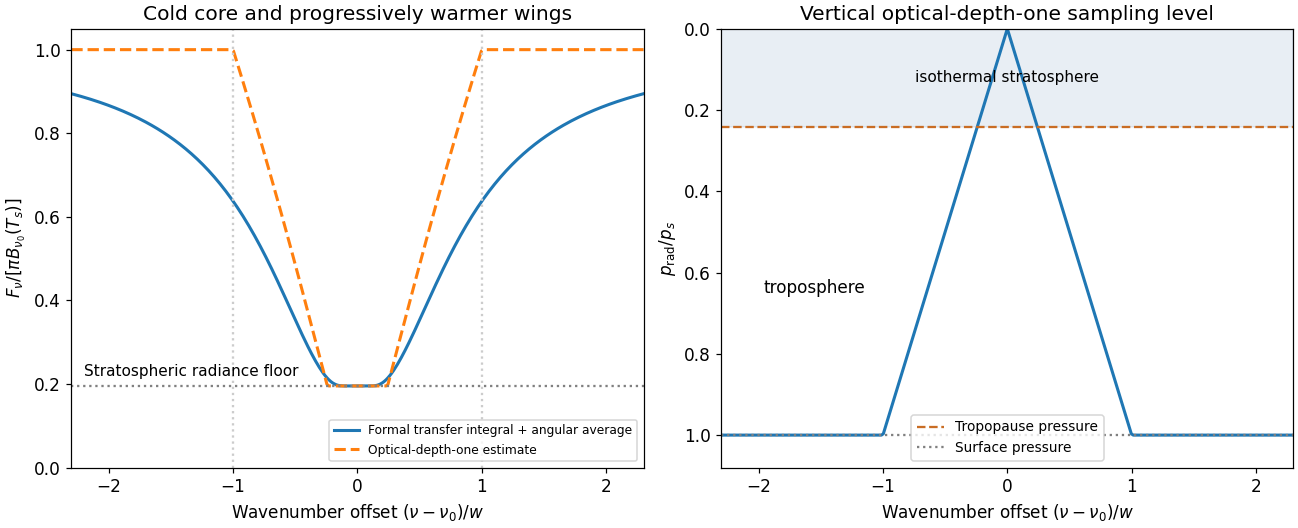
An isolated absorption line samples an isothermal stratosphere, a warmer troposphere and the surface
. Illustrative narrow-line model with , , and line centre ; horizontal offsets are normalized by . No measured spectrum is reproduced. Details.
Pressure broadening is proportional to collision frequency and therefore becomes small in the upper atmosphere. Doppler broadening remains finite at finite temperature, with a characteristic width of order up to the stated width convention. Where that exceeds the collisional width, the line core is Doppler dominated. A Voigt profile combines the two mechanisms; natural broadening can contribute at still lower pressures. Thus a Lorentz pressure-broadened profile cannot hold all the way to .
At line centre, replacing the fictitious opacity by a finite Doppler-core coefficient removes the divergent column optical depth. The emitting pressure is then finite rather than arbitrarily close to zero. If that level still lies in the isothermal stratosphere and the core is opaque, the central brightness temperature stays approximately , so the flux floor changes little. If it lies below the stratosphere, or the Doppler-core column becomes thin, warmer layers or the surface contribute and the core brightens. The core-to-wing transition changes shape and width, but Lorentz wings formed mainly at higher pressures remain approximately as in part (c). The size of the correction needs the missing spectroscopic widths, but no unique numerical correction is requested.
Articles by others on the same topic
There are currently no matching articles.