Use a rock strength envelope: at each depth plot the smaller differential stress needed for frictional failure and for sustained ductile material creep at a specified strain rate. Shallow rock generally strengthens with depth because effective confining pressure increases; sufficiently deep hot rock weakens because thermally activated material creep becomes efficient.
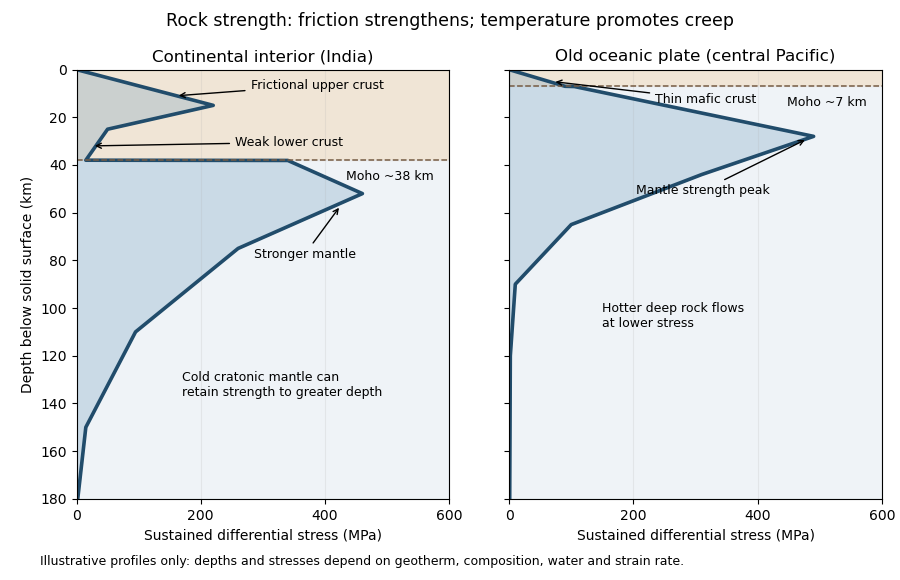
Illustrative rock-strength envelopes for a continental interior and an old central-Pacific plate; these are conceptual profiles, not measurements
. Details. 
At shallow depth, Byerlee's law or a Mohr-Coulomb failure criterion gives a relation of the formwhere is cohesion, a coefficient of friction, the compressive normal stress and the pore pressure. Increasing overburden generally increases effective stress, hence the frictional strength. Conversion from fault shear stress to differential stress depends on the stress regime and fault orientation; a sketch should not label a universal numerical slope. High pore pressure or weak fault gouge can lower the frictional strength substantially.
A simplified dislocation creep relation isHere is activation energy, activation volume, the molar gas constant and absolute temperature; and depend on composition and deformation mechanism. At fixed strain rate, increasing temperature usually decreases the required stress strongly. The competing effects of pressure, water weakening of rocks, grain size and composition also matter. The intersection with frictional failure gives a brittle-ductile transition, not a change from solid to liquid.
For the Indian continental interior, a useful first sketch has an upper-crustal strength peak, a weaker lower continental crust, and renewed strength in lithospheric mantle beneath the Moho. Quartz-bearing rocks can undergo ductile material creep at conditions where colder, drier olivine-rich mantle retains appreciable strength. This creates a possible two-peak, or “jelly sandwich”, rock strength envelope. With further depth the mantle also weakens. A cold craton can retain strong lithospheric mantle to much greater depths than a tectonically heated continental region.
For the central Pacific, show thin mafic oceanic crust above a relatively thick layer of strong lithospheric mantle. There need not be a conspicuous weak lower-crustal layer. Much of the integrated strength can reside below the Moho, with a broad strength peak followed by ductile weakening towards the asthenosphere. Cooling and age control the thickness: young hot oceanic lithosphere would give a much shallower and weaker profile than an old central-Pacific plate.
The plotted Moho depths of about 38 km and 7 km, and all plotted stresses, are illustrative assumptions. “India” alone does not specify a unique geothermal gradient, water content or strain rate, and the Pacific includes plates of different ages. The robust comparison is the possible crust–mantle layering in a continent versus the thin oceanic crust and mantle-dominated strength of an old oceanic plate. The Moho is a compositional boundary; neither it nor the deepest small plotted strength is automatically the seismic lithosphere-asthenosphere boundary.
Articles by others on the same topic
There are currently no matching articles.