Use a rock strength envelope: at each depth plot the smaller differential stress needed for frictional failure and for sustained ductile material creep at a specified strain rate. Shallow rock generally strengthens with depth because effective confining pressure increases; sufficiently deep hot rock weakens because thermally activated material creep becomes efficient.
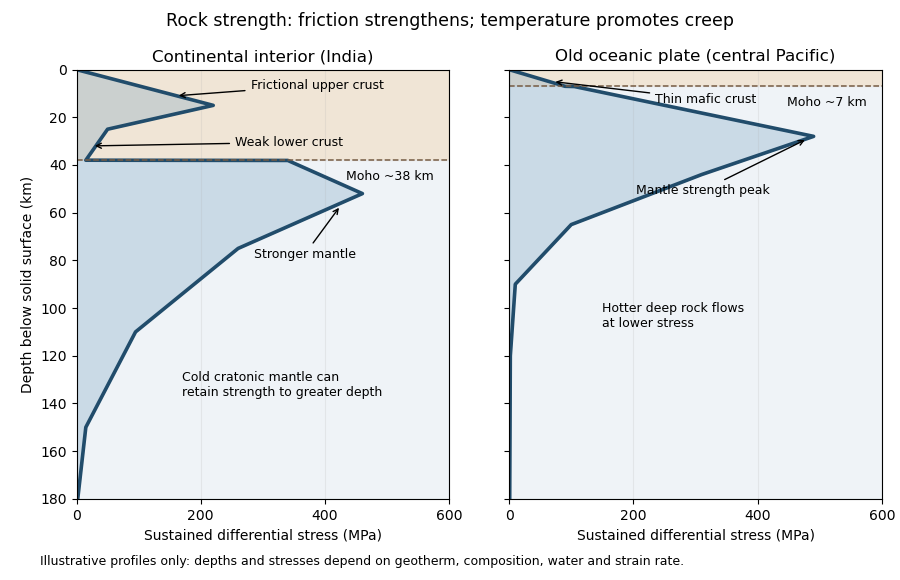
Illustrative rock-strength envelopes for a continental interior and an old central-Pacific plate; these are conceptual profiles, not measurements
. Details. 
At shallow depth, Byerlee's law or a Mohr-Coulomb failure criterion gives a relation of the formwhere is cohesion, a coefficient of friction, the compressive normal stress and the pore pressure. Increasing overburden generally increases effective stress, hence the frictional strength. Conversion from fault shear stress to differential stress depends on the stress regime and fault orientation; a sketch should not label a universal numerical slope. High pore pressure or weak fault gouge can lower the frictional strength substantially.
A simplified dislocation creep relation isHere is activation energy, activation volume, the molar gas constant and absolute temperature; and depend on composition and deformation mechanism. At fixed strain rate, increasing temperature usually decreases the required stress strongly. The competing effects of pressure, water weakening of rocks, grain size and composition also matter. The intersection with frictional failure gives a brittle-ductile transition, not a change from solid to liquid.
For the Indian continental interior, a useful first sketch has an upper-crustal strength peak, a weaker lower continental crust, and renewed strength in lithospheric mantle beneath the Moho. Quartz-bearing rocks can undergo ductile material creep at conditions where colder, drier olivine-rich mantle retains appreciable strength. This creates a possible two-peak, or “jelly sandwich”, rock strength envelope. With further depth the mantle also weakens. A cold craton can retain strong lithospheric mantle to much greater depths than a tectonically heated continental region.
For the central Pacific, show thin mafic oceanic crust above a relatively thick layer of strong lithospheric mantle. There need not be a conspicuous weak lower-crustal layer. Much of the integrated strength can reside below the Moho, with a broad strength peak followed by ductile weakening towards the asthenosphere. Cooling and age control the thickness: young hot oceanic lithosphere would give a much shallower and weaker profile than an old central-Pacific plate.
The plotted Moho depths of about 38 km and 7 km, and all plotted stresses, are illustrative assumptions. “India” alone does not specify a unique geothermal gradient, water content or strain rate, and the Pacific includes plates of different ages. The robust comparison is the possible crust–mantle layering in a continent versus the thin oceanic crust and mantle-dominated strength of an old oceanic plate. The Moho is a compositional boundary; neither it nor the deepest small plotted strength is automatically the seismic lithosphere-asthenosphere boundary.
The volume alone does not determine a unique change of elevation. A local isostatic response to an added surface layer depends on its thickness and density, so the Deccan Traps' footprint must be specified or retained as a parameter.
Let the deposited basalt have uniform thickness and density , where and is the loaded area. Let be downward displacement of the original land surface, and let be the density of displaced mantle. Assume a subaerial, laterally extensive deposit, negligible air density, unchanged thickness and density of the pre-existing crust, and complete local isostatic adjustment. Take the magma supply to be external to the local compensation column, and neglect cooling, erosion, magmatic underplating and any deep thermal or source-depletion anomaly.
Choose a compensation depth beneath all the displaced interfaces. The added column mass per unit area is . Downward translation of the pre-existing crust replaces a thickness of mantle within the column, reducing its mass by . Equality of hydrostatic pressure at the compensation depth therefore givesThe newly formed top of the basalt stands above the depressed original surface. Consequently the change of the region's top-surface elevation isThus the original substrate subsides, but the top of the deposit rises if . Distinguishing these two surfaces prevents reporting the large downward displacement as the change in plateau elevation.
For an explicitly illustrative choice , and , the deposit is 1000 m thick, the substrate subsides about 879 m, and the final surface rises about 121 m. This is a conditional estimate, not a number fixed by the paper. Half that footprint would double all three heights under the same assumptions. For a nonuniform deposit, local isostasy gives the same relation pointwise with ; the total volume still cannot specify a unique local elevation.
Elasticity lets the lithosphere share a load with neighbouring regions through lithospheric flexure. Beneath the centre of a localized load, subsidence is generally smaller than the local isostasy estimate, so the deposited surface stands higher. The surrounding plate also bends down, and a more distant flexural forebulge may rise. The extra support is regional bending resistance, rather than removal of the load's mass.
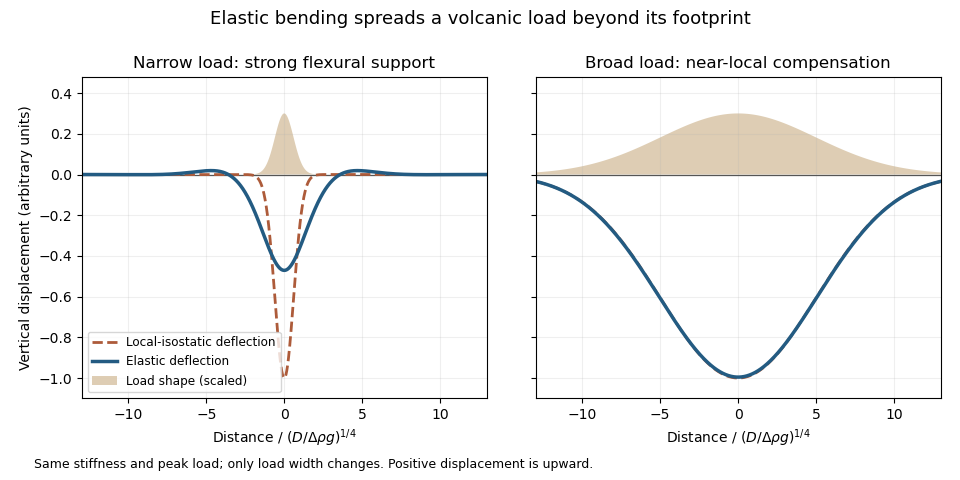
An original elastic-plate calculation contrasting narrow and broad loads at the same flexural rigidity; a broad load approaches local isostasy
. Details. 
The controlling comparison is load width against the lithosphere's flexural length, which increases with flexural rigidity and decreases with the relevant buoyant geophysical density contrast. Equivalently, the flexural support ratio becomes large for short-wavelength loading. A very broad nearly uniform load produces little curvature in its interior, so even a strong elastic lithosphere has a nearly local isostatic adjustment there. Bending matters most near its edges. A narrow load requires more curvature and can be supported appreciably by the surrounding elastic lithosphere.
The Deccan Traps form a broad continental large igneous province. The volcanic edifices of the Hawaiian Islands are more localized loads on an old oceanic lithosphere, for which regional bending and a flexural moat are prominent. Under the usual broad-Deccan versus narrow-Hawaiian-load comparison, elastic strength matters more for the Hawaiian Islands. The more coherent mantle-dominated strength of an old oceanic plate can reinforce this contrast. It cannot be deduced simply from “oceanic” versus “continental”: a cold Indian craton can be strong, and a site's effective elastic thickness depends on its thermal and loading history.
For an initially submerged Hawaiian load, replacing seawater changes both the load and buoyant restoring contrast. At fixed deposited thickness, the added load relative to the initial water column uses the rock-minus-water density, and the restoring term uses the mantle-minus-water density. An emerged island requires separate treatment of its subaerial and submerged portions. These corrections change the local isostasy reference but do not remove the importance of load width for lithospheric flexure. The broad Hawaiian swell should also be distinguished from the narrower volcanic load: deeper thermal or dynamic support of the Hawaiian swell is not the same mechanism as elastic support of the volcanic ridge.
Finally, over long periods material creep, yielding and thermal modification can reduce elastic support. Without measured load geometries, ages and effective elastic thicknesses, the ranking is a justified qualitative expectation rather than a theorem valid for every continental and oceanic load.
The asthenosphere exists because the mantle's ability to deform is strongly dependent on temperature, pressure, composition, water and deformation mechanism. Cooling from the surface creates a strong lithosphere. Beneath it, hotter mantle deforms by material creep at much lower stress on geological timescales. The asthenosphere is predominantly solid weak rock, not a global ocean of magma. On the much shorter timescale of a seismic wave, it still supports S waves.
The hot shallow mantle can be close to its solidus. Water weakening of rocks and, in some settings, a small connected melt fraction can further lower effective viscosity. At greater depths, changes in pressure, homologous temperature, mineral structure and water storage modify the deformation laws; increasing depth does not imply indefinitely decreasing viscosity. Explaining a weak upper-mantle interval does not require every location to contain the same amount of melt.
There are several physically distinct boundaries to test. The thermal lithosphere-asthenosphere boundary describes a thermal transition, the mechanical boundary a contrast in long-term strength or viscosity, and the seismic lithosphere-asthenosphere boundary a change in seismic velocity or other wave properties. They need not have identical depths. A smooth geothermal gradient can explain broad thermal weakening, but a very sharp decrease of seismic velocity may require changes in melt fraction, hydration, composition or seismic anisotropy. A sharp shallow reflector within a craton might instead be an internal lithospheric boundary.[ref]
A global view of the lithosphere-asthenosphere boundary by Catherine A. Rychert and Peter M. Shearer. Abstract and pp. 495–498: converted-wave sharpness and the possibility that the imaged cratonic discontinuity lies within thicker lithosphere.
Begin with a thermal null model. A half-space cooling model givesIf a thermal boundary corresponds to a fixed temperature , its depth isso it deepens as the square root of plate age. Test that prediction against independently determined seafloor ages, bathymetry and heat flux. An oceanic plate cooling model adds finite thickness and basal heat supply, allowing the old-age depth to approach a finite value. For continents, include radiogenic heating, crustal thickness, the history of continental rifting or tectonic thickening, and advective heating by magma or mantle flow. A cold, dry craton and a recently extended volcanic region should not share the same thermal profile.
Then calculate the observable consequences of competing mechanisms rather than merely assigning a boundary to a map:
- Use receiver functions from both P-to-S conversion and S-to-P conversion to constrain the depth and sharpness of a negative seismic velocity contrast. Check for crustal reverberations and whether the result changes with incident direction or frequency. Combine these with Rayleigh waves, Love waves and seismic tomography to constrain the broader shear-wave velocity profile.
- Measure seismic attenuation and seismic anisotropy. Elevated temperature, small amounts of melt and aligned minerals can all affect apparent seismic velocity, but predict different attenuation, polarization and directional patterns. Convert laboratory elastic and anelastic measurements into synthetic seismic observations at the relevant frequencies.
- Obtain magnetotelluric sounding constraints on electrical conductivity, together with surface heat flux. Connected melt or hydrated material can enhance electrical conductivity, but the interpretation depends on composition and connectivity. Joint thermal, seismic and electrical modelling is more discriminating than any single proxy.
- Use mantle xenoliths and erupted magmas to constrain pressure, temperature, water content, melt depletion and composition, recognizing that transport can alter a sample. Relate these observations to geodynamic modelling of mantle convection, slab flow, mantle plumes and lithospheric rejuvenation.
Compare models against the observed boundary depth and its sharpness, including uncertainty and resolution. An age–depth trend with matching heat flux favours thermal control; a sharp discontinuity that fails the thermal prediction but coincides with an electrical anomaly can support a melt- or hydration-related transition. Neither observation alone proves a unique cause. The spatially varying boundary is best understood as the result of thermal evolution interacting with composition, fluids and deformation history.
Articles by others on the same topic
There are currently no matching articles.