Exchange interaction arises from Coulomb interaction together with the antisymmetry required for identical electrons. Different spin states require different spatial symmetry and therefore different pair correlations and Coulomb energy; exchange is not the classical magnetic dipole force between spins. For electrons in distinct atomic orbitals, positive direct exchange favors parallel spins, underlying Hund's rules and the formation of local moments.
In a solid with localized moments, a common convention is . Then favors ferromagnetism and favors antiferromagnetism. Superexchange through a ligand and other virtual hopping processes can produce either effective sign depending on orbital occupancy and geometry; half-filled orbitals often give antiferromagnetic coupling. For itinerant electrons, the Stoner criterion describes a competition between exchange energy gain and the kinetic cost of splitting the spin populations.
Experiments distinguish these descriptions through both static and dynamic response. Magnetic neutron diffraction locates magnetic Bragg peaks and therefore the ordering wavevector; an antiferromagnet can have such peaks despite zero bulk moment. Inelastic neutron scattering measures spin-wave dispersion, from which an exchange scale can be fitted. A Curie-Weiss susceptibility intercept gives complementary information about dominant coupling, but its sign alone does not establish the actual ordered structure.
A Peierls transition is a lattice distortion coupled to a gap in an initially partly filled quasi-one-dimensional electronic band. A modulation at couples the opposite Fermi points. At half filling with one orbital per atom, it doubles the cell and alternates strong and weak bonds; the dimerized tight-binding chain shows explicitly how the gap opens at the Fermi energy. In the ideal weak-coupling zero-temperature model, the Peierls energy gain has a negative term proportional to , which can outweigh a positive quadratic elastic cost.
Observation should connect electronic and structural evidence: cooling through the transition can reduce conductivity as the gap develops, while diffraction satellites identify the ordering wavevector. A softened phonon near tests the precursor electron-lattice coupling. In inelastic neutron scattering of TTF-TCNQ, measurements from to found an increasing Kohn anomaly near as the transition was approached. Those particular measurements were above the transition, so they probe the precursor dynamics rather than a static low-temperature diffraction pattern.[ref]
Phonon dispersion and Kohn anomaly in TTF-TCNQ by Gen Shirane and others. Abstract: temperature interval and wavevector-dependent anomaly
A real finite-temperature transition also depends on interchain coupling and fluctuations. The ideal one-dimensional energy argument by itself does not prove finite-temperature long-range order.
A p-n junction joins p-type and n-type semiconductors. Initial carrier diffusion exposes ionized acceptors and donors, creating a depletion region and an internal electric field. At equilibrium the Fermi level is uniform and drift balances diffusion, so the built-in potential produces no net terminal current. For nondegenerate abrupt doping, its magnitude is .
Forward bias lowers the barrier and injects minority carriers across the junction. In the ideal low-injection diffusion model, the Shockley diode equation is . Reverse bias broadens the depletion region and leaves a small leakage current until breakdown mechanisms become important.
The asymmetric current-voltage curve enables rectification. Illumination produces electron-hole pairs that the junction field can separate, giving a photodiode or solar cell. Forward injection and radiative recombination in a suitable direct-gap material give a light-emitting diode. Measuring dark and illuminated current-voltage curves distinguishes electrical injection from photogenerated current; an ideal junction need not have zero reverse leakage or identical behavior in every material.
In a heavy fermion material, correlated low-energy quasiparticles have a large electronic density of states and effective mass. A Kondo lattice with hybridization between localized f-electron states and conduction states is an important setting. The large mass is a low-energy dynamical property, not a change in the electron's bare mass or the ionic mass.
Low-temperature calorimetry measures in a regime where an electronic linear term and a Debye lattice term are appropriate. The large intercept measures the enhanced quasiparticle density of states, with volume or molar conventions kept consistent. Apply a known heat pulse to a thermally characterized sample platform and measure the temperature rise, then vary the base temperature to separate contributions.
In low-temperature calorimetry and resistivity of CeAl3, measurements below gave and with . The large thermal coefficient and enhanced quadratic transport coefficient are complementary evidence for a strongly renormalized Fermi liquid.[ref]
4f-Virtual-Bound-State Formation in CeAl3 at Low Temperatures by Klaus Andres and others. Abstract: measured coefficients and sub-0.2 K range
Enhanced spin susceptibility provides another probe. Where coherent quantum oscillations can be resolved, their thermal damping determines a cyclotron effective mass, giving a band-sensitive comparison with the thermodynamic mass inferred from heat capacity.In a direct optical transition, a photon promotes an electron between the valence band and conduction band at essentially the same crystal wavevector: optical photon momentum is small on the scale of the Brillouin zone. An indirect optical transition also needs a phonon or another momentum source. Near an indirect gap, phonon emission requires photon energy approximately , while phonon absorption permits with a thermally occupied phonon.
Strong direct interband absorption needs both many allowed transitions and a nonzero optical matrix element. The joint density of states counts pairs with ; nearly parallel bands and critical points of this energy difference can enhance it. Dipole selection rules and polarization weight that count, so a large joint density of states alone does not guarantee a strong absorption peak.
The supplied infrared spectrum lies below the interband threshold and instead probes free-carrier response. In the Drude model, , with . At long wavelengths the mobile electrons screen the field and the reflectivity is high. As wavelength decreases through the screened plasma edge, the real dielectric function becomes positive and propagating light can enter. The reflectivity reaches its minimum near index matching, , then rises toward the bound-electron background reflectance.
For background , its refractive index is four and the normal-incidence Fresnel equations give . The short-wavelength side of the figure is approaching a reflectance of this order, consistent with that background; its shortest plotted wavelength still has a carrier correction. Here “infinity” means high frequency relative to the free-carrier scale while remaining below the remote interband resonances.
The Drude-Lorentz reflectivity minimum is near , not the plasma-edge zero . Reading the deep minimum as and neglecting damping there gives . The carrier effective mass from a reflectivity minimum is thereforeThe graph supports only a rough read-off: shifting the minimum by changes this mass by about five percent. The deep narrow minimum supports the weak-loss assumption in this region, although finite scattering explains why the long-wavelength reflectivity is below unity. The estimate also assumes one dominant carrier species, a nonmagnetic bulk sample and a nearly constant background dielectric function. If the plasma-edge zero is used instead, its denominator is and its wavelength is slightly longer; the two wavelengths must not be interchanged.
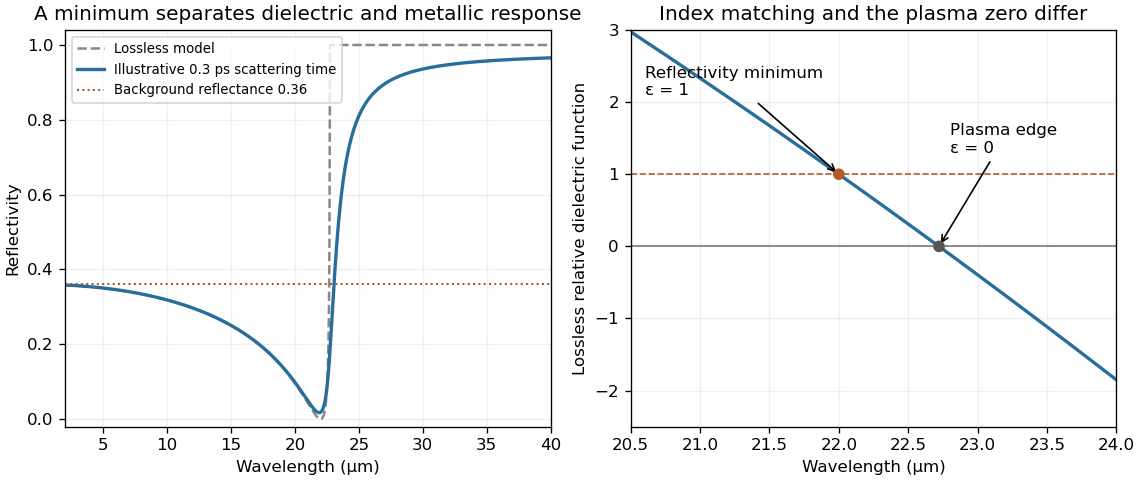
Drude-model reflectivity minimum and screened plasma edge
. Original calculation using , and a mass chosen to place the lossless reflectivity minimum at . The finite-scattering curve uses an illustrative relaxation time, not a fit to the exam's data. The supplied figure has not been copied or traced. Details.
In the Bloch wave sum, is the number of sites, the equilibrium position of site , a localized atomic orbital there, and the crystal wavevector. The phase factor gives the translation character of the Bloch state. The factor normalizes it when the site orbitals are treated as orthonormal; appreciable intersite overlap requires an overlap-dependent normalization.
For a tight-binding model, choose localized orbitals and calculate the on-site and intersite Hamiltonian matrix elements. Form Bloch sums for each orbital type and solve at each , where is the orbital-overlap matrix. In the orthogonal tight-binding approximation, . The eigenvalues give the energy bands and the eigenvectors their orbital composition; the nonorthogonal nearest-neighbour tight-binding band illustrates how retained overlap modifies this procedure.
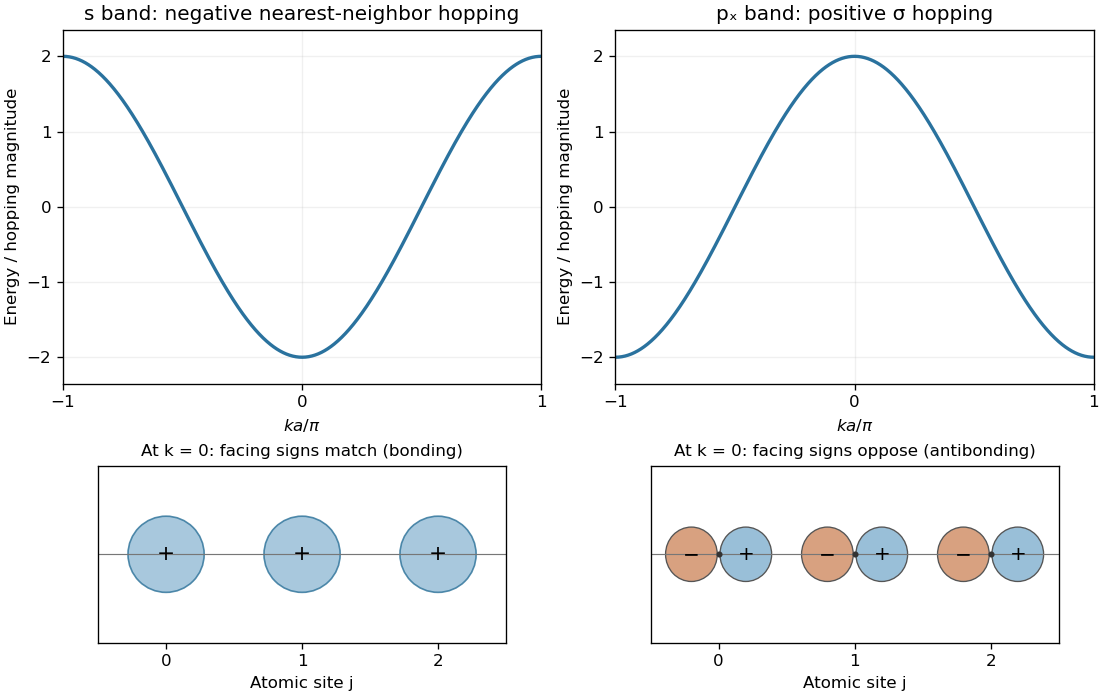
For one orthonormal s orbital per site, keep on-site energy and real nearest-neighbor hopping integral . The two neighbors contribute phases , giving . The band-curvature definition givesWith the usual bonding convention for these s orbitals, the center is a minimum with positive electron effective mass and the edge a maximum with negative electron effective mass. Hole masses near a filled-band maximum have the opposite sign.
For p orbitals aligned along the chain, the orbital phase and the sign of one-dimensional hopping reverse the usual center-versus-edge ordering. Choose every orbital with its positive lobe on the right. Equal neighboring Bloch coefficients then bring opposite-sign lobes together between sites, giving an antibonding state at . Alternating coefficients at make those facing lobes have the same sign, producing the lower bonding state. Thus a nearest-neighbor model has with the usual , maximum at zero and minima at the zone edges. This uses a fixed common orbital-phase convention at all sites.

Articles by others on the same topic
There are currently no matching articles.