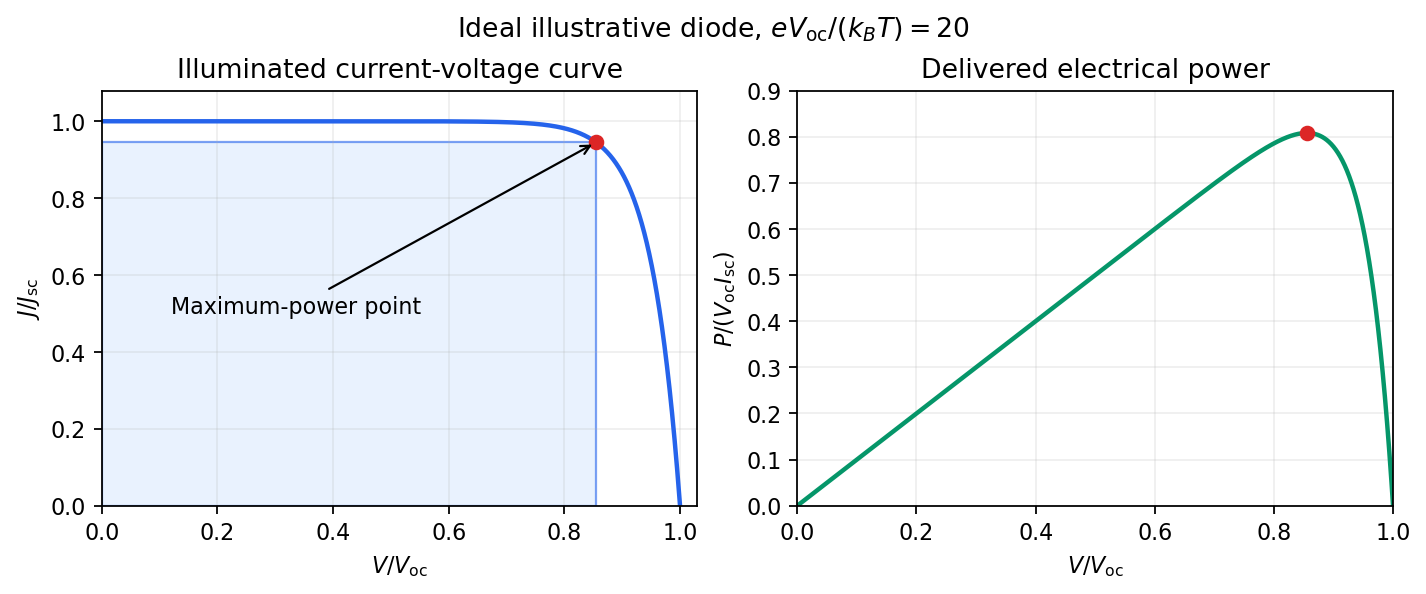
A solar cell converts incident light into electrical power through the photovoltaic effect. A semiconductor p-n junction separates and collects photogenerated electrons and electron holes. An ideal illuminated junction has output current densityHere is the short-circuit current density, is the diode saturation current, and is the open-circuit electric potential difference. The conversion efficiency is the largest delivered divided by the incident power per unit area; the short-circuit and open-circuit operating points themselves deliver zero power.
Production of more than one electronic excitation from a sufficiently energetic absorbed photon. It changes the one-pair-per-photon assumption in the conventional single-junction detailed-balance model; competing relaxation and collection losses remain relevant.
A device concept that seeks to extract carriers through energy-selective contacts before their excess photon energy is lost by thermalization. Suppressing cooling while maintaining extraction is the central challenge.
A stack of junctions with different band gaps divides the incident spectrum, reducing both below-gap transmission and above-gap thermalization compared with one optimized junction. Current matching and optical and electrical losses remain constraints.
A photovoltaic device with one main absorption gap and one junction. The ordinary detailed-balance limit assumes one collected electron-hole pair per above-gap photon, thermalized carriers and radiative recombination.
An organic solar cell converts light into electrical output using organic semiconductors, such as conjugated molecular or polymeric absorbers. Light absorption commonly produces a bound exciton, so useful charge generation requires more than simply creating an excited molecule.
In a donor–acceptor design, an exciton reaches an interface where charge transfer can separate its electron and electron hole. Selective contacts collect the separated charge carriers before they undergo recombination. A bulk heterojunction distributes donor–acceptor interfaces throughout the absorber, shortening the distance an exciton must travel. Its morphology must also supply connected transport pathways to the contacts. Absorption, exciton diffusion length, separation and charge collection therefore constrain performance together.
An interpenetrating donor-acceptor morphology in a photovoltaic absorber. Small domains facilitate exciton access to interfaces, while continuous pathways in each phase allow separated charges to reach selective contacts.
A photovoltaic device combining absorbers with different bandgaps to convert different spectral regions. A monolithic two-terminal stack has a common series current and therefore requires photocurrent matching; independently contacted junctions relax that constraint.
The short-circuit current is the terminal electric current of a device when its terminal voltage is zero. For a solar cell, it is usually denoted and is obtained from the illuminated current–voltage curve where the two terminals are connected through a sufficiently low-resistance measuring path.
A nonzero short-circuit current establishes photogenerated charge collection, but the delivered terminal power is zero at an ideal short circuit. Useful electrical output instead requires a finite operating voltage, often near the maximum power point. The short-circuit current depends on illumination, active area and collection efficiency; short-circuit current density divides it by the specified area, allowing devices of different sizes to be compared.
The maximum power point is the operating voltage and output electric current at which a source delivers its largest electrical power, . It is found along the device's current–voltage curve under specified illumination and temperature.
For a smooth solar-cell output curve written with delivered current positive, an interior maximum satisfies . The short-circuit current and open-circuit voltage are useful endpoints but neither delivers power, because one factor is zero at each endpoint. Changing illumination or temperature moves the maximum power point, motivating maximum power point tracking in the connected power converter.
Maximum power point tracking adjusts the electrical load presented to a source so that it operates near its maximum power point. In a photovoltaic system, a controlled power converter can change the panel's operating voltage while delivering energy to a battery or another load.
One elementary strategy perturbs the operating voltage, measures the resulting power, and continues in the direction that increases it. If illumination changes during the measurement, the power change may reflect the weather rather than the chosen perturbation, so the control must distinguish these effects over an appropriate time scale. Partial shading can also produce several local maxima in an array's power curve. Tracking changes the operating condition; it does not raise the power available on that instantaneous curve.
A rear doping gradient that reduces minority-carrier access to a recombination-active contact. In a p-type silicon cell, a more heavily doped rear region provides a common example.
A photovoltaic device using a perovskite-structure absorber. Selective contacts extract carriers; recombination and contact selectivity determine the attainable photovoltage.
Keep the illumination and cell temperature approximately constant. Connect an ammeter and an adjustable resistor as a series circuit across the solar cell; connect a high-resistance voltmeter across its terminals. Vary the electrical resistance and record pairs of electric potential difference and delivered electric current . This measures the illuminated current-voltage characteristic.
A load close to a short circuit estimates at . With the load disconnected, an open circuit measurement using a high-resistance voltmeter estimates at . Neither endpoint delivers useful power: vanishes there. The intermediate readings locate the maximum of and determine the solar-cell fill factor. Holding illumination fixed matters because the photogenerated electric current changes with light intensity; holding temperature fixed matters because the diode saturation current and junction response change with it.
This experiment distinguishes producing an electric potential difference from delivering energy to a load. To determine conversion efficiency as well, measure the incident power on the illuminated area, rather than equating it to a lamp's electrical rating.
The Shockley-Queisser limit is the radiative conversion-efficiency bound for an ideal single-junction solar cell, with one collected electron-electron hole pair per absorbed above-gap photon, carrier thermalization, and radiative recombination required by the reverse optical process. Photons below the band gap are not absorbed, while excess photon energy above it is thermalized. Maximizing the electrical power over the operating electric potential difference and then the band gap gives a ceiling of roughly thirty percent for ordinary unconcentrated sunlight; its precise value depends on the incident spectrum, cell temperature and emission geometry. The original calculation by William Shockley and Hans-Joachim Queisser obtained approximately at for a blackbody source and a cell at .[ref]
The solar-cell fill factor compares the maximum delivered electrical power with the rectangle formed by the open-circuit electric potential difference and short-circuit electric current. It measures the shape of the illuminated current-voltage characteristic. The conversion efficiency is .
Articles by others on the same topic


A solar cell, also known as a photovoltaic (PV) cell, is a device that converts sunlight directly into electricity through the photovoltaic effect. Solar cells are typically made from semiconductor materials, such as silicon, which have properties that allow them to generate electrical current when exposed to sunlight. ### Key Components of a Solar Cell: 1. **Semiconductor Material**: Most commonly silicon, but other materials like cadmium telluride (CdTe) and thin-film technologies are also used.