For smooth uncharged spheres, the basic attraction is the Van der Waals force, arising from correlated electric fluctuations. The Hamaker constant incorporates the particles and intervening medium. For equal spheres of radius separated by a surface gap , the near-contact van der Waals attraction of spheres isHere positive force means repulsion, and the attractive case has . At molecular separation, strong short-range repulsion prevents overlap and replaces the continuum divergence with a deep primary minimum. The energy approaches zero from below at large separation; an uncoated, uncharged attractive pair has no electrostatic barrier.
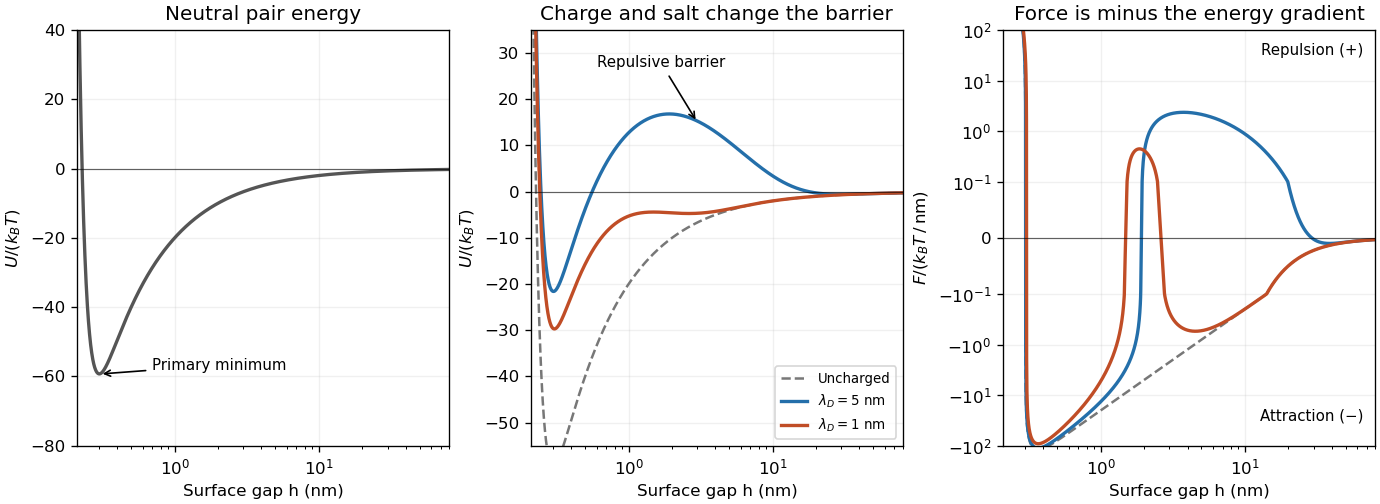
For illustration, , and give at . These are chosen scales, not universal material constants. Such a well can trap particles after a thermal encounter and cause particle aggregation, unless another mechanism such as steric stabilization intervenes. The neutral curve in the figure below shows the attraction regularized by an illustrative contact repulsion.
Use the colloidal probe technique: attach a sphere of known radius to the cantilever of an atomic force microscope and approach a chemically matched planar surface in the same liquid as the suspension. A laser reflected from the cantilever measures its deflection ; calibration of the spring constant converts this to force, . The surface separation is reconstructed from piezo motion after correcting for cantilever bending and defining the contact position. Slow approach reduces hydrodynamic drag; residual surface charge, roughness and hydration must be controlled when identifying a dispersion force.
The Derjaguin approximation accounts for the geometry. With interaction free energy per area between flat plates, , where for a sphere and plane but for equal spheres. Since , the sphere-plane force is ; divide it by two to infer the equal-sphere result in the same near-contact approximation. Attractive force gradients can produce a jump to contact, limiting the directly accessible approach curve.
An actual demonstration attached a silica sphere of radius to an AFM force sensor and measured its interaction with a plane in sodium chloride solutions. Its double-layer contribution and short-distance deviations show why charge and surface conditions must be measured rather than simply presumed absent.[ref]
Distinguish the fixed surface charge density from the mobile-ion charge magnitude . Let be the bulk number density of each species in a symmetric electrolyte, choose bulk potential zero, and write . This convention removes the ambiguity between the surface charge and ion valence in the wording.
Constancy of each ionic electrochemical potential gives the Boltzmann distribution in the local electric potential:Positive potential repels positive ions and attracts negative counterions. The coordinate measures distance from a locally planar surface; the same local relations hold for a spherical potential with its appropriate radial coordinate.
Multiplying each ion number density by its signed charge gives the local charge densityThe fixed surface charge is supplied separately as a boundary condition; it is not part of this mobile charge density in the liquid.
Substitution into Poisson's equation, , gives the Poisson-Boltzmann equationFor a plane, ; for a sphere, it is . The bulk conditions are and . At a planar wall with negligible internal field and normal pointing into the liquid, Gauss's law imposes ; alternatively, a prescribed surface potential gives .
The Debye–Hückel approximation linearizes the hyperbolic sine, giving withThe planar Debye-Hückel double layer has . For an isolated sphere of radius , the Debye-Hückel potential of a charged sphere is outside the sphere; the factor accounts for spherical spreading as well as screening.
The Debye–Hückel screening length is the characteristic distance over which the ion cloud suppresses a weak surface potential. Adding salt increases ionic strength and therefore increases , shortening the interaction range. Linearization requires , particularly near the surface where the potential is largest. It means the ionic electrostatic energy is small compared with thermal energy; for monovalent ions near room temperature, . This condition alone does not remove other limitations of point-ion mean-field theory at high concentration or strong correlations.
The force is determined by the total normal stress of the ionic liquid. The ions contribute osmotic pressure because confining an excess number density costs translational entropy. The osmotic stress in a symmetric electric double layer, relative to the bulk reservoir, isThe second term is the normal electrostatic stress. The Poisson-Boltzmann equation makes this combination independent of position between planar surfaces. At the midpoint of identical equally charged surfaces, symmetry gives , soCalculating only the repulsion of bare surface charges would omit both the screening ion cloud and its entropic stress. Evaluating the total stress at the midpoint packages their combined force in a particularly simple form.
For equal spheres, assume , , weak surface potential and weak overlap, with prescribed . Then gives . Integrating once gives the planar interaction energy per area, , and the Derjaguin approximation gives the repulsive sphere force. Combining it with the near-contact van der Waals attraction of spheres yields the DLVO theory approximationPositive force is repulsive. The exponential term can produce a repulsive barrier in the corresponding pair energy; the short-range attraction leads to a primary minimum, while a shallower secondary minimum may occur farther out. Adding salt shortens the repulsion and can destroy the barrier, allowing particle aggregation. Molecular contact requires a repulsive-core correction, and changing the charge-regulation boundary condition changes the electrostatic prefactor.

Articles by others on the same topic
There are currently no matching articles.