The attractive part of the Lennard-Jones potential represents the London dispersion force between fluctuating atomic electric dipoles. The dipole-dipole interaction is proportional to ; for nonpolar ground-state atoms its first-order expectation vanishes. In second-order perturbation theory, virtual excitations give a negative energy shift proportional to the square of that interaction, hence with . This applies at separations large compared with atomic size but small enough that electromagnetic retardation is negligible.
The repulsive term models the steep energy increase when closed electron shells overlap, involving the Pauli exclusion principle and increased electronic energy. The power is an empirical convenient approximation, not a universal power derived from the exclusion principle; its being the square of makes computation convenient. At still larger separations retardation changes the attractive asymptotics, outside this model.
A wave packet in an energy band has group velocity . The semiclassical force law then gives . The curvature therefore defines the one-dimensional effective mass by . Here , so at the band minimum ,It measures acceleration within the band, rather than a change in the electron's rest mass. At a band maximum the electron curvature mass can be negative; a missing electron is then described by a positively charged hole with a positive curvature mass.
For elastic scattering, . Contributions from sites differing by any Bravais lattice translation add in phase exactly whenfor every , namely when the momentum-transfer wavevector is a reciprocal lattice vector . For a family of planes of spacing , the th reciprocal vector normal to those planes has magnitude . The scattering geometry gives . Combining the two expressions provesConversely, reflection from that plane family satisfying Bragg's law supplies the corresponding normal reciprocal vector. The scalar angle condition alone needs this plane-normal geometry; it does not specify an arbitrary outgoing direction. A nontrivial atomic basis can extinguish an otherwise allowed reciprocal-lattice reflection through its structure factor.
A charge density wave is a spatial modulation of the electron charge density, often accompanied by a periodic lattice distortion. Write a weak modulation as . In a one-dimensional metal, the Peierls distortion couples states near opposite Fermi points most strongly for . Opening a gap near the Fermi energy lowers occupied electronic energies, while the lattice deformation has a positive elastic energy cost. Their competition can make a periodic state favorable below a transition temperature.
The modulation can be commensurate or incommensurate with the underlying Bravais lattice. Diffraction detects additional satellite peaks, while transport can show reduced low-energy carrier density. Impurities can pin its phase; above a depinning field a collectively sliding modulation can contribute nonlinear current. These effects distinguish collective density modulation from simply assigning independent static charges to isolated lattice sites.
Electrons contribute magnetic response through both spin and orbital motion. In an ordinary weakly interacting metal, a field splits the two spin energies. Only states near the Fermi energy can change occupancy because of the Pauli exclusion principle, producing Pauli paramagnetism. For a total two-spin density of states , the simple result is . Orbital cyclotron motion gives Landau diamagnetism; for an isotropic parabolic free-electron band it contributes . Filled shells can also supply a diamagnetic background.
Interactions can favor parallel spin occupancy. In an itinerant description, the exchange-energy gain competes with the kinetic-energy cost of redistributing electrons between spin bands. The Stoner criterion describes when an unpolarized state becomes unstable, with the precise factor in depending on whether the density of states counts one spin or both. This mechanism can yield spontaneous ferromagnetism and magnetic domains. Alternatively, sufficiently localized moments in a metal can interact through conduction electrons. A high density of states alone is therefore not a complete microscopic explanation of a material's magnetism; band structure, electron interactions and temperature matter.
In a Hall effect measurement, a current flows along and a magnetic field is applied along . The transverse Lorentz force initially deflects the mobile charges, building a transverse electric field until the net transverse current vanishes. Defining , the one-carrier Drude model gives . Thus electron-like carriers give and hole-like carriers give .
A nearly filled band can conduct through holes: its missing electrons behave as positive mobile charges. Metals can have both electron-like and hole-like Fermi surface sheets. In the weak-field two-carrier approximation the Hall coefficient isThe sign depends on the carrier densities and squared mobilities; it need not identify the most numerous carrier. Experimentally the Hall voltage changes sign when the field or current reverses, allowing subtraction of unwanted longitudinal-voltage pickup. Anisotropic bands and different scattering rates complicate a literal conversion of into a carrier count.
The de Haas-van Alphen effect is an oscillation of equilibrium magnetization, and hence magnetic susceptibility, as Landau levels pass through the Fermi energy when the field changes. For a fixed slice perpendicular to the field, Onsager quantization givesAt , successive crossings change by one, soHere is the oscillation frequency in inverse field. In three dimensions, integrating the oscillatory response over the momentum parallel to the field causes most sections to cancel by phase averaging. The leading surviving contributions come from stationary, hence extremal, cross-sectional areas. Low temperature and sufficiently weak scattering are needed to resolve the levels. Measuring several field directions therefore probes the shape of the Fermi surface rather than only a single scalar electron density.
For the cylindrical sheet, . The measured frequency givesThere are electrons per site in this band, with two spin states per wavevector. Thus the occupied disk takes fraction of the square Brillouin zone:This uses the paper's circular, electron-occupied disk approximation and equal band populations.
In the tight-binding approximation, hopping to the two neighbors at adds phase factors and . Their sum is ; absorb twice the hopping matrix element into . With no or hopping this yields . For , occupancy is centered on . The filling fraction of an independent cosine band is , requiring the occupied strip , so sheet consists of the two planes ; sheet similarly has . Each extends along , with no dispersion in that direction. The sheet is a cylinder along , of radius .
Numerically the planar offsets are , the zone boundary is , and the cylinder radius is in dimensionless coordinates. If instead, the band minimum is at the zone edge; occupying its lowest two-thirds puts the planes at or , with the central third unoccupied. The sign of the hopping must therefore accompany an absolute placement of these open sheets. The following sketch uses and the stipulated independent-band model, before any avoided crossings caused by additional interorbital hybridization.
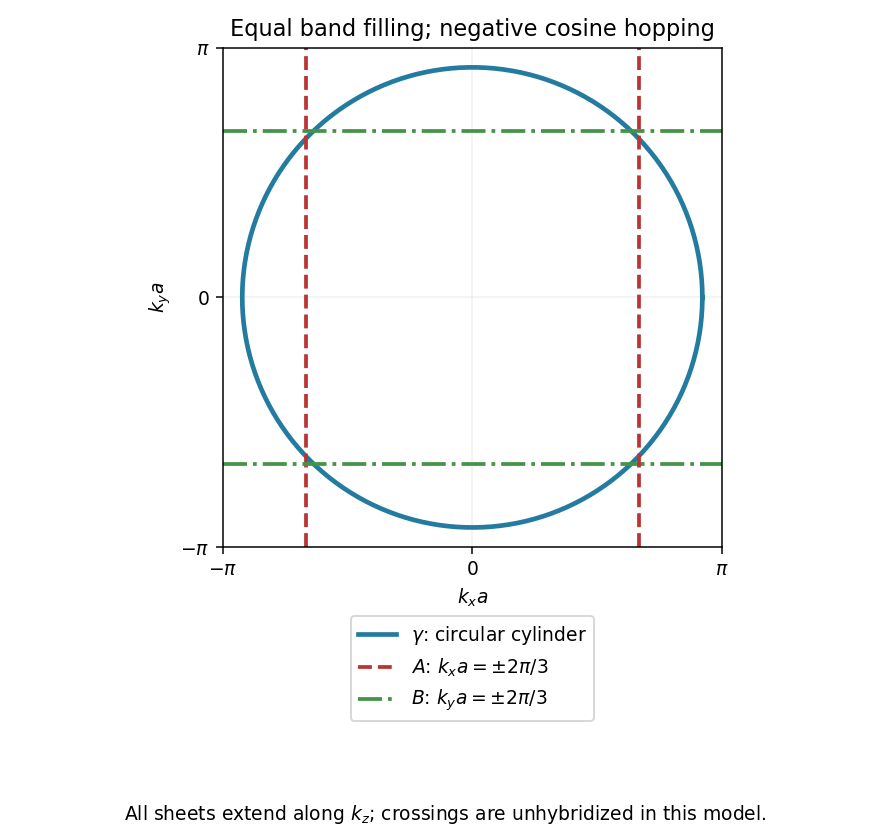
Independent-band Fermi-surface cross-sections for negative cosine hopping and equal populations of the three bands
. Details. 
In a conductor, mobile electrons redistribute in response to an electric potential, producing an induced charge density that opposes its source. Finite electronic compressibility means a finite density change requires a change of local kinetic Fermi energy. Screening is therefore not perfect at every microscopic distance. On scales comparable to atomic structure or the Fermi wavelength, a continuum local-density model itself fails.
Thomas-Fermi screening treats electrons as a locally uniform degenerate free electron gas, replaces the ionic background by a smooth neutralizing charge, and neglects nonlocal response, exchange and correlation corrections. The electrochemical chemical potential is uniform in equilibrium. Because an electron has charge , its electrostatic energy is , givingAt zero potential . Linearizing at fixed , with , givesInsert this in Poisson's equation to obtain , where the Thomas-Fermi screening length isAway from a point source, direct radial differentiation shows . The decaying solution is therefore . Integrating Poisson's equation over a small sphere containing charge fixes . For a sufficiently large source, the linearized formula is only a far-field approximation, not a justified description of its singular core.
For monovalent sodium, the electron number density is its atomic number density,This gives andRoom temperature is far below the corresponding Fermi temperature, so degeneracy is well justified, and sodium's simple conduction band makes a free-electron estimate useful. However and the mean atomic spacing is . The potential varies on a scale shorter than and the atomic spacing, so the slowly varying local-density and continuum assumptions are not quantitatively controlled at the screening length itself. A nonlocal treatment includes Friedel oscillations, absent from the pure exponential.
Nearly unchanged interlayer force constants in two-layer and twenty-layer films are consistent with very local screening and bonding forces: reducing the distant bulk need not strongly change the force between adjacent layers. They also indicate that metallic electronic response can survive in the thin film. The observation does not by itself validate the numerical Thomas-Fermi approximation, establish an identical full phonon spectrum, or rule out surface-induced electronic changes; it directly constrains the measured local force constant.
Articles by others on the same topic
There are currently no matching articles.