A free contraction must connect one and one field. In momentum space,Represent the nonzero propagator by a directed line so the two conjugate ends remain distinguishable; an undirected line alone would incorrectly allow same-charge contractions. Choose one consistent arrow convention, for example pointing from the starred end to the unstarred end.
The interaction contains two identical fields and two identical fields. Their assignments cancel the coefficient , givingThe vertex has two incoming and two outgoing arrows. Include at every vertex, integrate for each independent loop, and divide by the oriented graph's symmetry factor. There is no fermion-loop sign.
The two real fields have canonical normalization becauseThereforeThe interaction is invariant under rotations and reflections of . The continuous rotations are the original complex-field symmetry. The factor follows from both the original and the square of the in .
The propagator carries a real-species label rather than a charge-flow arrow:Differentiating the interaction with respect to its four external real fields gives the compact tensor ruleThus four legs or four legs give , while two of each give . Vertices with an odd number of either species vanish. For example, , whereas . These factors already account for assignments at one vertex; graph symmetry factors must still be included separately. Momentum conservation and loop measures are the same as in part a.
Use renormalized propagators of mass and tree vertex . The interaction counterterms have Feynman factors for a two-leg mass insertion and for a four-leg insertion. At one loop the two-point one-particle-irreducible vertex isThe directed tadpole has : interchanging its two ends would reverse the field labels, so the real-scalar tadpole's factor does not apply. It is independent of external momentum, so no wave-function counterterm is required at this order.
For the four-point vertex, label the two unstarred incoming fields by and the starred ones by , with all momenta incoming. The tree contact, the three oriented bubbles and the contact counterterm giveThe first bubble has two equivalent arrows along the same direction between its vertices, giving . In the other two channels the arrows oppose one another, and interchanging the lines does not preserve their oriented attachments, giving . This is the oriented complex-scalar quartic graph factors rule.
The mass tadpole is order , while the four-point loop is order . In the multiplicative coupling convention of the source,The distinction between and the whole additive four-leg coefficient matters for the requested order counting.
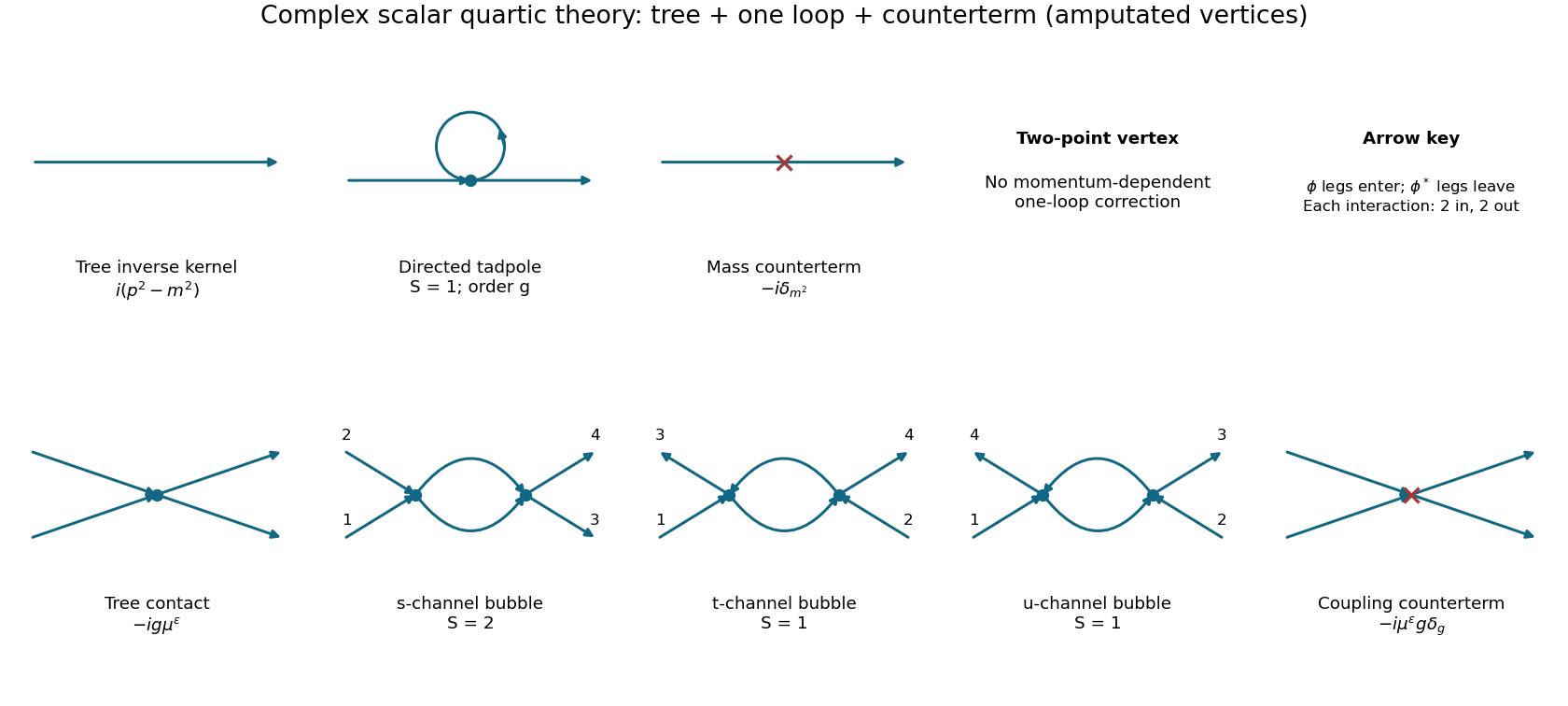
Tree, loop and counterterm contributions to the two-point and four-point vertices of a complex scalar field
. Details. 
Source correction: equation 11 on the original page has . The dimensionally regulated integral instead contains . This is not an interchangeable convention: for and , the correct factor has a logarithmic ultraviolet pole, whereas the printed is finite.
To obtain the correct expression, shift the loop momentum and perform a Wick rotation. For positive Euclidean , introduce a Schwinger parameterization:The derivation first holds in the convergent range and defines the result elsewhere by analytic continuation. For integer , rotating back giveswith the branch inherited from . This is the Lorentzian continuation of the Euclidean massive loop integral.
Set , , . Since ,Consequently the directed tadpole in part d givesThe counterterm is , so cancelling only the pole in the minimal subtraction scheme requiresThis is the quartic complex-scalar mass renormalization result. The scale factors and logarithms contribute finite terms at this order and do not change the displayed pole coefficient. A real-field check gives a tadpole coefficient , in agreement with the oriented complex-field computation.
To first order, invert and use :The remainder is a perturbative statement at fixed regulator. When differentiating, hold the bare mass fixed as well as ; otherwise the mass running would not be defined by a fixed bare theory. Since ,Thus, with the source's extra factor of one half,The factor from the running dimensionless bare coupling cancels the counterterm pole. Differentiating as though were independent of would miss this finite result. Some conventions call itself the mass anomalous dimension; that convention is twice the one defined here.
Articles by others on the same topic
There are currently no matching articles.