With and ,ThusFor , spin down is the lower energy eigenstate. The negative electron magnetic moment is already accounted for in the positive coefficient multiplying in the given Hamiltonian.
In the ordered basis , the transverse magnetic field producesThe off-diagonal complex exponentials follow directly from . This matrix is Hermitian at every time.
Insert the expansion with amplitudes and the two unperturbed dynamical phases into . Differentiation of the explicit phases cancels , leavingEquivalently, with ,These interaction-picture equations conserve . They are exact for the circularly rotating magnetic drive; a rotating-wave approximation has not been used.
Differentiate and substitute the equation for . The result isPutting removes the first derivative and gives , where . For the general solution isThe initial spinor fixes , and the first-order coupled equation fixes the second initial datum . Thus , , andTheir squared magnitudes sum to one. If both and vanish, the initial amplitudes simply remain ; the formulas have that continuous limit.
Source convention correction. For positive , the printed expression for lacks the factor required by the stated basis and initial vector. A concrete test is its derivative at : the printed expression gives , whereas the Schrödinger equation gives . Multiplying only by a phase changes the relative quantum phase. One may change the overall phase of the entire spinor, but must then transform and its initial amplitude as well. The printed modulus nevertheless gives the correct transition probability.
On Rabi resonance, and , soFor nonzero drive the probability starts at zero, reaches unity at , and repeats with period . The population oscillation therefore has angular frequency . This is complete resonant Rabi transfer; a drive of zero strength gives no transition.
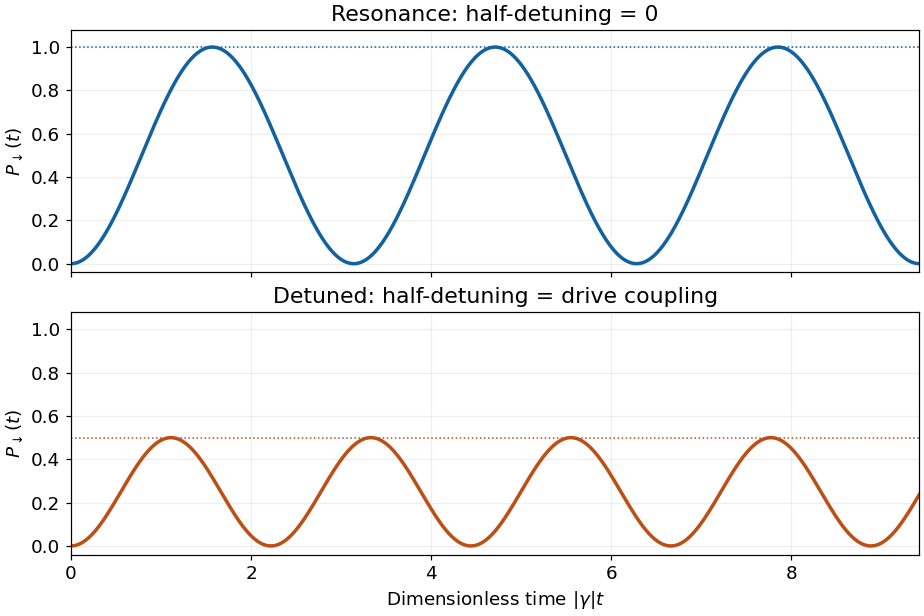
Resonant and detuned spin transition probabilities
. The dimensionless time is the drive coupling times time. The detuned example uses half-detuning equal to the drive coupling, making the maximum transition probability one half. Details.
For nonzero Rabi detuning,The sketch starts at zero and oscillates between zero and , with period when the coupling is nonzero. Relative to resonance, the oscillations have a smaller maximum and a shorter period at fixed coupling. The sign of the Rabi detuning changes the amplitudes' phases but leaves this transition probability unchanged. For , its maximum is approximately , so population transfer is strongly suppressed. The plotted detuned example has , giving maximum .
Articles by others on the same topic
There are currently no matching articles.