Inside the infinite square well, the Schrödinger equation and Dirichlet boundary conditions areThe wavefunction vanishes outside the box. These walls constrain its values, not its first derivatives: requiring both to vanish at an endpoint would eliminate all the nonzero stationary solutions.
For a nonzero separated solution, separation of variables givesThe last equation is the time-independent Schrödinger equation. Its energy eigenvalue is real. Multiplication by and integration by parts, with the endpoint values zero, givesEquality would force to be constant and hence zero, so a nonzero energy eigenstate has . Writing , the general solution is . The left wall gives ; the right gives . Negative integers reproduce the same functions up to a constant, and gives the zero function, leaving for .
Finally . Thus wavefunction normalization with positive coefficient givesAn arbitrary constant global phase has no effect on the quantum state.
The operator is the midpoint parity operator about . The angle-subtraction identity givesConsequently . The sine functions form a complete orthonormal basis of , so the simultaneous diagonal action implies commutation on the Hamiltonian operator's operator domain. More directly, preserves the Dirichlet boundary conditions and ; hence whenever is defined. This checks the domain as well as the differential expressions.
For arbitrary , use in the inner product:Also , so is bounded and defined everywhere. The identity therefore proves , with no extra domain restriction. In particular is a self-adjoint operator; also makes it a unitary operator.
The spatial quantum phase has unit modulus. Thus the probability density and total probability areThe exterior contributes zero. This establishes wavefunction normalization, although the spatial quantum phase means the state is not the ground energy eigenstate.
The requested energy eigenvalue is . By the Born rule, its probability amplitude is the inner product . Put and use :The first integral is ; the second is zero under . ThereforeFor the time-independent Hamiltonian operator, expand in its orthonormal basis of energy eigenstates:Unitary time evolution changes to , whose modulus is unchanged. Thus the same energy measurement probability holds at every time, even though relative quantum phases and other measurements can change.
Write , and . Its derivative isIntegration by parts with the Dirichlet boundary conditions gives the energy expectationIt is constant in time, since the time-independent Hamiltonian operator has fixed energy measurement probabilities: .
For the midpoint parity operator, . Hence, again putting ,Indeed the imaginary part integrates to zero by reflection and . This expectation value is also constant in time, because the bounded self-adjoint operator commutes with and hence with its time-evolution operator. Equivalently, .
For the momentum operator, direct evaluation givesThe real sine-cosine integral vanishes. This expectation value is not constant in time: the infinite square well walls reverse motion. One can prove the change exactly without approximating the wavefunction. Atthe energy eigenstate expansion and give . Differentiation shows , soThis half revival in an infinite square well is a concrete counterexample to momentum conservation. The sign from is only a global phase.
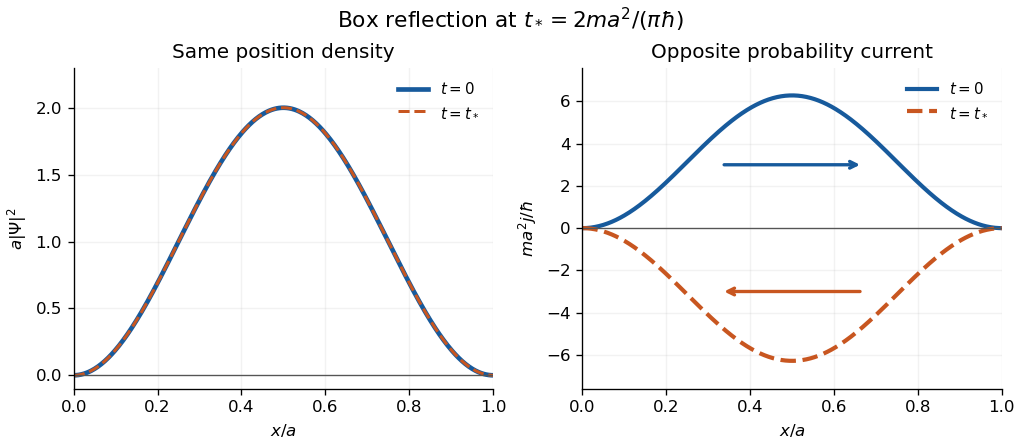

The apparent interior identity cannot justify conservation here: the momentum operator does not preserve the Dirichlet boundary conditions of the Hamiltonian operator's operator domain. For sufficiently regular states, retaining the boundary terms in Ehrenfest theorem instead gives the boundary force in an infinite square well,In the strictly confined interval, with both endpoint values zero is symmetric but not itself a self-adjoint operator. The requested integral is the conventional mean momentum; it also equals the full-line momentum mean of the zero-extended state, as measured upon releasing the walls. This domain distinction explains why the formal interior commutator misses the wall force.
Articles by others on the same topic
There are currently no matching articles.