Source: released examination archive, member
FOI-20210708-1 - Data/a13761w1 (2).pdf, four pages, 12 June 2017. The solutions below cover all three questions. Oxford's published solutions policy excludes odd years other than 2019; a bounded search found no advertised answers to this exact paper.Inside the infinite square well, the Schrödinger equation and Dirichlet boundary conditions areThe wavefunction vanishes outside the box. These walls constrain its values, not its first derivatives: requiring both to vanish at an endpoint would eliminate all the nonzero stationary solutions.
For a nonzero separated solution, separation of variables givesThe last equation is the time-independent Schrödinger equation. Its energy eigenvalue is real. Multiplication by and integration by parts, with the endpoint values zero, givesEquality would force to be constant and hence zero, so a nonzero energy eigenstate has . Writing , the general solution is . The left wall gives ; the right gives . Negative integers reproduce the same functions up to a constant, and gives the zero function, leaving for .
Finally . Thus wavefunction normalization with positive coefficient givesAn arbitrary constant global phase has no effect on the quantum state.
The operator is the midpoint parity operator about . The angle-subtraction identity givesConsequently . The sine functions form a complete orthonormal basis of , so the simultaneous diagonal action implies commutation on the Hamiltonian operator's operator domain. More directly, preserves the Dirichlet boundary conditions and ; hence whenever is defined. This checks the domain as well as the differential expressions.
For arbitrary , use in the inner product:Also , so is bounded and defined everywhere. The identity therefore proves , with no extra domain restriction. In particular is a self-adjoint operator; also makes it a unitary operator.
The spatial quantum phase has unit modulus. Thus the probability density and total probability areThe exterior contributes zero. This establishes wavefunction normalization, although the spatial quantum phase means the state is not the ground energy eigenstate.
The requested energy eigenvalue is . By the Born rule, its probability amplitude is the inner product . Put and use :The first integral is ; the second is zero under . ThereforeFor the time-independent Hamiltonian operator, expand in its orthonormal basis of energy eigenstates:Unitary time evolution changes to , whose modulus is unchanged. Thus the same energy measurement probability holds at every time, even though relative quantum phases and other measurements can change.
Write , and . Its derivative isIntegration by parts with the Dirichlet boundary conditions gives the energy expectationIt is constant in time, since the time-independent Hamiltonian operator has fixed energy measurement probabilities: .
For the midpoint parity operator, . Hence, again putting ,Indeed the imaginary part integrates to zero by reflection and . This expectation value is also constant in time, because the bounded self-adjoint operator commutes with and hence with its time-evolution operator. Equivalently, .
For the momentum operator, direct evaluation givesThe real sine-cosine integral vanishes. This expectation value is not constant in time: the infinite square well walls reverse motion. One can prove the change exactly without approximating the wavefunction. Atthe energy eigenstate expansion and give . Differentiation shows , soThis half revival in an infinite square well is a concrete counterexample to momentum conservation. The sign from is only a global phase.
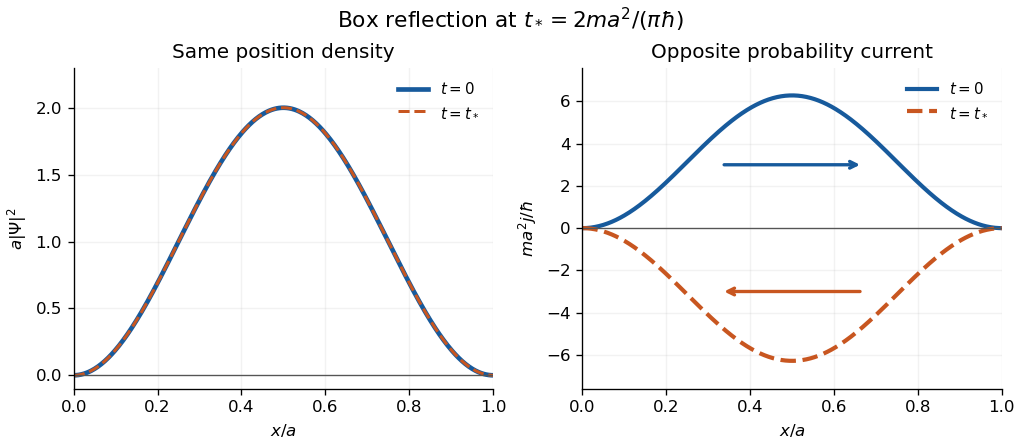

The apparent interior identity cannot justify conservation here: the momentum operator does not preserve the Dirichlet boundary conditions of the Hamiltonian operator's operator domain. For sufficiently regular states, retaining the boundary terms in Ehrenfest theorem instead gives the boundary force in an infinite square well,In the strictly confined interval, with both endpoint values zero is symmetric but not itself a self-adjoint operator. The requested integral is the conventional mean momentum; it also equals the full-line momentum mean of the zero-extended state, as measured upon releasing the walls. This domain distinction explains why the formal interior commutator misses the wall force.
On a smooth wavefunction , the position operator and momentum operator giveThus the canonical commutation relation is . Since and are self-adjoint operators and are real, the adjoint operator of isExpanding the products in the stated order is essential:Subtracting gives . These identities initially hold on smooth rapidly decaying functions, which contain the quantum harmonic oscillator energy eigenstates used below.
The factorization also proves a lower bound: for a normalized energy eigenstate ,Therefore . The commutator product rule, applied to , givesSo a nonzero application of the creation operator raises the energy eigenvalue by , while the annihilation operator lowers it by the same amount.
Begin with any energy eigenstate, whose existence is assumed. Repeated lowering must terminate: otherwise it would eventually produce a nonzero energy eigenstate below , contradicting the lower bound. More explicitly, if with integer and , the first lowering steps are nonzero. If , one further step is also nonzero by its positive squared norm and has energy , an impossibility. Thus and the last state satisfies . This provesEvery level exists as well: , so repeated raising from never vanishes. The same factorization bounds the energy expectation of any normalized state in the one-dimensional harmonic oscillator form domain below by , proving that the terminated state really is a ground state.
To find its probability density, solve the first-order equationIts solutions are . With , the supplied Gaussian integral givesTaking fixes an irrelevant global phase. ConsequentlyThe ground-state energy is positive even though the potential minimum is zero: it is the oscillator's zero-point energy.
Put . If is a normalized energy eigenstate at , the factorization from part (a) givesIt follows inductively that has squared norm . The commutator with establishes its energy eigenvalue at each step. Henceis normalized and has . Distinct levels are orthogonal because is a self-adjoint operator. In particular,
To decompose the specified initial wavefunction, retain this exact phase convention for the creation and annihilation operators. Their difference givesSince and ,This quadratic excitation of an oscillator ground state, , contains only the and energy eigenstates. The printed initial function has an unspecified overall normalization, so the Born rule requires division by its squared norm. After wavefunction normalization the state isThe minus sign is consistent with the paper's convention: its is times the usual real-coordinate raising operator multiplied by , so its has the opposite sign to the usual real second harmonic oscillator eigenfunction. The energy measurement probabilities are independent of this choice of phase.
Therefore the complete answer isEvery other energy has probability zero. At any later time the two coefficients only acquire their separate dynamical phases, so these probabilities remain the same. A direct check of the normalization isThis also confirms the factor of three in the squared norm of the two-component expansion.
The given angular momentum commutation relations imply and . By linearity,Similarly,For the remaining commutators, the commutator product rule gives, for each ,The last sum vanishes because the Levi-Civita symbol is antisymmetric under , while is symmetric. Taking and then linear combinations with proves
If and , these identities yieldOne must also prove that this candidate eigenstate is nonzero. Since the angular momentum operators are self-adjoint operators, , and expanding the product givesThereforeThis is nonnegative and, by the assumed inequality, nonzero. Hence it is positive. The angular momentum raising operator really does produce a nonzero simultaneous eigenstate with the claimed eigenvalues.
To prove that raising terminates, let be any nonzero state reached after steps, with projection . Positivity givesso . Thus the sequence cannot remain nonzero for every integer . At its last nonzero state , one has , and the squared norm identity givesUnder the paper's initial inequality the first step is nonzero, so in fact . An angular momentum ladder endpoint must therefore be reached: bounded projection follows from positivity, and the final raising norm fixes the total angular momentum eigenvalue. Writing , the complementary product gives , also showing .
Put . For the regular, single-valued orbital angular momentum states, is a nonnegative integer. Differentiation immediately givesFor , the derivatives needed for areConsequently the angular differential expression inside the parentheses of equalsusing . ThereforeThe expressions extend regularly through the polar coordinate singularities: is the restriction of the polynomial to the unit sphere. It is proportional to the lowest-projection spherical harmonic of degree ; for it is the constant state.
Starting from , part (i) gives and . Apply the angular momentum raising operator explicitly:A second application givesSince commutes with , both raised functions retain the eigenvalue . Their eigenvalues follow either by differentiating their dependence or from . Thus three valid unnormalized functions, in the requested order, areFor later Born rule calculations, normalize with the solid angle measure . Their squared norms are , , , respectively. For example and . A convenient orthonormal basis is thereforeOrthogonality follows from the distinct Fourier factors in . An overall phase of each basis function is arbitrary; these choices need not impose the usual phase convention for the spherical harmonics.
Recover from the given angular momentum raising operator and angular momentum lowering operator:This is the generator of rotations about the first coordinate axis. A natural candidate is the angular function pointing along that axis, . Direct substitution givesAlso , so linearity and part (ii) give . Thus an answer is . Its squared norm on the sphere isso the normalized quantum state isThe supplied starting state gives an alternative derivation with a changed quantization axis. Put and . The angular momentum commutation relations give and , so raises the projection from to zero. Direct differentiation giveswhich is nonzero and proportional to the same . This also connects the construction directly to the given state.
Use the normalized eigenstates from part (ii). The quantum state found in part (iii) has the decompositionThere is no component. Equivalently, its inner product with contains . The Born rule therefore givesFor completeness the only outcomes are , each with probability . Thus does not mean that zero is a possible result in this state: its quantum uncertainty in is , even though is exactly zero.
Articles by others on the same topic
There are currently no matching articles.