Write . The mass density has a finite central value because as , is monotonically decreasing on , and first vanishes at . Near the centre, ; near the surface, . It is zero outside. The enclosed mass isConsequently , soThis is the polytrope of index one profile. Its derivative is negative because for : the latter function vanishes at zero and has derivative .
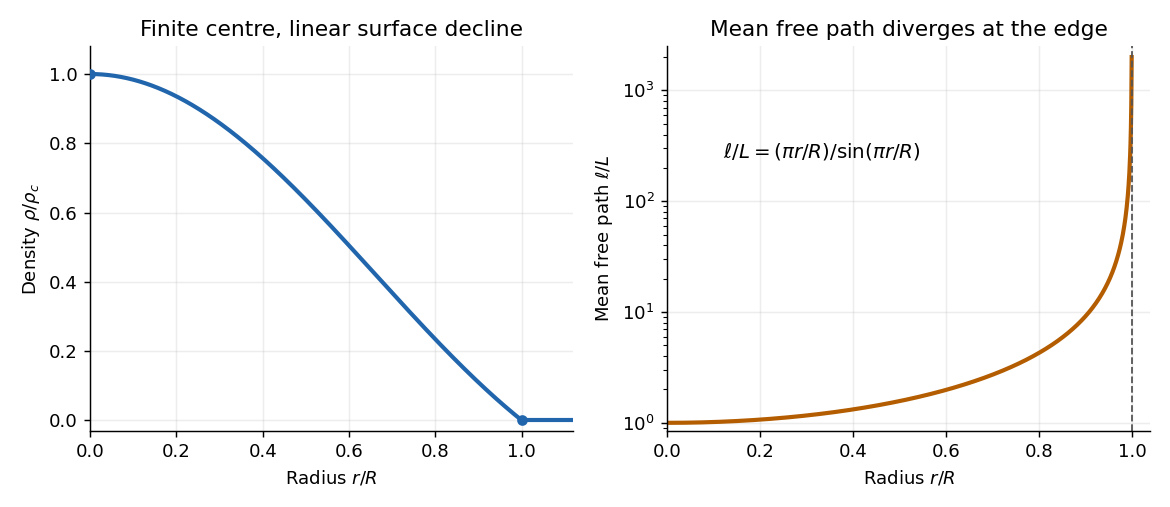

Charge neutrality in fully ionized hydrogen gives and . With only Thomson scattering, the photon mean free path is . HenceHere and below the tiny electron mass correction can be retained by replacing by . is the central mean free path, not a luminosity. The divergence at reflects the vanishing electron number density.
Using , , , and givesThese are this profile's values, rather than the Sun's actual central mass density or opacity profile.
Put . The near-surface mass density and mean free path from a and b areA simple local escape estimate sets the remaining distance equal to the mean free path, . It givesFor the Sun's parameters this is .
A more precise operational definition uses the outward radial optical depth. In this varying mass density,The chance of an outward radial photon escaping without another scattering is . Thus the conventional last-scattering depth givesThere is no sharp escape surface: gives nearly free propagation, and oblique rays have different optical depths. The local estimate actually has in this model, not ; the factor is a convention-dependent order-one correction, not a discrepancy in the Thomson cross-section. Neither scattering criterion establishes a thermalization surface.
For a spherical star in Newtonian hydrostatic equilibrium, the total supporting pressure satisfieswhere zero external pressure is the idealized vacuum boundary condition. Substitute the enclosed mass from a, set , and integrate inwards:The supplied integral follows directly by differentiating . It yieldsThus , about for the Sun's parameters. This is precisely the equation of state of a polytrope of index one.
For nonrelativistic fully ionized hydrogen with electrons and protons at a common temperature, the gas pressure is . If gas pressure dominates, the resulting temperature profile isNumerically for the Sun's parameters, and tends to zero at the idealized outer edge.
If the photons are additionally assumed to be in local thermodynamic equilibrium with this gas, their radiation pressure is , with . The consistent temperature is instead the unique nonnegative root ofThe left side is strictly increasing in for , so the root is unique. Evaluating the radiation pressure at gives at most for the Sun's parameters, at the centre; the ratio decreases approximately as outwards. The gas-only profile is consequently an excellent approximation within this imposed stellar model.
Hydrostatic equilibrium by itself fixes total pressure, not how it is divided between gas and radiation. Thomson scattering alone does not enforce a common gas–radiation temperature or a Planck photon distribution. Without either neglecting radiation pressure or specifying the radiation field and its thermodynamic closure, a unique gas temperature cannot be inferred from the given mass density alone.
Under an additional thermalization assumption, an opaque star emits approximately black-body radiation characterized by the temperature near the layer from which thermal photons escape. Planck's law gives a Rayleigh-Jeans law low-frequency tail and a Wien approximation high-frequency tail .
Using the gas-dominated temperature profile in d and the local escape criterion in c, the model's putative emission temperature for the Sun's parameters would beUsing radial instead gives . The frequency form of Wien's displacement law for the maximum of is , so these two prescriptions predictrespectively, in the far infrared/submillimetre region. These are conditional estimates for this model, not observed solar peaks. A realistic solar effective temperature near gives in . The maximum of occurs near ; it is not obtained by simply taking , because spectral densities transform with a Jacobian determinant.
The model is unsuitable for the solar photosphere: fully ionized hydrogen at – is inconsistent with thermal ionization, and the assumed opacity and near-surface temperature gradient do not resemble the Sun's. Even its central temperature is substantially below the actual solar value, about .
There is a further logical limitation: the question retains only Thomson scattering. In its coherent, cold-electron limit, this redistributes photon directions without generating a Planck photon distribution. For a concrete counterexample, monochromatic injected radiation remains monochromatic after any number of such elastic scatterings; large optical depth cannot turn it into black-body radiation. True absorption and emission, or a specified pre-existing thermal radiation field with appropriate energy exchange, are missing. Thus an approximately blackbody emergent spectrum is the usual additional physical assumption, while the stated scattering-only model does not uniquely predict an emergent spectrum or its peak.
Articles by others on the same topic
There are currently no matching articles.