Source PDF: Oxford, A15809W1, 10 June 2024. Solutions cover all three questions. The crossing convention in 1(b), the escape criterion and thermalization assumptions in 2, and the sightline in 3(e) are made explicit below.
Use the shock frame, with upstream and downstream fluid velocities and pointing in the same direction. These are the Strong-shock Rankine-Hugoniot conditions for a nonrelativistic monatomic gas with adiabatic index . The two scattering media approach one another at relative speed , to first order in . An energetic electron repeatedly crosses the shock wave, scatters from magnetic turbulence carried by the local plasma, and returns. Each scattering approximately conserves its energy in the local fluid rest frame while changing its direction; comparing successive fluid frames produces a systematic energy and momentum gain. The energy comes from the converging bulk flow, through the moving magnetic field irregularities and their associated electric fields. This is diffusive shock acceleration, a first-order Fermi acceleration process.
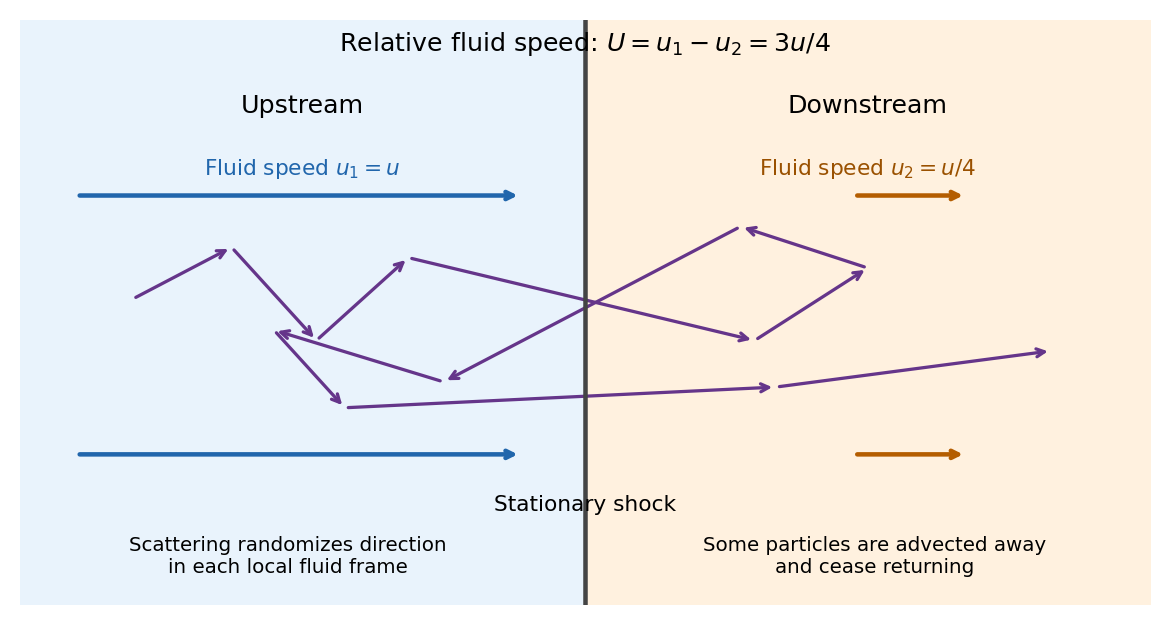
Let be the positive cosine of the crossing angle with the shock wave's normal. The Lorentz transformation between fluid frames gives, for either crossing direction with the corresponding sign of the normal reversed,For an almost isotropic population, the number crossing a unit area is weighted by its normal velocity. Thus the normalized crossing distribution is , rather than a uniform distribution in , andFor an ultrarelativistic electron, and its speed , soMore generally gives , while a nonrelativistic kinetic energy has . A complete upstream–downstream–upstream cycle contains two crossings and has ultrarelativistic fractional energy gain .
The initially cold electrons need an injection stage: shock wave heating and small-scale plasma processes must first produce particles with speed much larger than that can return across the front. The result is a description of that accelerated population; a cold electron cannot simply be assigned at its first encounter.
In the ultrarelativistic regime of a, retaining a constant mean fractional energy gain and ignoring losses gives, after individual crossings,After complete return cycles, and , to the same first-order accuracy. These products approximate the mean amplification; individual electron crossing angles give a distribution around it.
The downstream electron distribution is nearly isotropic. Its crossing particle flux per unit area is , where is the accelerated-particle number density. The downstream flow permanently advects particles away at particle flux . Their ratio estimates the escape probability after a downstream visit:Upstream particles are swept back towards the shock wave in this idealized infinite-upstream model. Consequently this return probability applies once per complete cycle, not once per individual crossing or local scattering event.
Let be the amplification per complete cycle and . A steady injection of particles leaves surviving to reach . Eliminating gives the cumulative power law and differential energy distributionThe escape distribution has the same differential exponent when is independent of energy. Thus the standard Strong-shock Rankine-Hugoniot conditions giveEquivalently the phase-space one-particle distribution function is for ultrarelativistic particles. Equal logarithmic intervals then contain equal particle energy. A finite source age, upstream escape, and radiative losses eventually introduce cutoffs or breaks.
A particle exponent is not automatically the radiation spectral index. For optically thin uncooled synchrotron radiation from , the characteristic frequency scales as and the emitted power as . Hence . With the convention , this gives and . Strong synchrotron cooling steepens a continuously injected particle distribution by one exponent, giving above its cooling break. A photon number distribution has , or in the uncooled case.
Convention qualification. If the printed is instead imposed independently at every individual crossing, its combination with gives and uncooled . For example gives , whereas the consistent cycle model gives . The standard estimate requires matching the probability and amplification to the same complete cycle.
In a sufficiently tight binary star, the main sequence companion can fill its Roche lobe. Roche-lobe overflow then transfers gas through the inner Lagrange point towards the neutron star. The gas carries angular momentum, so it generally forms an accretion disk rather than falling radially onto the surface. Internal stresses carry angular momentum outwards and permit accretion inwards. Capture of a stellar wind is another possible supply mechanism if the companion does not fill its Roche lobe.
Near the neutron star, the rapidly increasing magnetic dipole field, with , becomes dynamically important when its magnetic pressure is comparable to the inflow stresses. The accretion disk is truncated around a magnetospheric radius. Ionized material attaches to magnetic field lines and streams along them in magnetically channelled accretion, forming an accretion column above one or both magnetic poles. The Lorentz force impedes motion across the magnetic field, but does not forbid motion parallel to it. Gas can therefore reach the polar surface, with its gravitational potential energy released in a hot shock wave and radiation.
This description presumes the neutron star rotates slowly enough for material to reach it: sufficiently rapid rotation can centrifugally expel the inflow instead. A strong magnetic field by itself does not guarantee surface accretion.
Work in the locally planar shock frame, taking towards the surface. For a stationary normal shock wave with negligible radiative loss inside the discontinuity, the Rankine-Hugoniot conditions for a perfect gas express conservation of mass, conservation of momentum, and conservation of energy per unit area asHere is specific enthalpy, including the pressure work; using only internal energy would omit that work. The gravitational potential is continuous across an infinitesimally thin front. For cold upstream gas, and are negligible, while a monatomic gas has and .
The hydrodynamic equations apply to flow parallel to the guiding magnetic field when its stress contributions cancel across the front. An oblique magnetohydrodynamic shock requires magnetic stresses and Poynting flux; a radiation-mediated front or appreciable escaping radiation requires the corresponding radiative momentum and energy flux terms. These are additional physics, not terms hidden in here.
For the stipulated Strong-shock Rankine-Hugoniot conditions, and . The ideal gas law is , with a dimensional mean particle mass. The specific enthalpy of a nonrelativistic monatomic gas is . Dividing the energy flux equation in d by the common mass flux givesThereforeAs an independent check, conservation of momentum gives , and division by gives exactly the same temperature. The numerical coefficient relies on and the absence of dynamically important radiative or magnetic stresses.
Interpret the terminal infall speed as the free-fall speed from a radius much larger than the neutron star radius . In the Newtonian estimate,For fully ionized hydrogen with electrons and protons at a common temperature, there are two particles per atom and . The result of e then yieldsThis is the thermal energy scale per particle. In the same classical monatomic gas approximation, the mean random kinetic energy per particle is . Before the shock wave, the bulk kinetic energy per proton is . Distinguishing these quantities avoids an ambiguity in “particle energy”. If only the ions support the downstream pressure because electrons have not equilibrated, instead gives ; that is a different, two-temperature assumption.
These are estimates within the question's Newtonian, model. Its self-consistency is poor here: , and is much larger than the electron rest energy . Relativistic electrons, electron–positron pair production, radiation, unequal species temperatures, and general relativity can alter the equation of state and shock wave structure. In particular, the numerical must not be presented as a precision surface temperature prediction.
Write . The mass density has a finite central value because as , is monotonically decreasing on , and first vanishes at . Near the centre, ; near the surface, . It is zero outside. The enclosed mass isConsequently , soThis is the polytrope of index one profile. Its derivative is negative because for : the latter function vanishes at zero and has derivative .
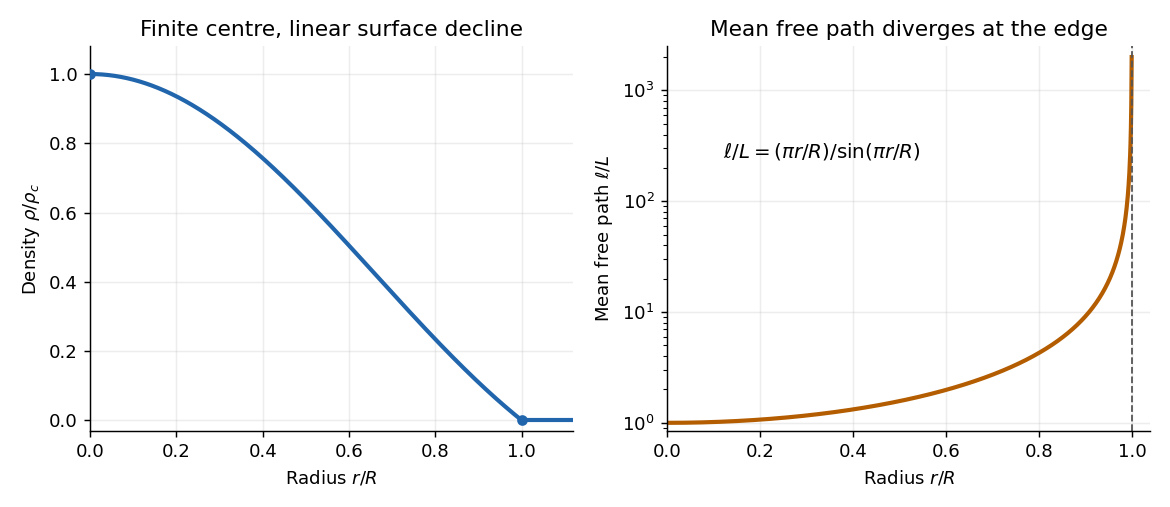


Charge neutrality in fully ionized hydrogen gives and . With only Thomson scattering, the photon mean free path is . HenceHere and below the tiny electron mass correction can be retained by replacing by . is the central mean free path, not a luminosity. The divergence at reflects the vanishing electron number density.
Using , , , and givesThese are this profile's values, rather than the Sun's actual central mass density or opacity profile.
Put . The near-surface mass density and mean free path from a and b areA simple local escape estimate sets the remaining distance equal to the mean free path, . It givesFor the Sun's parameters this is .
A more precise operational definition uses the outward radial optical depth. In this varying mass density,The chance of an outward radial photon escaping without another scattering is . Thus the conventional last-scattering depth givesThere is no sharp escape surface: gives nearly free propagation, and oblique rays have different optical depths. The local estimate actually has in this model, not ; the factor is a convention-dependent order-one correction, not a discrepancy in the Thomson cross-section. Neither scattering criterion establishes a thermalization surface.
For a spherical star in Newtonian hydrostatic equilibrium, the total supporting pressure satisfieswhere zero external pressure is the idealized vacuum boundary condition. Substitute the enclosed mass from a, set , and integrate inwards:The supplied integral follows directly by differentiating . It yieldsThus , about for the Sun's parameters. This is precisely the equation of state of a polytrope of index one.
For nonrelativistic fully ionized hydrogen with electrons and protons at a common temperature, the gas pressure is . If gas pressure dominates, the resulting temperature profile isNumerically for the Sun's parameters, and tends to zero at the idealized outer edge.
If the photons are additionally assumed to be in local thermodynamic equilibrium with this gas, their radiation pressure is , with . The consistent temperature is instead the unique nonnegative root ofThe left side is strictly increasing in for , so the root is unique. Evaluating the radiation pressure at gives at most for the Sun's parameters, at the centre; the ratio decreases approximately as outwards. The gas-only profile is consequently an excellent approximation within this imposed stellar model.
Hydrostatic equilibrium by itself fixes total pressure, not how it is divided between gas and radiation. Thomson scattering alone does not enforce a common gas–radiation temperature or a Planck photon distribution. Without either neglecting radiation pressure or specifying the radiation field and its thermodynamic closure, a unique gas temperature cannot be inferred from the given mass density alone.
Under an additional thermalization assumption, an opaque star emits approximately black-body radiation characterized by the temperature near the layer from which thermal photons escape. Planck's law gives a Rayleigh-Jeans law low-frequency tail and a Wien approximation high-frequency tail .
Using the gas-dominated temperature profile in d and the local escape criterion in c, the model's putative emission temperature for the Sun's parameters would beUsing radial instead gives . The frequency form of Wien's displacement law for the maximum of is , so these two prescriptions predictrespectively, in the far infrared/submillimetre region. These are conditional estimates for this model, not observed solar peaks. A realistic solar effective temperature near gives in . The maximum of occurs near ; it is not obtained by simply taking , because spectral densities transform with a Jacobian determinant.
The model is unsuitable for the solar photosphere: fully ionized hydrogen at – is inconsistent with thermal ionization, and the assumed opacity and near-surface temperature gradient do not resemble the Sun's. Even its central temperature is substantially below the actual solar value, about .
There is a further logical limitation: the question retains only Thomson scattering. In its coherent, cold-electron limit, this redistributes photon directions without generating a Planck photon distribution. For a concrete counterexample, monochromatic injected radiation remains monochromatic after any number of such elastic scatterings; large optical depth cannot turn it into black-body radiation. True absorption and emission, or a specified pre-existing thermal radiation field with appropriate energy exchange, are missing. Thus an approximately blackbody emergent spectrum is the usual additional physical assumption, while the stated scattering-only model does not uniquely predict an emergent spectrum or its peak.
Thermal bremsstrahlung is radiation from the acceleration of electrons in the Coulomb force of ions. At fixed temperature, the encounter rate per electron is proportional to ion number density , and the number of radiating electrons per unit volume is . Therefore in a dilute, optically thin plasma. This is a binary-encounter rate, not a one-particle emission process.
For a fixed encounter geometry, the ionic electric field and hence the electron acceleration are proportional to ionic charge . The Larmor formula is quadratic in acceleration, giving at fixed species number densities. The dimensionless Gaunt factor corrects the simple classical result for the detailed quantum scattering and radiation calculation, after averaging over the thermal electron distribution. It depends on frequency and temperature and, in a more complete notation, ionic charge.
For , expand the exponential in the thermal free-free emissivity:The energy emitted per unit frequency is therefore approximately flat, with the weak Gaunt factor dependence superposed. At these low photon energies, most of the thermal electrons can participate in emission; there is no exponentially small population threshold.
For , the spectrum turns down approximately as , apart from the Gaunt factor. Conservation of energy requires an emitting electron to supply at least . The high-energy tail of its Maxwell-Boltzmann distribution is exponentially rare, which produces this cutoff.
“Flat” refers to , an energy spectrum per unit frequency. The emitted photon number spectrum instead contains , while energy per logarithmic frequency interval is . At sufficiently low frequency the plasma can also become optically thick to free-free absorption; the given optically thin emissivity is then not the escaping spectrum.
Neglect electron mass and nuclear binding corrections when converting mass density into hydrogen and helium number densities. With ,The thermal free-free emissivity adds over ion species with weights . ConsequentlyWith each Gaunt factor set to one, the mixture hasAt fixed , pure hydrogen gives the composition factor , and pure helium gives . The latter check follows independently from and ; simply replacing by an average charge would lose this weighting.
The coefficient is power per unit volume, frequency and solid angle. For uniform, optically thin, isotropic emission from , the spectral luminosity is . With photon energy , conservation of energy and the change of spectral variable giveThusThe outside integrates over emitted solid angle; changes radiated energy to a photon count, and is the Jacobian determinant from frequency to energy.
With in and in joules, this formula produces . To compare with counts per , multiply by . Equivalently, the conversion cancels the same joule-per- factor in : one can use the numerical in in the factor, retain in , and express in in the exponential. The radius in the volume must still be converted to metres because is per .
In the thermal Sunyaev-Zeldovich effect, hot intracluster electrons transfer energy to cosmic microwave background photons by inverse Compton scattering. Their thermal energy is much larger than the CMB photon energy; in the nonrelativistic limit the mean fractional photon energy gain per scattering is about . Multiplication by the incremental Thomson scattering optical depth explains why measures the electron pressure integrated along the line of sight. The result is a spectral distortion, with a low-frequency decrement and a high-frequency increment, rather than a positive additional emission component at every frequency.
For a uniform sphere, a line of sight at impact parameter has path length . ThereforeOn the central line of sight this reduces to the requested expressionThe central-ray qualification matters: the average over the projected disk is , while the tangent ray has . Thus the printed formula does not hold for an arbitrary sightline. Part f uses the specified as this central value, as required by the preceding formula.
Write in . The photon count ratio in d eliminates radius, electron number density and the common normalization:The extra is essential for a photon number spectrum. HenceThe measured central Compton y parameter and the supplied conversion coefficient then determine a column combination:To determine the two remaining quantities separately, define and . Use , , , , and in d. With the spectral unit conversion explained there, the count luminosity isExplicitly the numerical coefficient isSince , substitution gives , soRounding consistently with the supplied coefficient , the cluster has , and . Substituting the unrounded values into both X-ray count luminosities gives and , and the central Compton y parameter returns . If the observed were a projected-disk average, its central value would be times larger and this same inversion would give smaller by and larger by ; specifying the sightline is therefore part of the inference.
Articles by others on the same topic
There are currently no matching articles.