Put and let dots now denote an affine parameter derivative. The null geodesic lagrangian in the orbital plane is . The time and azimuthal Euler-Lagrange equations integrate once; the null normalization givesFor completeness, the differential radial geodesic equation isthe remaining differential equations are and . Spherical symmetry permits the equatorial choice.
Eliminating yields . For , divide by :The impact parameter is unchanged by a common rescaling of the affine parameter. At infinity it is times angular momentum divided by energy. Radial photons have and obey the undivided equation .
The effective potential is zero at , positive outside, and tends to zero as . Its derivative is . ThusThe circular null geodesic lies at a maximum, since . It is unstable: a small radial displacement away from the maximum permits motion away from the orbit. For incoming photons from infinity in the exterior of a black hole, an outer turning point exists when ; for the photon can cross the event horizon. For a material central body, the vacuum circular orbit is relevant only if lies outside its surface.
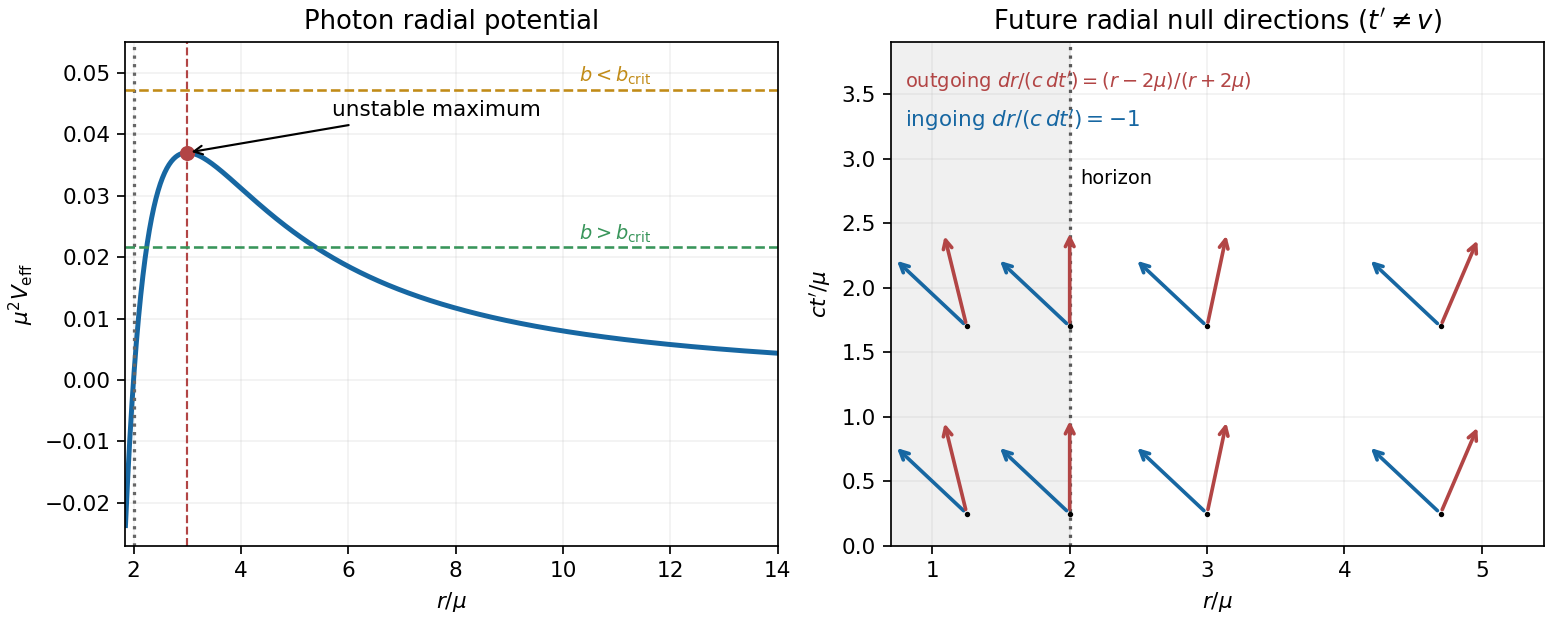
Photon potential and horizon-penetrating light cones
. Details. 
For the new coordinates, set , so . The geodesic Lagrangian is . Cyclic-coordinate conservation and the null condition give the required analogous equations:Here denotes the same conserved time-translation quantity as before. The transformation is . In particular, the displayed time coordinate belongs to Ingoing Kerr-Schild coordinates for Schwarzschild spacetime; the usual advanced null coordinate of ingoing Eddington-Finkelstein coordinates is . Using a metric tensor with a vanishing coefficient while retaining the name would therefore solve a different coordinate representation.
An elimination that stays finite at the horizon is especially simple:The middle equality uses . Hence the radial energy equation and are unchanged, including the horizon limit. The radial metric tensor block has determinant and is regular at . Its radial null directions are and , as shown in the original schematic.
This coordinate invariance of the Schwarzschild photon radial potential follows because the transformation changes the time slicing but preserves the areal radius and the stationary Killing vector field . Consequently the conserved Killing energy, angular momentum and impact parameter are the same. photon capture, the circular orbit and the radial turning points cannot depend on coordinate labels; coordinate velocities can.
Articles by others on the same topic
There are currently no matching articles.