Original source: physical PDF pages 203–206; paper pages 1–4. All three optional notes and both longer alternatives are answered below. The metric signature is ; Question 3 uses .
In the rest frame, conservation of energy would require , whereas conservation of momentum would require the photon momentum to vanish. These contradict . More generally, four-momentum conservation would equate the initial massive four-momentum to a null four-momentum, although their Minkowski norms differ:An isolated massive particle cannot decay into one photon in any inertial frame. Directly, a laboratory speed gives and ; matching a photon would require , hence . Recoil against another object could change the kinematics, but would introduce an additional participant.
Write the four-velocity and four-acceleration . Since , spatial orthogonality implies . Thus and the speed is constant. If “acceleration” is read as the laboratory three-acceleration instead, immediately gives the same conclusion.
For four-acceleration in uniform circular motion, the speed is , so is constant. Differentiating the four-velocity using givesThe proper acceleration is . The vanishing time component reflects constant energy; the spatial components describe the changing momentum direction.
The geodesics of the product-weighted diagonal plane metric follow from the geodesic Lagrangian . With dots denoting an affine parameter derivative, its Euler-Lagrange equations giveSubstituting with constant nonzero reduces both equations to . Thus is constant, and a suitable affine parametrization exists; explicitly, on a segment of fixed sign.
These straight rays are geodesics only in the regular domain . The metric tensor determinant is . On the axes, including the origin, this is a degenerate metric tensor: the calculation does not establish a regular geodesic continuing through the origin. The slope-zero ray is outside the regular domain. Geometrically, on each quadrant the change , gives . A fixed slope has constant and is therefore locally a radial geodesic of a flat metric tensor.
In general relativity, light follows null geodesics. A weak gravitational field outside an isolated spherical mass gives the Schwarzschild light deflectionfor impact parameter . At the solar limb this is approximately arcseconds. A Newtonian corpuscular calculation gives half this value; the full result depends on spatial curvature as well as the gravitational time dilation. The parametrized post-Newtonian formalism predicts , with in general relativity.
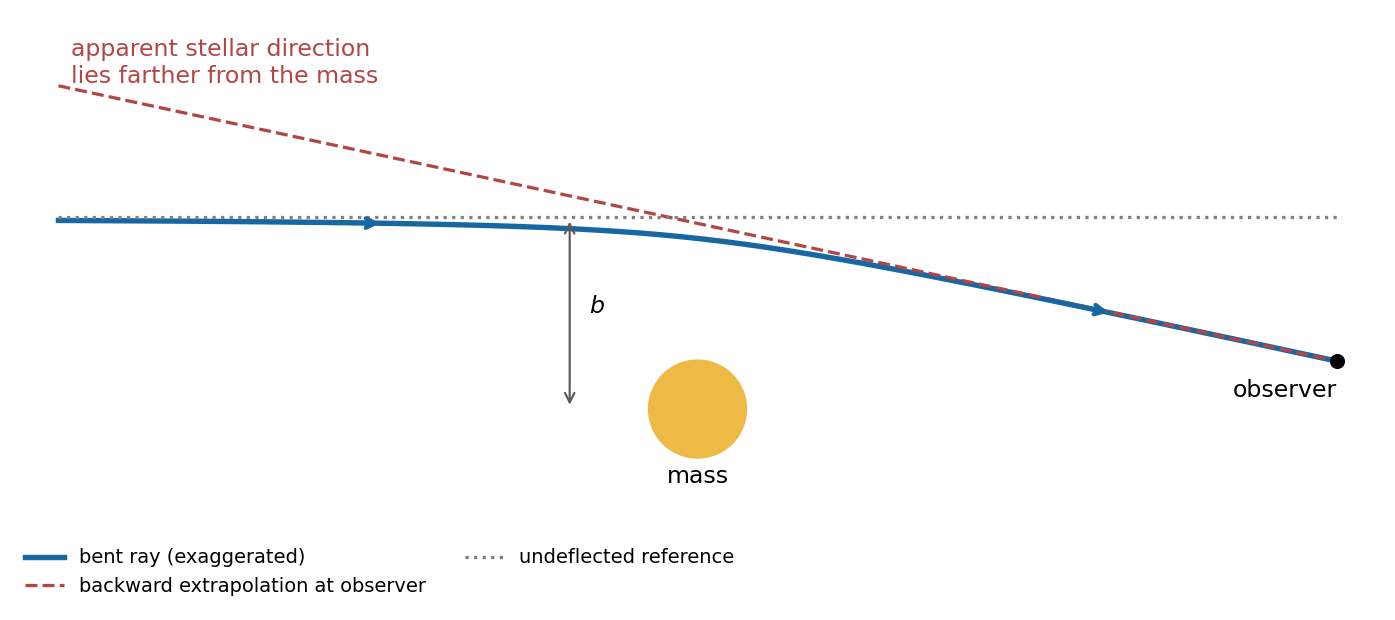

The Eddington experiment compared photographic star positions near the eclipsed Sun with reference exposures taken without the Sun in that field. Rays bend toward the Sun, but their backward extrapolations place the apparent stellar images farther from it. Plate scale, focus changes, atmospheric refraction and comparison-field alignment must be separated from a radial displacement proportional to . The original report discusses the instruments, plate reductions and competing predicted deflections; the test is a quantitative comparison with uncertainty, not a unique proof of a gravitational theory.[ref]
a determination of the deflection of light by the Sun's gravitational field by Frank Watson Dyson and others. 1920, pp. 291–333: eclipse observations, instruments and plate reductions
radio interferometry permits an independent test without an eclipse. A 2005 Very Long Baseline Array experiment observed four compact sources at 43, 23 and 15 GHz. Differential astrometry suppressed common antenna errors, while a fit separated refraction in the solar corona from achromatic gravitational deflection. Tropospheric errors and radio-source structure also required calibration. The reported was consistent with general relativity.[ref]
Progress in Measurements of the Gravitational Bending of Radio Waves Using the VLBA by Edward Fomalont and others. 2009, §§II–III on observations, calibration and coronal subtraction; §V on the reported result
tidal forces measure differences in gravitational acceleration across an extended region. Neighboring freely falling particles each have zero four-acceleration, but their separation need not accelerate uniformly. Let be the tangent to a reference timelike geodesic and its infinitesimal separation from a neighboring one, chosen from an affinely parametrized geodesic congruence. Using the Riemann curvature tensor convention specified in Solution 3,Changing the overall curvature convention changes this displayed sign. The covariant derivatives compare vectors by parallel transport, avoiding a coordinate-dependent subtraction of accelerations.
In the Newtonian limit, expand the force field at two nearby points:For , a local orthonormal frame aligned with the radius givesThere is radial stretching and transverse compression; the trace vanishes outside the mass. Two freely falling test masses and a measurement of their changing separation implement gravity gradiometry. Their common acceleration drops out, while a relative acceleration proportional to separation remains. A local inertial frame removes Christoffel symbols at a point, but cannot remove nonzero curvature over a finite region.
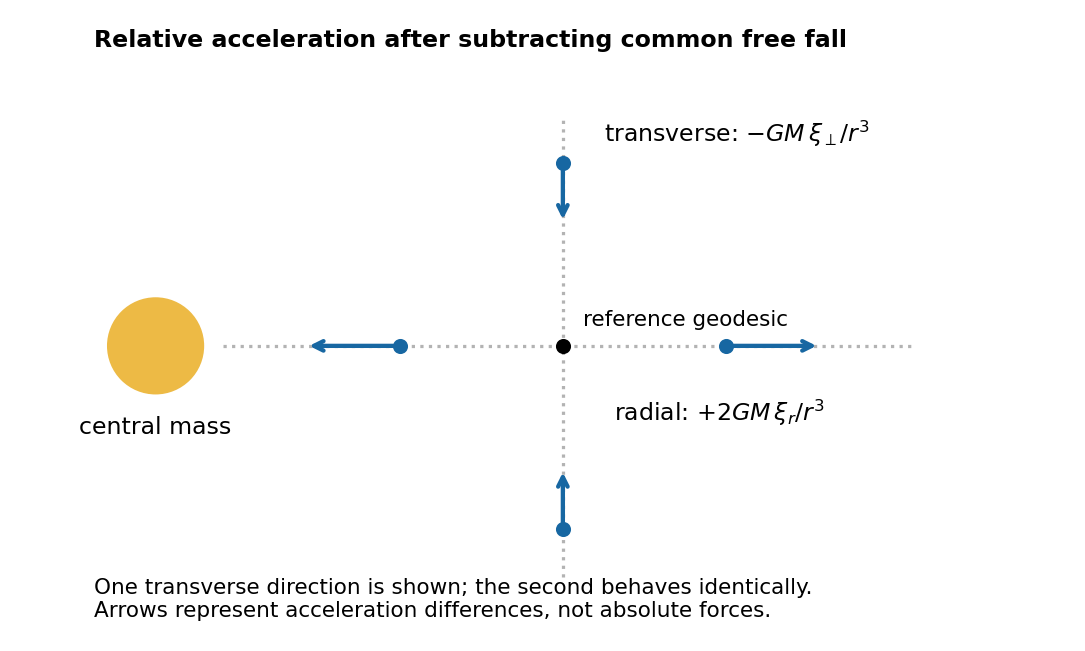
Point-mass tidal deviation
. Details. 
With Cartesian Minkowski spacetime coordinates , introduce the four-current and electromagnetic four-potential . The antisymmetric electromagnetic field tensor has components and . Maxwell equations becomeThe time and space components reproduce Gauss's law and the Ampère-Maxwell equation; the dual equation gives absence of magnetic monopoles and Faraday's law of induction. Antisymmetry gives charge conservation . The relativistic Lorentz force is . Every displayed equation transforms tensorially under a Lorentz transformation; the electric field and magnetic field are different components of the same object.
Two independent algebraic electromagnetic field invariants areThe second is a pseudoscalar: it is invariant under proper Lorentz transformations but changes sign under spatial reflection. For perpendicular fields, the sign of the first distinguishes a frame with purely magnetic field from one with purely electric field. Both invariants vanish for a plane electromagnetic wave with and , although the field itself is nonzero.
The Einstein tensor and its contractions areTo match the supplied Ricci tensor components, use the Riemann curvature tensor conventionThis convention also fixes the sign used for geodesic deviation above. In vacuum, tracing the Einstein field equations gives . Substitution therefore yields .
Differentiate the angular field equation to obtainConsequently and . The other angular component follows from . Thus the single angular equation implies all the displayed vacuum equations wherever this coordinate chart is regular.
Integrating gives . Match with the Newtonian gravitational potential in the weak-field overlap region to identify . Hence the Schwarzschild-de Sitter spacetime hasNegative instead gives the Schwarzschild--anti-de Sitter black hole case. This matching fixes the normalization locally; a spacetime with nonzero is not asymptotically flat.
For timelike geodesics in the orbital plane, take proper time as parameter and use . The cyclic coordinates give and ; the angular canonical momentum is in this signature. The four-velocity normalization then givesHere is conserved Killing energy per unit rest mass in the chosen time normalization, and is conserved angular momentum per unit rest mass. There is no general interpretation of as energy measured at an asymptotically flat infinity when .
For radial motion , differentiation gives . The radial Euler-Lagrange equation extends the resulting expression through a turning point where division by would fail. ThusThis is the proper-time second derivative of the areal radius, not a nonzero four-acceleration of the freely falling particle. Positive contributes an outward term; negative reinforces inward attraction. Restoring units in the slow-motion, weak-field Newtonian limit givesThe extra term describes the gravitational effect of a cosmological constant, not drag or a contact force. The approximation requires , and speed much less than .
Put and let dots now denote an affine parameter derivative. The null geodesic lagrangian in the orbital plane is . The time and azimuthal Euler-Lagrange equations integrate once; the null normalization givesFor completeness, the differential radial geodesic equation isthe remaining differential equations are and . Spherical symmetry permits the equatorial choice.
Eliminating yields . For , divide by :The impact parameter is unchanged by a common rescaling of the affine parameter. At infinity it is times angular momentum divided by energy. Radial photons have and obey the undivided equation .
The effective potential is zero at , positive outside, and tends to zero as . Its derivative is . ThusThe circular null geodesic lies at a maximum, since . It is unstable: a small radial displacement away from the maximum permits motion away from the orbit. For incoming photons from infinity in the exterior of a black hole, an outer turning point exists when ; for the photon can cross the event horizon. For a material central body, the vacuum circular orbit is relevant only if lies outside its surface.
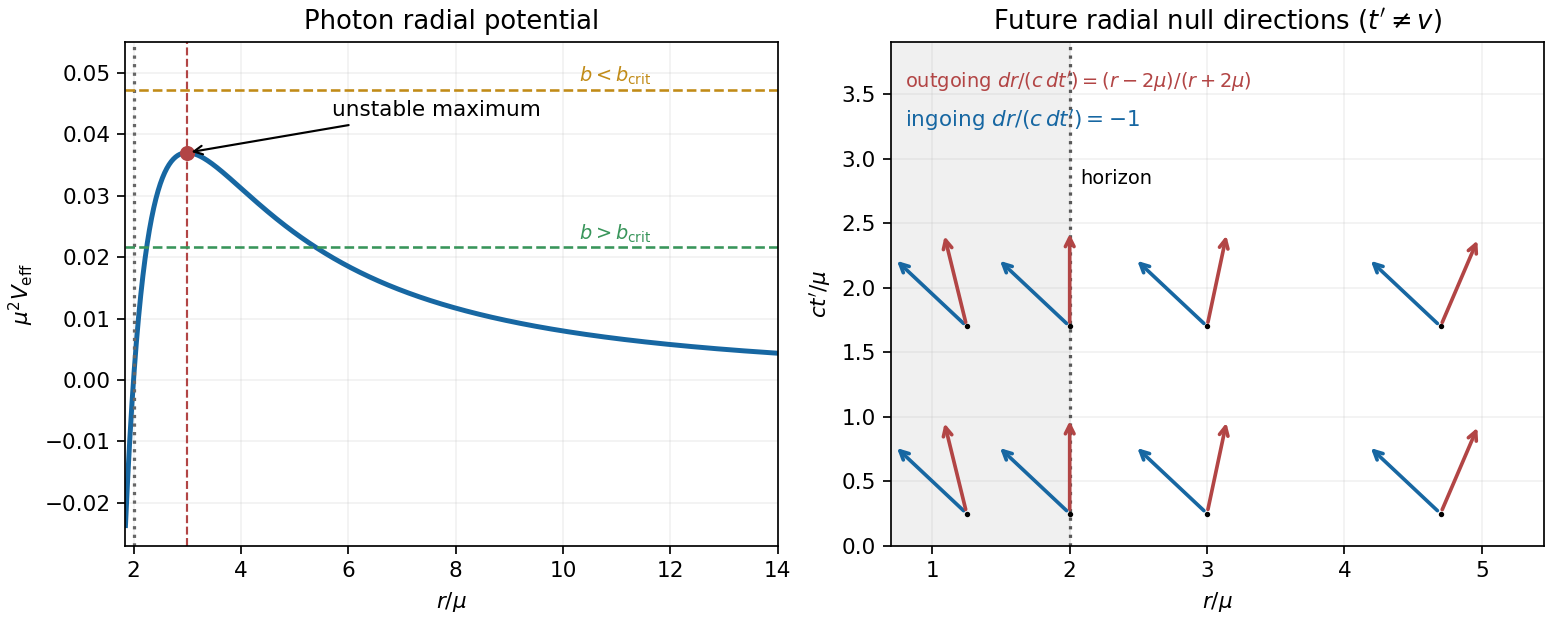
Photon potential and horizon-penetrating light cones
. Details. 
For the new coordinates, set , so . The geodesic Lagrangian is . Cyclic-coordinate conservation and the null condition give the required analogous equations:Here denotes the same conserved time-translation quantity as before. The transformation is . In particular, the displayed time coordinate belongs to Ingoing Kerr-Schild coordinates for Schwarzschild spacetime; the usual advanced null coordinate of ingoing Eddington-Finkelstein coordinates is . Using a metric tensor with a vanishing coefficient while retaining the name would therefore solve a different coordinate representation.
An elimination that stays finite at the horizon is especially simple:The middle equality uses . Hence the radial energy equation and are unchanged, including the horizon limit. The radial metric tensor block has determinant and is regular at . Its radial null directions are and , as shown in the original schematic.
This coordinate invariance of the Schwarzschild photon radial potential follows because the transformation changes the time slicing but preserves the areal radius and the stationary Killing vector field . Consequently the conserved Killing energy, angular momentum and impact parameter are the same. photon capture, the circular orbit and the radial turning points cannot depend on coordinate labels; coordinate velocities can.
Articles by others on the same topic
There are currently no matching articles.