The map is differentiable at if there is a linear map such thatEquivalently, . This linear map is unique and is the Fréchet derivative . Its matrix in the standard bases is the Jacobian matrix, whose entry is at . A function is differentiable on its domain if this condition holds at every point.
A sufficient condition is that the derivative is surjective, equivalently that its Jacobian matrix has rank . Then the implicit function theorem makes the zero set near a embedded submanifold of dimensionThe rank condition persists nearby because the derivative is continuous. This is the local form of the regular level set theorem; only the rank at the specified point is needed for this local conclusion.
Expand the increment of the quadratic form, using :The last term obeys . Thus is differentiable andThis is the quadratic form gradient. The derivative is a linear functional of the increment , whereas the gradient is its representing vector under the Euclidean inner product.
Since is invertible, the quadratic form gradient vanishes exactly at the origin. At every nonzero point of , the scalar derivative is surjective, so the regular level set theorem gives a smooth submanifold of dimension .
If , the nontriviality assumption forces the form to be an indefinite quadratic form: an invertible definite form would have zero set consisting only of the origin. Every nonzero point is regular. To show that the origin really fails to be a manifold point, use Sylvester's law of inertia to reduce to . With positive and negative coordinate vectors , the null vectors and span . Each line in one of these directions lies in the cone.
If a relatively open manifold neighborhood of the origin existed, its tangent space would contain all these line directions, so would have dimension . Such an embedded manifold would be open in , impossible for the zero set of a nonzero quadratic form. ConsequentlyThis gives the smooth locus of a nondegenerate real quadratic level set, including maximality at the singular vertex.
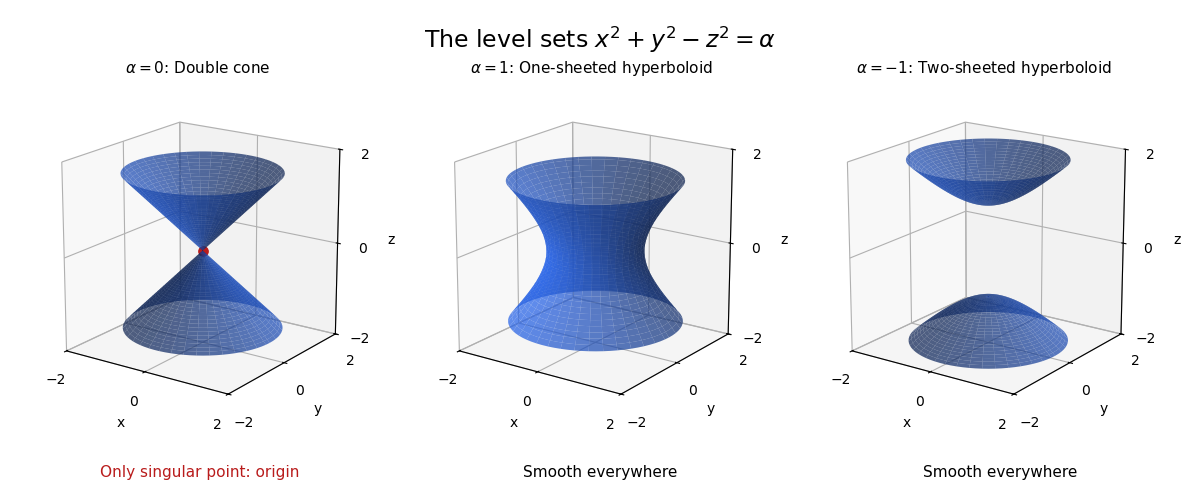
- : a circular double cone, . Its vertex at the origin is the sole singular point; every other point is a smooth surface point.
- : a one-sheeted hyperboloid, with horizontal radius . It is smooth everywhere.
- : a two-sheeted hyperboloid, . Both sheets are smooth everywhere, including their tips .
The cone vertex is an instance of the double cone singularity. The tips of the two-sheeted hyperboloid are regular because the gradient is nonzero there.

Articles by others on the same topic
There are currently no matching articles.