The Joukowski map f(z)=z+z−1 is holomorphic on C∖{0}. A holomorphic function is locally conformal where its derivative is nonzero. Here f′(z)=1−z−2 vanishes at z=±1. Thereforewhere the exclusion of zero is because the function is undefined there. Holomorphy alone does not supply conformality at the two critical points.
holomorphic on C∖{0};conformal at every point except 0,1,−1,
Put z=1+ζ. Expanding the holomorphic function near its critical point givesFor a small ray ζ=reiθ, the leading image displacement is r2e2iθ. Thus oriented ray angles are doubled modulo 2π at z=1. This is angle multiplication at a holomorphic critical point of multiplicity two; an unoriented angle between full tangent lines must also be interpreted modulo π. The map is not locally one-to-one there.
f(1+ζ)=2+ζ2−ζ3+O(ζ4).
For z=eiθ the image is w=2cosθ, a real number. Therefore each semicircle maps onto the real interval [−2,2], with endpoints included for closed semicircles. Under positive traversal of the full unit circle, the upper half runs from 2 to −2 and the lower half returns from −2 to 2. Every interior point has two unit-circle preimages. The Joukowski circle-to-ellipse mapping degenerates to a doubled line segment at this radius.
For a radius ρ>0, write z=ρeiθ. ThenFor ρ=1 its image is the ellipseIts horizontal semiaxis is ρ+ρ−1, its vertical semiaxis is ∣ρ−ρ−1∣, and its foci are ±2 because the squared semiaxes differ by 4. Reciprocal radii give the same ellipse, traversed in opposite directions as θ increases.
w=(ρ+ρ−1)cosθ+i(ρ−ρ−1)sinθ.
(ρ+ρ−1)2(Rew)2+(ρ−ρ−1)2(Imw)2=1.
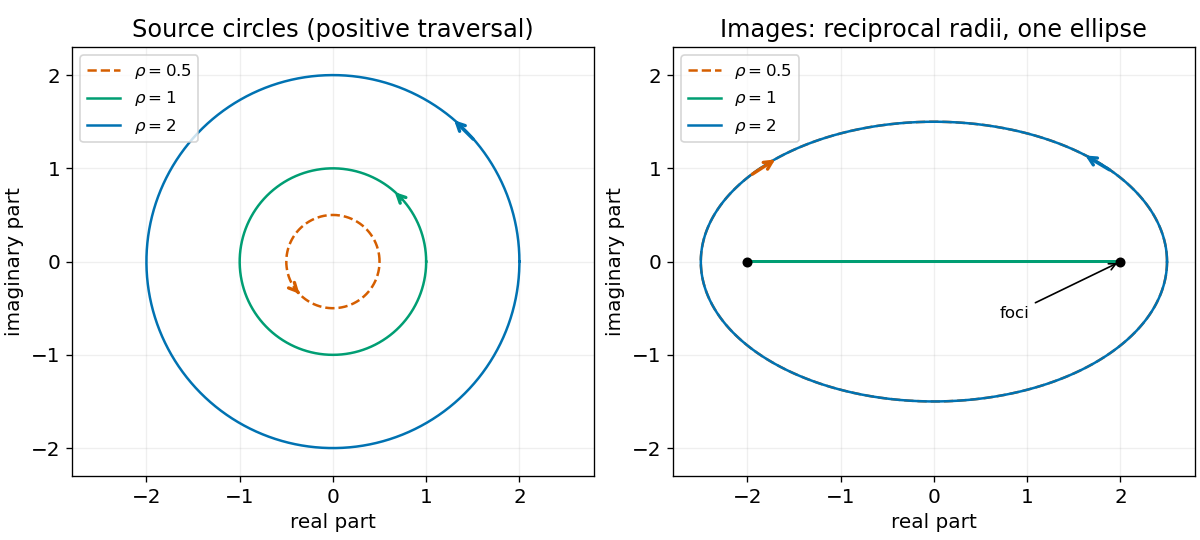
The Joukowski map sends reciprocal-radius circles to one ellipse and the unit circle to a doubled interval
. Details. 
Ancestors (10)
- S1
- 2012
- Past exam of the short options paper shared by Prelims and Parts A and B of the physics course of the University of Oxford
- Short options paper shared by Prelims and Parts A and B of the physics course of the University of Oxford
- Physics course of the University of Oxford
- Undergraduate course of the University of Oxford
- Course of the University of Oxford
- University of Oxford
- List of universities
- Home
Discussion (0)
New discussionThere are no discussions about this article yet.
Articles by others on the same topic (0)
There are currently no matching articles.