The Laurent series isIts principal part contains infinitely many nonzero negative powers, so zero is an essential singularity. The first three displayed terms are not an asymptotic truncation as z→0; they are the beginning of the convergent Laurent series in powers of 1/z.
e−1/z=∑n=0∞n!(−1)nz−n=1−z1+2z21−6z31+⋯,z=0.
The coefficient of z−1 in the Laurent series is −1. The residue theorem therefore gives, for the standard positive orientation,The residue theorem applies to an isolated essential singularity as well as to a pole.
∮Ce−1/zdz=2πiResz=0e−1/z=−2πi.
Parametrize the positively oriented unit circle by z=eiθ. Then e−1/z=e−cosθ+isinθ and dz=ieiθdθ, soEquating the real part and imaginary part with −2πi gives
∮Ce−1/zdz=i∫02πe−cosθcos(θ+sinθ)dθ−∫02πe−cosθsin(θ+sinθ)dθ.
∫02πe−cosθcos(θ+sinθ)dθ=−2π,∫02πe−cosθsin(θ+sinθ)dθ=0.
The Joukowski map f(z)=z+z−1 is holomorphic on C∖{0}. A holomorphic function is locally conformal where its derivative is nonzero. Here f′(z)=1−z−2 vanishes at z=±1. Thereforewhere the exclusion of zero is because the function is undefined there. Holomorphy alone does not supply conformality at the two critical points.
holomorphic on C∖{0};conformal at every point except 0,1,−1,
Put z=1+ζ. Expanding the holomorphic function near its critical point givesFor a small ray ζ=reiθ, the leading image displacement is r2e2iθ. Thus oriented ray angles are doubled modulo 2π at z=1. This is angle multiplication at a holomorphic critical point of multiplicity two; an unoriented angle between full tangent lines must also be interpreted modulo π. The map is not locally one-to-one there.
f(1+ζ)=2+ζ2−ζ3+O(ζ4).
For z=eiθ the image is w=2cosθ, a real number. Therefore each semicircle maps onto the real interval [−2,2], with endpoints included for closed semicircles. Under positive traversal of the full unit circle, the upper half runs from 2 to −2 and the lower half returns from −2 to 2. Every interior point has two unit-circle preimages. The Joukowski circle-to-ellipse mapping degenerates to a doubled line segment at this radius.
For a radius ρ>0, write z=ρeiθ. ThenFor ρ=1 its image is the ellipseIts horizontal semiaxis is ρ+ρ−1, its vertical semiaxis is ∣ρ−ρ−1∣, and its foci are ±2 because the squared semiaxes differ by 4. Reciprocal radii give the same ellipse, traversed in opposite directions as θ increases.
w=(ρ+ρ−1)cosθ+i(ρ−ρ−1)sinθ.
(ρ+ρ−1)2(Rew)2+(ρ−ρ−1)2(Imw)2=1.
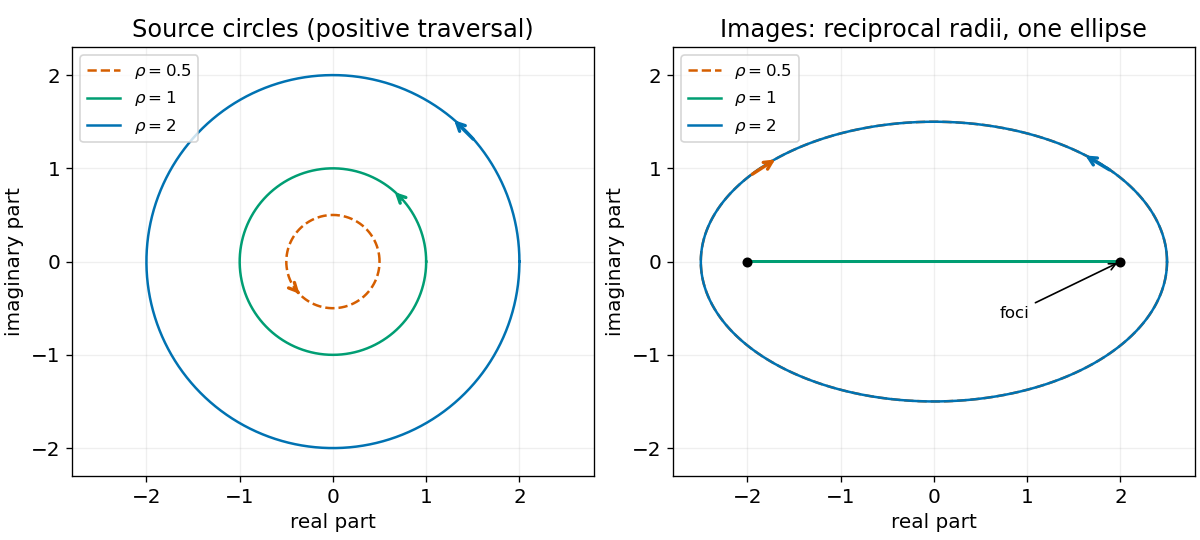
The Joukowski map sends reciprocal-radius circles to one ellipse and the unit circle to a doubled interval
. Details. 
The square-root branch points are zero and infinity. At zero the local behavior is z−1/2; in the coordinate u=1/z near infinity it is u1/2. In either case one circuit reverses the sign and two restore it. Thus the ramification index is 2: these are two-sheeted algebraic branch points, sometimes described as branch order one when order means ramification index minus one. The decay to zero at infinity does not remove the branching.
TODO: the original closed-contour drawing is absent from the source. The following independent Bromwich contour deformation establishes the required discontinuity relation without asserting the missing drawing's exact geometry. Orient the vertical line upward, as required by the positive imaginary answer in the next part, and use the principal square root, −π<argz<π.
Close a truncated vertical line to the left with a rectangle, slit it along the negative real axis, and exclude a small circle about zero. The integrand is holomorphic inside that slit domain, so the boundary contour integral is zero. Horizontal boundary integrals are O(R−1/2): integrating ex along −R≤x≤1 gives a bounded factor while ∣z∣−1/2≤R−1/2. The left boundary contributes O(e−RR1/2), and the small circle contributes O(ε). All vanish in the indicated limits.
At z=−x with x>0, the upper and lower bank values are respectively −ie−x/x and +ie−x/x. The boundary follows the upper bank toward zero and the lower bank away from zero. Their combined contribution is −2i∫0∞e−xx−1/2dx. HenceThe vertically improper integral converges conditionally; these estimates also justify the contour limit. Reversing the vertical orientation reverses its sign.
I=2i∫0∞e−xx−1/2dx.
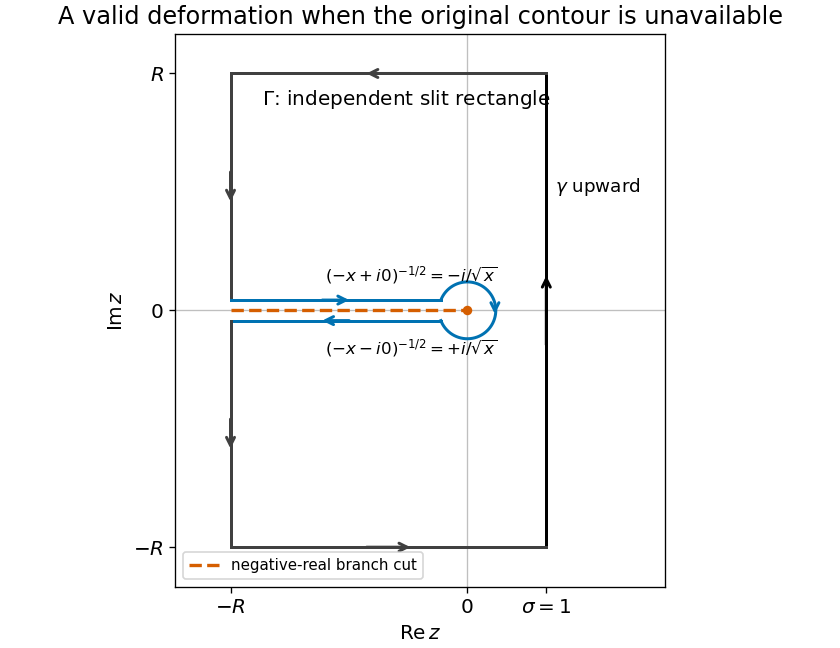
An independently chosen slit-rectangle contour relates the upward Bromwich integral to the square-root branch jump
. Details. 
The Gamma function identity Γ(1/2)=π gives the Bromwich integral of an inverse square root directly:Equivalently, put x=u2 in the real integral. It becomes 2∫0∞e−u2du=π by the Gaussian integral.
I=2iΓ(1/2)=2iπ.
Ancestors (9)
- 2012
- Past exam of the short options paper shared by Prelims and Parts A and B of the physics course of the University of Oxford
- Short options paper shared by Prelims and Parts A and B of the physics course of the University of Oxford
- Physics course of the University of Oxford
- Undergraduate course of the University of Oxford
- Course of the University of Oxford
- University of Oxford
- List of universities
- Home
Discussion (0)
New discussionThere are no discussions about this article yet.
Articles by others on the same topic (0)
There are currently no matching articles.