The first law gives elliptical relative orbits with the center of force at a focus; the second gives equal swept areas in equal times, expressing angular-momentum conservation. For circular binary motion, let r1+r2=a and M1r1=M2r2. The force equation M1(2π/P)2r1=GM1M2/a2 givesThe corresponding relation for ellipses uses the relative semimajor axis rather than instantaneous separation.
P2a3=4π2G(M1+M2).
Eclipses justify an approximately edge-on orbit, and equal velocity amplitudes imply equal masses. The relative speed is 200 km s−1, so a=(v1+v2)P/(2π)≃1.50×1010 m, or a≃0.100 AU. Substitution in the binary period law gives M1+M2≃4.52M⊙, hence M1=M2≃2.26M⊙. Inclination corrections scale the dynamical masses as sin−3i if exact edge-on viewing is relaxed.
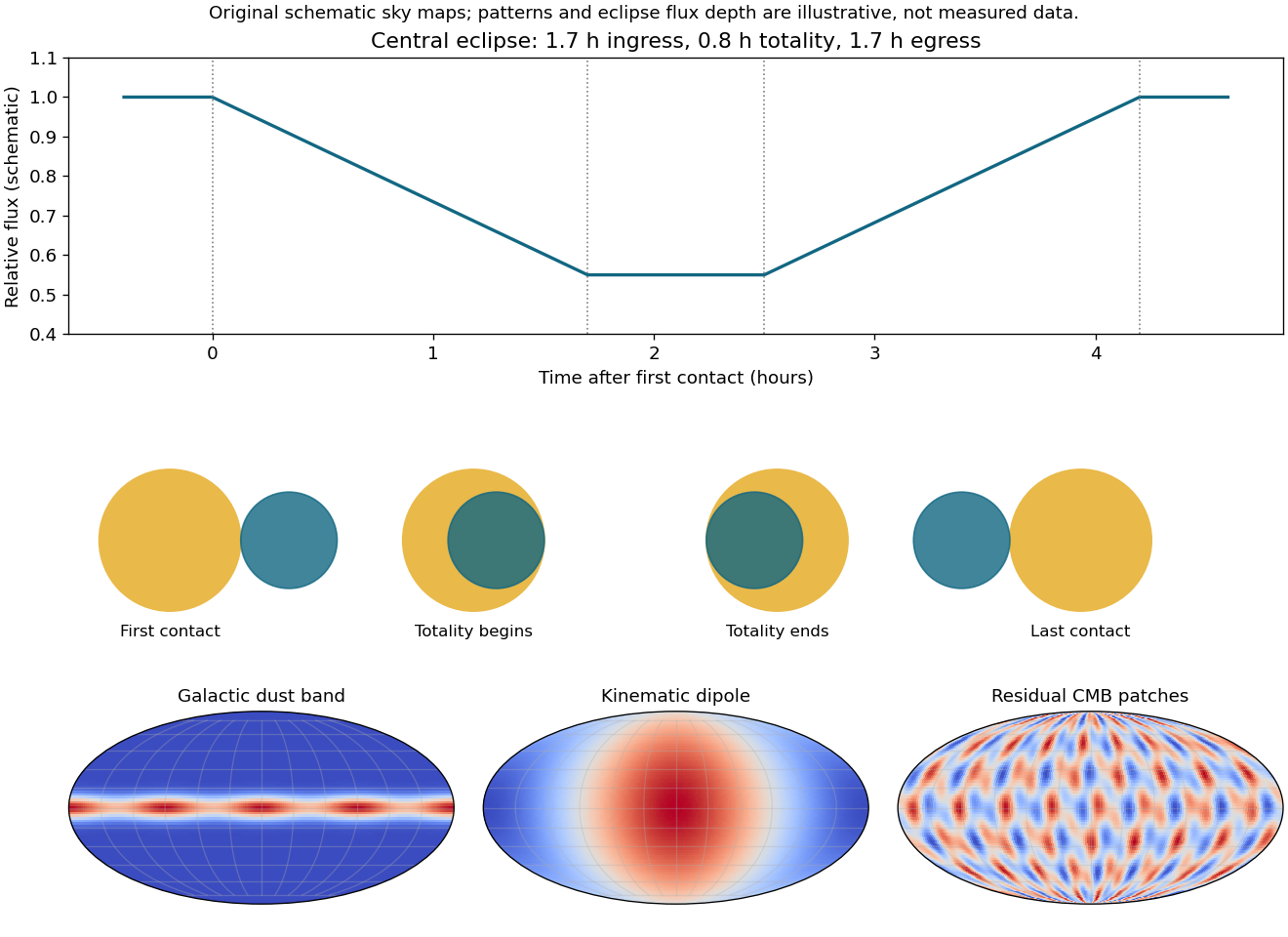
Assume a central eclipse and nearly uniform projected speed during it. Let r be the smaller radius and R the larger. First-to-second contact requires travel 2r, whereas the totality interval requires 2(R−r). With relative speed 200 km s−1,The light curve has ingress, flat minimum and egress lasting 1.7, 0.8 and 1.7 hours. At the four contacts the projected center separations are R+r,R−r,R−r,R+r. A noncentral chord would require an impact parameter and changes the inferred radii; the data alone do not fix that geometry exactly. For comparable masses in an ordinary coeval system, a component larger than its main sequence companion suggests expansion away from the main sequence, conventionally toward a subgiant/early giant track. That is a conditional evolutionary interpretation: neither effective temperature nor a bolometric flux is supplied, so a unique position on the Hertzsprung-Russell diagram cannot be inferred from these radii alone. Binary interactions and the assumed central chord also matter; these numbers do not establish an ordinary single-star evolutionary model.
r=2v(1.7 h)≃6.12×10⁵ km,R=r+2v(0.8 h)≃9.00×10⁵ km.

Ancestors (10)
- S2
- 2016
- Past exam of the short options paper shared by Prelims and Parts A and B of the physics course of the University of Oxford
- Short options paper shared by Prelims and Parts A and B of the physics course of the University of Oxford
- Physics course of the University of Oxford
- Undergraduate course of the University of Oxford
- Course of the University of Oxford
- University of Oxford
- List of universities
- Home
Discussion (0)
New discussionThere are no discussions about this article yet.
Articles by others on the same topic (0)
There are currently no matching articles.