The first law gives elliptical relative orbits with the center of force at a focus; the second gives equal swept areas in equal times, expressing angular-momentum conservation. For circular binary motion, let r1+r2=a and M1r1=M2r2. The force equation M1(2π/P)2r1=GM1M2/a2 givesThe corresponding relation for ellipses uses the relative semimajor axis rather than instantaneous separation.
P2a3=4π2G(M1+M2).
Eclipses justify an approximately edge-on orbit, and equal velocity amplitudes imply equal masses. The relative speed is 200 km s−1, so a=(v1+v2)P/(2π)≃1.50×1010 m, or a≃0.100 AU. Substitution in the binary period law gives M1+M2≃4.52M⊙, hence M1=M2≃2.26M⊙. Inclination corrections scale the dynamical masses as sin−3i if exact edge-on viewing is relaxed.
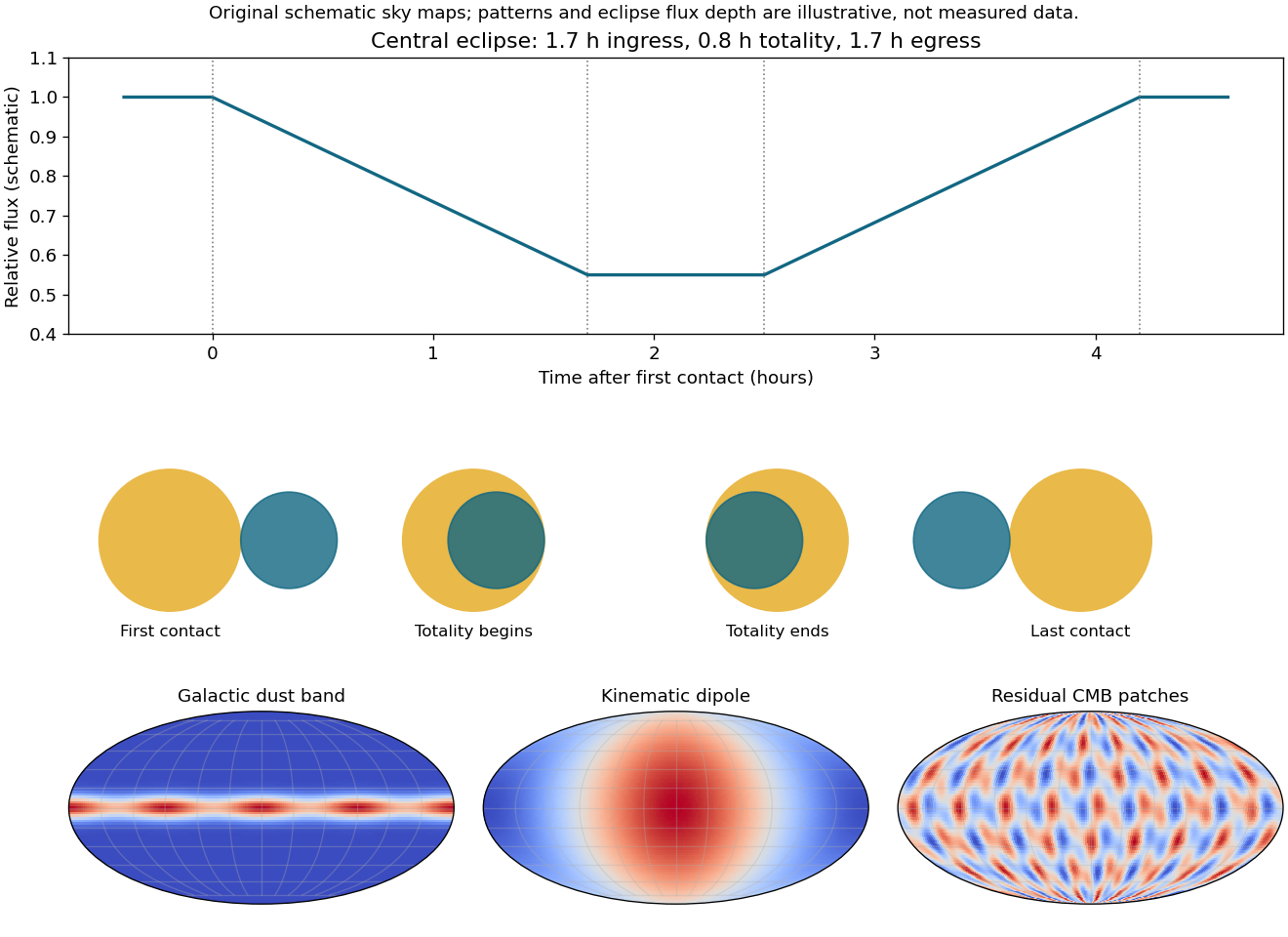
Assume a central eclipse and nearly uniform projected speed during it. Let r be the smaller radius and R the larger. First-to-second contact requires travel 2r, whereas the totality interval requires 2(R−r). With relative speed 200 km s−1,The light curve has ingress, flat minimum and egress lasting 1.7, 0.8 and 1.7 hours. At the four contacts the projected center separations are R+r,R−r,R−r,R+r. A noncentral chord would require an impact parameter and changes the inferred radii; the data alone do not fix that geometry exactly. For comparable masses in an ordinary coeval system, a component larger than its main sequence companion suggests expansion away from the main sequence, conventionally toward a subgiant/early giant track. That is a conditional evolutionary interpretation: neither effective temperature nor a bolometric flux is supplied, so a unique position on the Hertzsprung-Russell diagram cannot be inferred from these radii alone. Binary interactions and the assumed central chord also matter; these numbers do not establish an ordinary single-star evolutionary model.
r=2v(1.7 h)≃6.12×10⁵ km,R=r+2v(0.8 h)≃9.00×10⁵ km.

Hydrostatic balance is dP/dr=−GM(r)ρ/r2. A free-fall estimate gives tdyn∼R⊙3/(GM⊙)≃1.6×103 s; a test particle falling in a fixed point-mass field adds factor π/(22), giving about 30 minutes.
For an ideal nonrelativistic gas with negligible boundary pressure, the virial theorem is 2U+Ω=0, so total energy is Ω/2. Since Ω=−∫0MGmdm/r(m) and r≤R, ∣Ω∣≥GM2/(2R). This is a minimum magnitude, not a lower bound on the negative energy: unrestricted central concentration can make the latter arbitrarily negative. A uniform-density estimate gives Ω=−3GM2/(5R) and available contraction energy 3GM2/(10R). Its release at present solar luminosity lasts t∼107 yr (order 107–108 years for alternative structural estimates), much less than a nuclear-burning lifetime.
Using the supplied atomic masses consistently includes the net electron bookkeeping after positron annihilation. The released fraction is η=(4mH−mHe)/(4mH)≃0.0071, corresponding to about 26.7 MeV per helium nucleus. If 10% of the solar mass is processed and luminosity stays constant, t≃0.1ηM⊙c2/L⊙≃1010 years.
At separation one femtometre the proton Coulomb energy is 1.44 MeV. At 2×10⁷ K, mean thermal kinetic energy 3kBT/2≃2.59 keV, making their ratio about 5.6×10². Classical over-barrier collisions are therefore extremely improbable. Quantum tunnelling through the Coulomb barrier and the high-energy distribution tail allow fusion, with the slow weak-interaction step regulating the proton-proton chain. The reaction summary is a net energy/matter balance, not one simultaneous four-proton collision.
Galactic dust emission is concentrated in a bright band along the Galactic plane, with clumps associated with dust-rich regions. It is a foreground with a spectrum different from a 2.7 K blackbody, so multi-frequency observations can help separate it from the CMB. The schematic below illustrates its geometry rather than reproducing observed sky data.
Motion relative to an isotropic radiation field produces a dipole: one broad hot hemisphere and an opposite cool hemisphere. To first order T(θ)=T0[1+(v/c)cosθ], where θ=0 is the forward direction. This is not a narrow Galactic-plane feature and is not the intrinsic small-scale CMB pattern.
After foreground and dipole removal, primordial CMB anisotropies are small hot and cold patches across the sky, with characteristic correlated angular scales and amplitudes of order 10−5 of the mean temperature. They trace perturbations at photon decoupling and subsequent propagation, not simply the current distribution of Milky Way dust.
Expansion redshifts photon energies and preserves a blackbody spectrum, so a comoving observer at z=2 sees T=T0(1+z)≃8.18 K. A one-sided dipole excess of 0.105% means v/c=0.00105, hence v≃315 kms−1. Motion is toward the hotter region. The peak-to-peak contrast is twice this, so using 0.210% for v/c would double the inferred speed incorrectly.
The given calibration yields MV=−3.5log1050≃−5.946. The distance modulus is 31.446, giving d≃19.5 Mpc if extinction is negligible. Hubble's law predicts vH≃1400 km s−1, compared with 1150 km s−1 observed. The approximately −250 km s−1 difference can be a line-of-sight peculiar velocity of the cluster and observer, together with distance-calibration uncertainties. The local flow need not follow a perfectly smooth expansion law.
Ancestors (9)
- 2016
- Past exam of the short options paper shared by Prelims and Parts A and B of the physics course of the University of Oxford
- Short options paper shared by Prelims and Parts A and B of the physics course of the University of Oxford
- Physics course of the University of Oxford
- Undergraduate course of the University of Oxford
- Course of the University of Oxford
- University of Oxford
- List of universities
- Home
Discussion (0)
New discussionThere are no discussions about this article yet.
Articles by others on the same topic (0)
There are currently no matching articles.