Optical depth increases downward because dτ=−kρdz. Along an upward ray the beam loses irradiance by absorption, as in Beer-Lambert attenuation, and gains it from local thermal emission. Kirchhoff's law equates emissivity and absorptivity in local thermodynamic equilibrium, giving source term πB. Thus −dI/dτ=−I+πB, equivalently the given equation. The factor π converts isotropic radiance into hemispheric irradiance in the stipulated diffuse approximation. The following two limits hold for the same downward optical-depth coordinate.
With negligible atmospheric emission, dI/dτ=I. If the warm surface is at τs, I(τ)=Ise−(τs−τ). Irradiance decreases as the beam travels upward to smaller τ, and I(0)=Ise−τs. The positive derivative with respect to downward optical depth is consistent with attenuation, not amplification along propagation.
For an infinitely deep isothermal atmosphere the bounded solution is I(τ)=πB. A more general formal solution contains Ceτ, excluded by the bounded deep boundary condition. Emission exactly replenishes absorption, so the emergent spectrum is blackbody in this idealized wavelength-by-wavelength thermal model.
Multiplying I′−I=−πB by e−τ gives (Ie−τ)′=−πBe−τ. Integrating to depth T yields I(0)=I(T)e−T+π∫0TB(t)e−tdt. If the first term vanishes as T→∞,Each layer emits in proportion to Bdτ and is attenuated by its overlying optical depth. The normalized exponential weighting emphasizes optical depths of order unity, while retaining contributions from a range of heights.
I0=π∫0∞B(τ)e−τdτ.
Hydrostatic balance and the ideal gas law give dp/dz=−pg/(RaT), hence approximately p=p0e−z/H with H=RaT/g for weak temperature variation. For well-mixed absorber abundance, ρabs∝p/T, while pressure broadening gives k∝p. Thus kρabs∝e−2z/H and its integral above height z has the same scale. ThereforeThe factor two depends on both pressure dependence of absorption and constant mixing ratio; it is not the ordinary density scale height.
τ(z)∝e−z/Hτ,Hτ=RaT/(2g).
Let τt be the tropopause optical depth and linearize B with positive derivative BT. In the troposphere T=Tt+ΓHτlog(τ/τt), so the requested schematic isIt is constant in the isothermal stratosphere and rises linearly with logτ below it. At unchanged temperatures and a multiplicative abundance change a, optical depth at each height changes to aτ, hence Ba(τ)=Bold(τ/a). Doubling moves the tropopause kink to 2τt and gives colder emission temperatures at a fixed optical depth; halving does the opposite.
B(τ)={Bt,Bt+BTΓHτlog(τ/τt),τ≤τt,τ>τt.
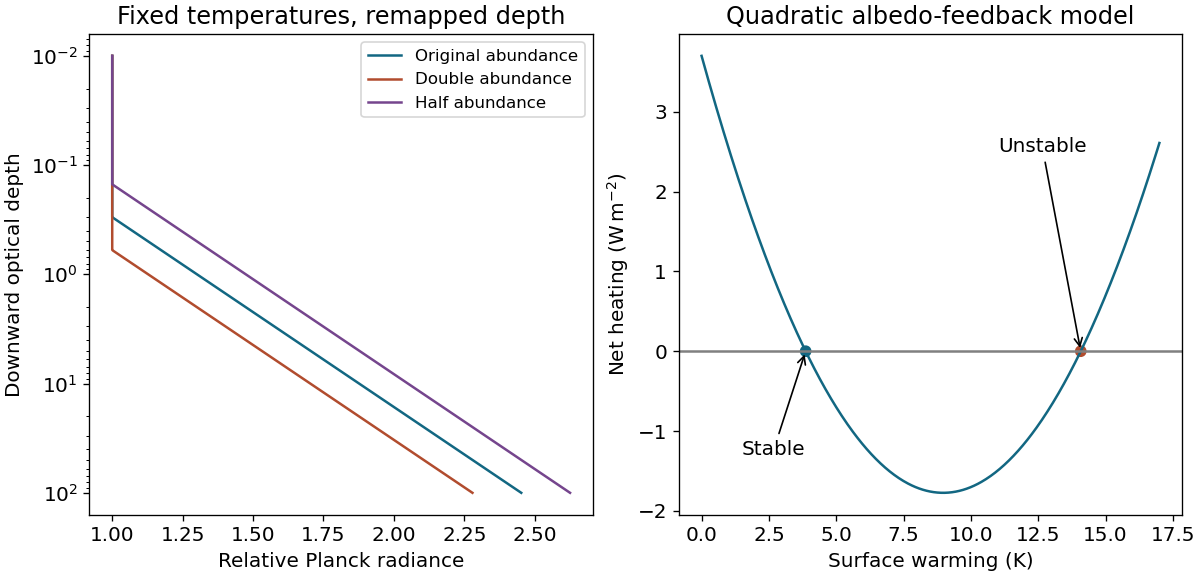
Optical-depth remapping of atmospheric emission and stable versus unstable climate-feedback equilibria
. Details. 
Ancestors (10)
- S25
- 2017
- Past exam of the short options paper shared by Prelims and Parts A and B of the physics course of the University of Oxford
- Short options paper shared by Prelims and Parts A and B of the physics course of the University of Oxford
- Physics course of the University of Oxford
- Undergraduate course of the University of Oxford
- Course of the University of Oxford
- University of Oxford
- List of universities
- Home
Discussion (0)
New discussionThere are no discussions about this article yet.
Articles by others on the same topic (0)
There are currently no matching articles.