Use SI units, uniform absolute permittivity and a neutral bulk reservoir. Local equilibrium of ideal mobile ions gives . Combining their charge with the Poisson equation yieldsThe reference is in the bulk. Boundary data specify fixed charge, fixed potential or a surface reaction/charge regulation law. These are physically different problems. The mean-field theory assumes point ions, thermal equilibrium and a continuum solvent; ion-size packing, dielectric structure and strong electrostatic correlations can invalidate it.
For a symmetric monovalent electrolyte let count each sign and define , . Outside fixed sources,For , the Debye-Hückel approximation is . A planar wall bounding electrolyte in has ; assuming zero field on the other side, its charge is . A sphere of radius and total charge instead givesThe factors arise from geometry and boundary conditions; planar screening cannot be substituted unchanged for a small sphere. The weak-potential condition must hold where the potential is largest, particularly at the surface.
The nonlinear planar Poisson-Boltzmann profile is also exactly integrable. Multiply by and use at infinity:The sign selects a profile decaying to the bulk for either sign of surface potential. Integration givesFor weak this reduces to the linear solution. Strong surface potentials have a bounded far-field amplitude , while the near-wall ion density still grows strongly. There is no need to permit the negative ion densities produced by an invalid extrapolation of a linearized density formula.
The same first integral yields the Grahame equation and its diffuse-layer differential capacitance per unit area:These describe the diffuse layer. A compact interfacial layer adds a voltage drop and can place its capacitance in series with ; a measured electrode capacitance need not equal the ideal diffuse contribution.[ref]
The Electrical Double Layer and the Theory of Electrocapillarity by David C. Grahame. section VI, printed pp. 470–474, especially equations (31)–(48); diffuse charge and differential versus integral capacitance
For comparison, a planar counterion-only double layer next to a negative plane has positive counterions and no salt reservoir. Its profile is algebraic:Integrating over gives , checking charge neutrality. This problem cannot be obtained by putting a finite reservoir density into the symmetric-electrolyte answer without changing its boundary conditions.
Applications include screening around synthetic colloids, diffuse-layer electrode capacitance and forces between charged plates. In planar geometry, the bulk-subtracted normal stress is constant:At the midpoint of identical plates, symmetry sets , so the remaining excess ionic osmotic pressure determines their repulsion. A comparison with force or capacitance measurements should vary salt and surface potential independently, test charge regulation and adsorption, and distinguish compact-layer effects from failures of diffuse screening. Nonlinear Poisson-Boltzmann theory retains finite-potential Boltzmann populations, but still omits correlations and finite-ion-volume saturation.
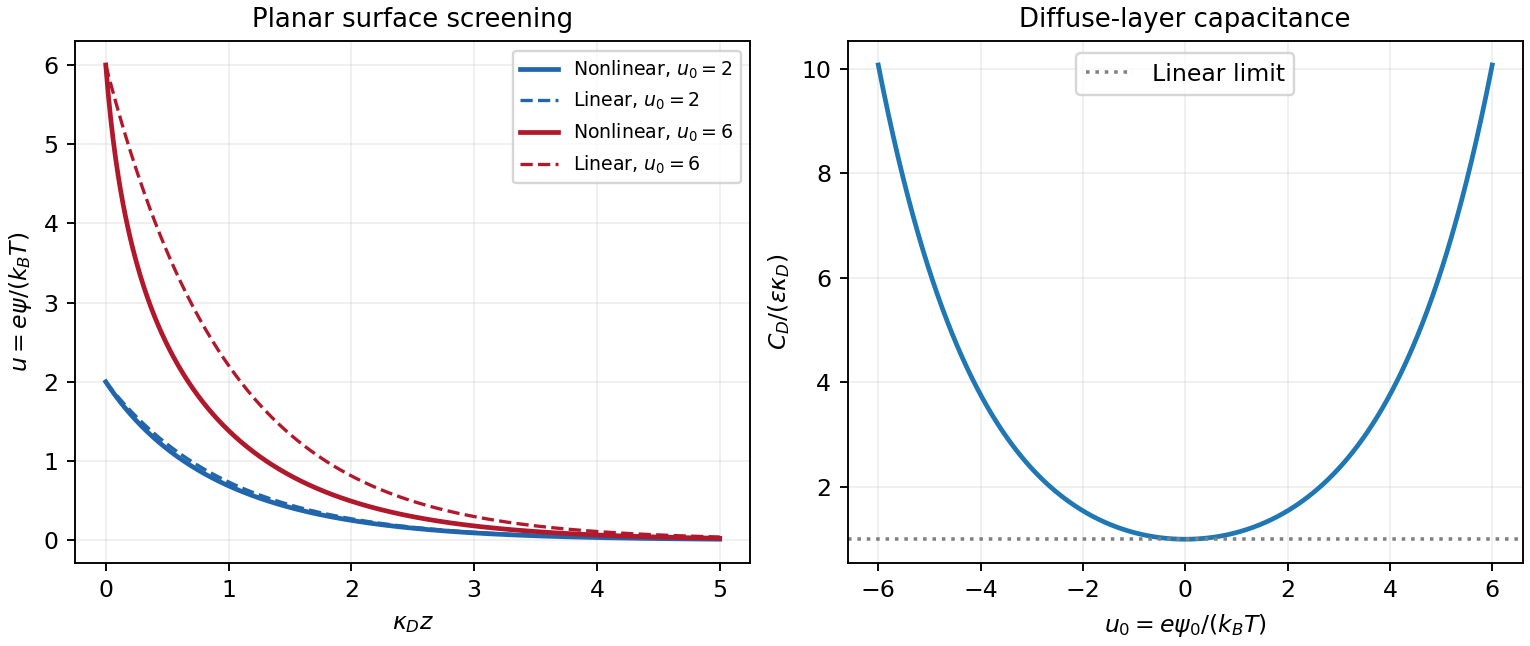
Original linear and nonlinear planar screening profiles and diffuse-layer capacitance
. Details. 
Articles by others on the same topic
There are currently no matching articles.