Original paper: Public original, physical PDF pages 567–569.
For the generic instrument, magnetic tweezers combine a magnetically responsive bead, a controllable magnetic field gradient, a tether attached to a fixed support, and optical tracking of bead coordinates. For a fixed magnetic dipole moment, the force is ; an induced linear isotropic moment instead gives . A uniform magnetic field can orient an anisotropic bead, but a gradient is needed for translation. Magnet height sets the load, while field rotation can impose torque if bead orientation is coupled to the field. Tracking uses lateral images and a calibrated axial image/defocus response; a fixed reference removes stage drift. A sufficiently slowly varying gradient approximates a force clamp over the bead's displacement. TODO: user-deferred biomolecular implementation; DNA-specific attachment, preparation and response are not treated.
For transverse-fluctuation calibration of a tensioned tether, use an ideal tether of vertical extension whose endpoint is displaced by small . Keeping its length fixed to quadratic order lowers its vertical coordinate by , increasing load potential by . The equipartition theorem therefore givesHere fluctuations are about the mean. The height is the effective pendulum length of the measured coordinate, not automatically the polymer contour length. The displayed formula uses the point-endpoint or fixed-bead-orientation idealization; freely rotating large beads can require a bead-radius correction to that lever arm. The finite-exposure correction to fluctuation force calibration restores variance lost through exposure averaging; ignoring it would overestimate force; localization noise increases it and would underestimate force. Drift, wall coupling, finite observation time and magnetic lateral stiffness must be checked. Vertical fluctuations measure longitudinal stiffness and do not obey the same geometrical formula.
For the stretch and twist coefficients of an elastic filament, take as reference contour length and as local axial strain. The three positive quadratic costs represent bending of the tangent, stretching of the material and excess twist about its relaxed orientation. With the paper's coefficient convention, are bending and torsional rigidities with units of energy times length; is an axial force modulus. Thus have units of length and inverse length. Positive quadratic forms describe a stable relaxed filament; odd terms vanish when expansion is about its zero-stress, zero-torque reference configuration.
At weak and intermediate tension, changing thermal bending conformations can extend the filament without appreciably stretching the backbone. Axial strain is , so material stretching must be included when this is no longer negligible. For a long strongly aligned but nearly inextensible three-dimensional worm-like chain, the thermal extension deficit is approximately ; stretch adds approximately to fractional extension. Twist matters whenever torque or imposed end rotation is present, at any tension. A freely swivelling, torque-free tether need not store excess twist. There is no universal force-only threshold for switching on torsional energy.
The circular bending energy of an elastic filament follows because curvature is over contour length . Integrating the bending term givesThis is bending energy alone: imposed tension, stretching and twist would add costs. The dimensionless bending action is . Its tangent propagator in three dimensions obeys rotational diffusion on the unit sphere, . The vector spherical harmonic has angular eigenvalue , givingHence is the persistence length in this three-dimensional convention. A strictly planar filament instead has tangent-correlation length ; one cannot infer the factor merely by setting a loop's energy equal to .
TODO: user-deferred biomolecular applications. Both enzyme-driven unwinding experiments, their experimental sketches, the requested numerical force and plectoneme radius, energy loss per turn and enzyme-specific dissipation mechanisms remain unsolved. None of their biomolecular parameters has been used in a calculation.
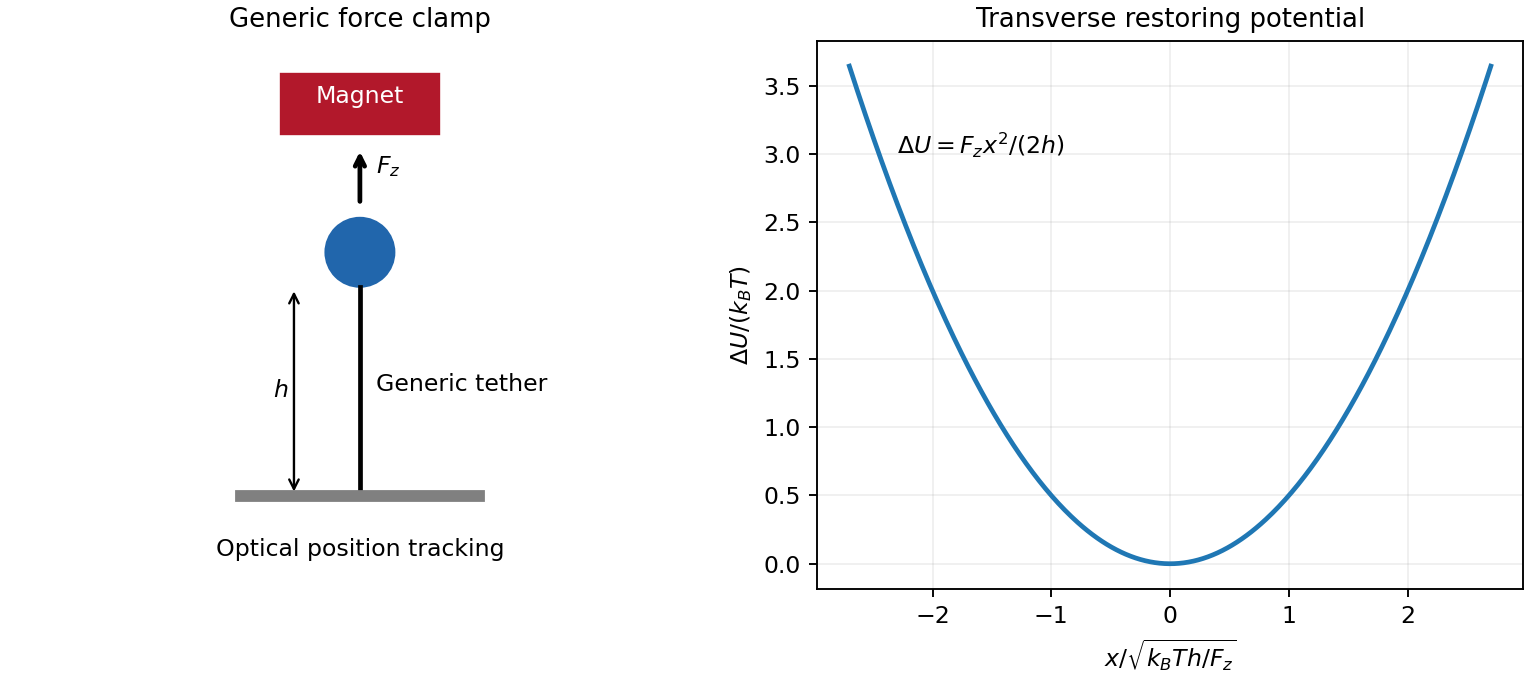
Original generic magnetic-tether instrument and its transverse fluctuation calibration
. Details. 
Use a force-tilted activation barrier for a generic one-coordinate escape model. A tensile force tilts a free-energy landscape to . If is the initial minimum and the saddle, define and the zero-force barrier . The relevant activation barrier is measured relative to the initial minimum, not an arbitrary absolute transition-state energy. To first order in force,The attempt prefactor is assumed force independent, and the saddle displacement is approximated as constant. This single-barrier approximation need not survive large landscape deformations or a change of escape pathway. TODO: user-deferred biomolecular implementation; the protein-specific shear-force arrangement and attachment chemistry are not solved.
For a generic force-ramp measurement, a calibrated atomic force microscope cantilever pulls an attachment while a stage changes separation. cantilever deflection gives force , and the cantilever compliance correction subtracts from imposed separation to give tether extension, with further corrections for other apparatus compliance. A prescribed stage speed does not automatically produce constant force loading rate when tether stiffness varies; the assumed must be measured or controlled. The original schematic below illustrates a generic nonbiological bond/tether geometry. Protein-specific construction is deferred.
The no-rebinding approximation is a physical escape assumption: after the link breaks, separation removes the partners from the capture region before appreciable reassociation. It requires the integrated return/association probability during that separation to be small. If the separated state stays nearby or the force is held without separation, setting can fail. Under the stipulated approximation, with the link initially intact,This survival under a linear force ramp differs from the probability density for rupture. It starts at one, decreases to zero and shifts to larger force as the loading rate increases. For small , ; a slow ramp allows much escape before substantial force is reached.
The median rupture force under a linear ramp satisfies , givingAt high loading rate, the slope of against tends to ; it is not exactly for a slow ramp. Fit the full expression across loading rates to recover and . The rupture-force probability density is , whose most probable rupture force under a linear ramp is if , and zero otherwise. median and mode are different observables and must not be interchanged when fitting.
At known temperature, yields the activation distance ; gives the zero-force mean lifetime in this exponential model. Absolute barrier height additionally requires the attempt prefactor, and neither equilibrium binding free energy nor an association rate follows from dissociation-only data. A loading-rate-dependent rupture force is a kinetic readout, not an intrinsic equilibrium strength. TODO: user-deferred biological conclusions. The protein-specific stability interpretation and cell-adhesion strategy are left unsolved.
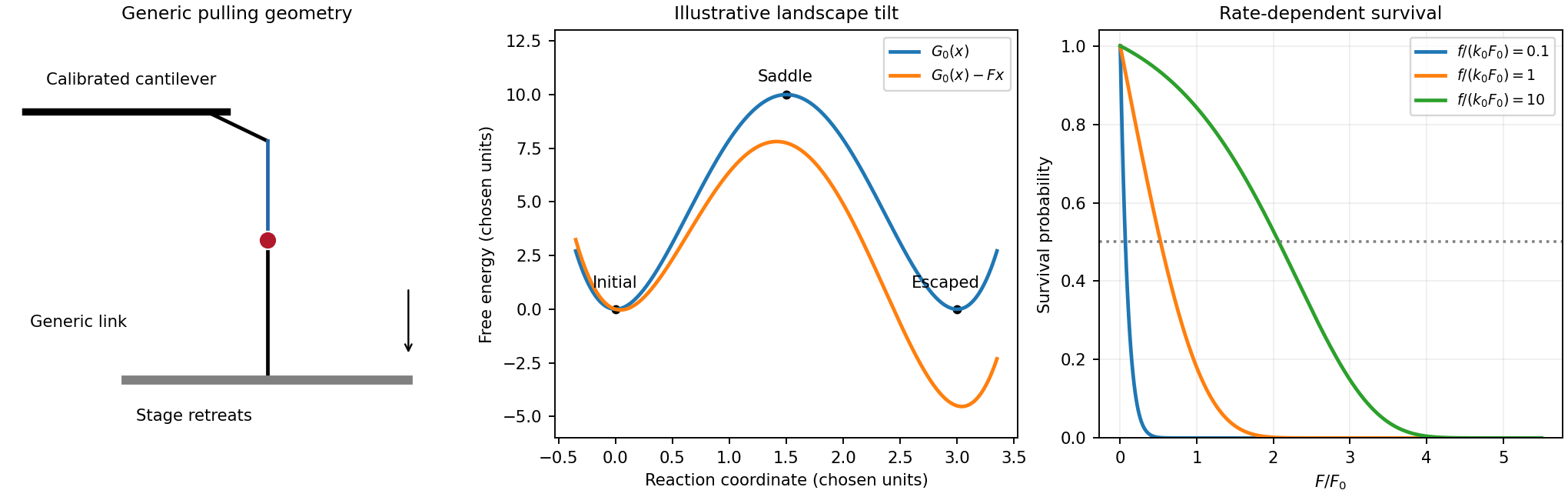
Original generic pulling arrangement, tilted energy landscape and calculated survival under a force ramp
. Details. 
In gel sieving of synthetic polymers, gel electrophoresis combines drift under an electric field with size- and conformation-dependent obstruction by a porous matrix. In weak-field free solution, force balance gives and, in a simple effective-charge/effective-friction model, . The mobility is motion relative to the medium, so fluid motion from electro-osmosis must be accounted for separately. This is the operational mobility convention, not a claim that the bare structural charge is always the effective driving charge.[ref]
IUPAC Compendium of Chemical Terminology, fifth edition (Gold Book) by International Union of Pure and Applied Chemistry. entry E02024, electrophoretic mobility: migration speed divided by electric field strength
For a chain with free-draining polymer friction with approximately constant effective electric charge per segment, both charge and friction scale with . The free-solution mobility can therefore become nearly independent of length, making size separation poor. A gel adds steric constraints. Coils smaller than the mesh can pass relatively easily; larger coils require deformation and pore-to-pore rearrangement. A schematic weak-sieving law is , where matrix concentration and retardation coefficient are defined by a calibration; it is not a universal size law.
When a long flexible charged polymer is confined to a tube of available paths, reptation supplies another regime. An additive-friction model gives contour diffusion and renewal time . For ideal large-scale chain statistics, , so centre-of-mass diffusion scales as . With total effective driving charge proportional to , weak-field mobility can then scale as . This assumes screened/ideal large-scale conformations and linear response; strong-field alignment, trapping and nonideal matrices can alter the scaling.
Operationally, load narrow zones of independently characterized synthetic standards and sample into a controlled gel, apply a known field and detect migration positions after a measured time. Compare with a free-solution measurement, vary matrix concentration and field, and control temperature, ionic strength, pH and matrix charge. Larger gel pores or lower matrix concentration usually reduce sieving within a given calibrated material system. Excessive field causes Joule heating and can change conformation and mobility. adsorption or electro-osmotic drift can mimic a size effect; standards should match charge chemistry and topology as well as nominal mass.
Band centres move as while ordinary diffusion gives . Resolution depends on separation of centres relative to band widths, not travel distance alone. A neutral tracer helps identify bulk flow, and multiple concentrations test adsorption or overloading. A mobility or band position does not uniquely determine size without a regime-specific calibration. TODO: biomolecular examples, sample preparation and biological applications are user deferred; the account here concerns synthetic charged polymers only.
Use SI units, uniform absolute permittivity and a neutral bulk reservoir. Local equilibrium of ideal mobile ions gives . Combining their charge with the Poisson equation yieldsThe reference is in the bulk. Boundary data specify fixed charge, fixed potential or a surface reaction/charge regulation law. These are physically different problems. The mean-field theory assumes point ions, thermal equilibrium and a continuum solvent; ion-size packing, dielectric structure and strong electrostatic correlations can invalidate it.
For a symmetric monovalent electrolyte let count each sign and define , . Outside fixed sources,For , the Debye-Hückel approximation is . A planar wall bounding electrolyte in has ; assuming zero field on the other side, its charge is . A sphere of radius and total charge instead givesThe factors arise from geometry and boundary conditions; planar screening cannot be substituted unchanged for a small sphere. The weak-potential condition must hold where the potential is largest, particularly at the surface.
The nonlinear planar Poisson-Boltzmann profile is also exactly integrable. Multiply by and use at infinity:The sign selects a profile decaying to the bulk for either sign of surface potential. Integration givesFor weak this reduces to the linear solution. Strong surface potentials have a bounded far-field amplitude , while the near-wall ion density still grows strongly. There is no need to permit the negative ion densities produced by an invalid extrapolation of a linearized density formula.
The same first integral yields the Grahame equation and its diffuse-layer differential capacitance per unit area:These describe the diffuse layer. A compact interfacial layer adds a voltage drop and can place its capacitance in series with ; a measured electrode capacitance need not equal the ideal diffuse contribution.[ref]
The Electrical Double Layer and the Theory of Electrocapillarity by David C. Grahame. section VI, printed pp. 470–474, especially equations (31)–(48); diffuse charge and differential versus integral capacitance
For comparison, a planar counterion-only double layer next to a negative plane has positive counterions and no salt reservoir. Its profile is algebraic:Integrating over gives , checking charge neutrality. This problem cannot be obtained by putting a finite reservoir density into the symmetric-electrolyte answer without changing its boundary conditions.
Applications include screening around synthetic colloids, diffuse-layer electrode capacitance and forces between charged plates. In planar geometry, the bulk-subtracted normal stress is constant:At the midpoint of identical plates, symmetry sets , so the remaining excess ionic osmotic pressure determines their repulsion. A comparison with force or capacitance measurements should vary salt and surface potential independently, test charge regulation and adsorption, and distinguish compact-layer effects from failures of diffuse screening. Nonlinear Poisson-Boltzmann theory retains finite-potential Boltzmann populations, but still omits correlations and finite-ion-volume saturation.
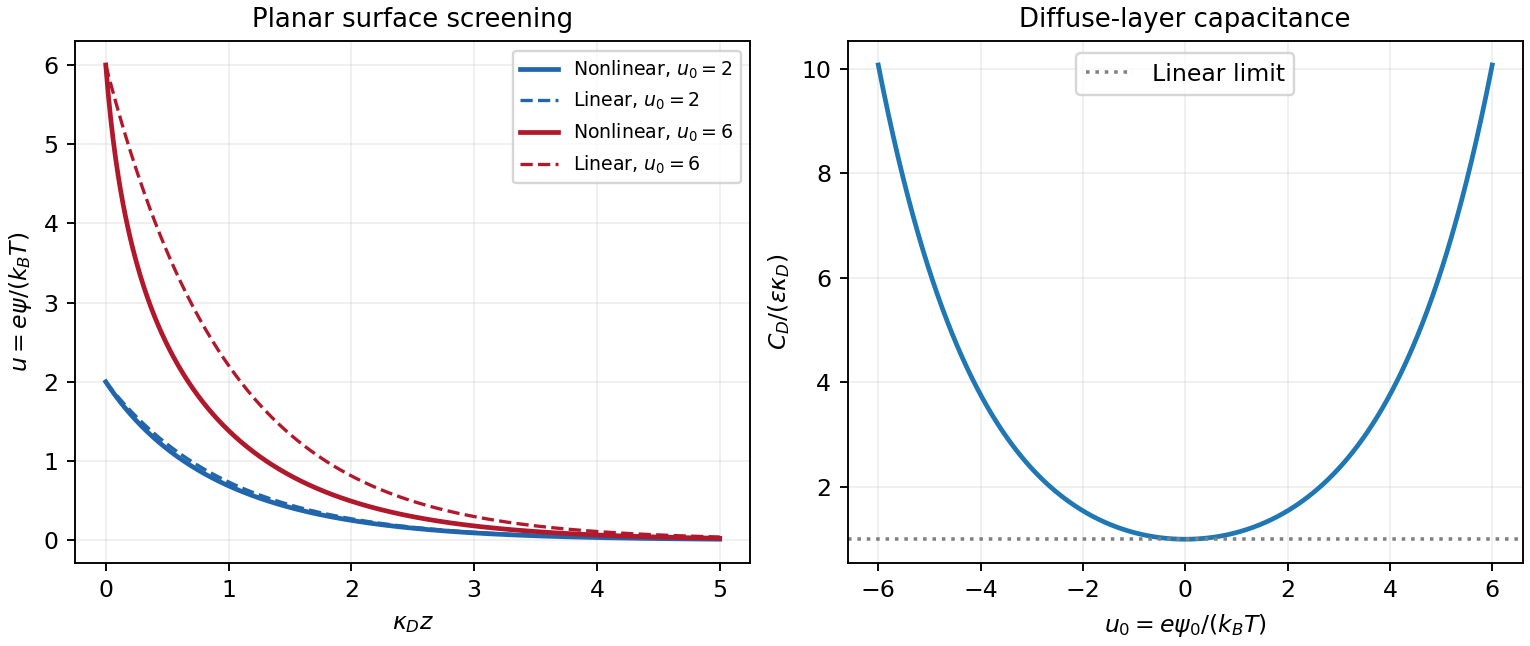
Original linear and nonlinear planar screening profiles and diffuse-layer capacitance
. Details. 
Articles by others on the same topic
There are currently no matching articles.