The released 2015 paper uses this historical course title. Generic physical and mathematical parts are covered; biological questions remain deferred.
The released 2015 paper is linked in its paper section. Student-answer availability remains unverified; biology portions are deferred.
Write and take to be the reservoir density of each monovalent ion species. Equal electrochemical potentials in equilibrium give the Boltzmann ion densities in a symmetric electrolyte,Combining this with the electrostatic Poisson equation gives the planar Poisson-Boltzmann equation,The Debye length is . If the symbol instead denotes the combined density of both species, the factor two is absent; the per-species convention above makes the normalization explicit. At , the linearized planar screening solution obeys . With and ,
The positive ions are counterions and the negative ions are co-ions. At weak potential,They approach from above and below respectively, with equal first-order excess and deficit. For stronger negative potential, interpret the source's strong-potential comparison as a statement about , since itself is negative. Counterions become strongly concentrated near the wall, while co-ions are exponentially depleted and remain nonnegative. Linearization misses this asymmetry and would eventually predict unphysical negative co-ion density. Point-ion mean-field theory itself eventually needs finite-size and correlation corrections; it provides no steric cap at arbitrarily large counterion concentration.
For steady tangential electro-osmosis, with no imposed pressure gradient and negligible inertia, the Stokes equation is . Since ,The conditions and giveThe printed constant speed is the bulk velocity outside the double layer, not the velocity at the no-slip wall. With negative the positive counterion excess drives fluid along the applied field. The far-field value is the Helmholtz-Smoluchowski electro-osmotic velocity.[ref]
Induced-Charge Electro-osmosis and Electrophoresis by Martin Z. Bazant. Section1,page1: diffuse charge, slip velocity and plug-flow limit
For the finite channel, first model the added wall as an ideally uncharged insulating boundary with no normal field on its outer side: , while . The one-charged-wall electro-osmotic channel then hasIntegrating the same force balance and enforcing givesFor , the maximum occurs atIn that limit : the velocity rises rapidly from zero at the charged wall, reaches a maximum a few screening lengths away, then falls approximately linearly to zero at the neutral wall. One charged wall does not give a symmetric plug across a channel with no-slip at the other wall.
An alternative electrode condition means a wall held at reservoir potential; it is not the same as zero surface charge. Under that convention,with . Both boundary conventions have the same leading thin-double-layer profile above. An externally imposed pressure gradient would add a pressure-driven profile; none is specified here.
For dilute nonadsorbing uncharged polymers in equilibrium or sufficiently weak flow, the entropic polymer depletion near nonadsorbing walls suppresses chain configurations near each wall. A depletion layer of order the coil radius of gyration is expected at both walls, with a bulk-like central region when is much larger than the coil size. Strong confinement rounds this into a central enrichment. Neutrality removes a direct electrophoretic force, not excluded-volume entropy. Adsorption, concentration and strong-flow migration were not specified, so this is a conditional equilibrium sketch rather than a universal flowing-polymer profile.
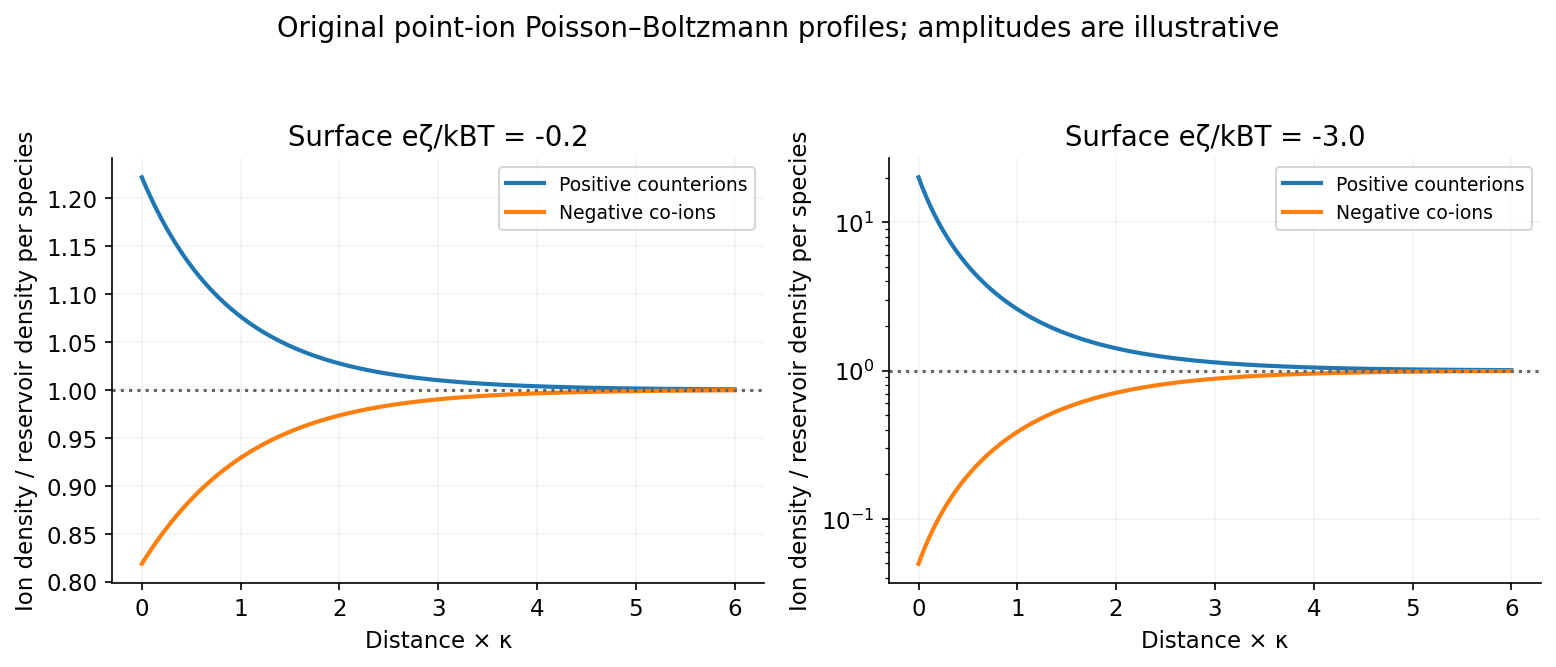
Weak screening gives symmetric first-order ion excess and deficit, while stronger potentials separate co-ion depletion from counterion accumulation
. Source. Details. 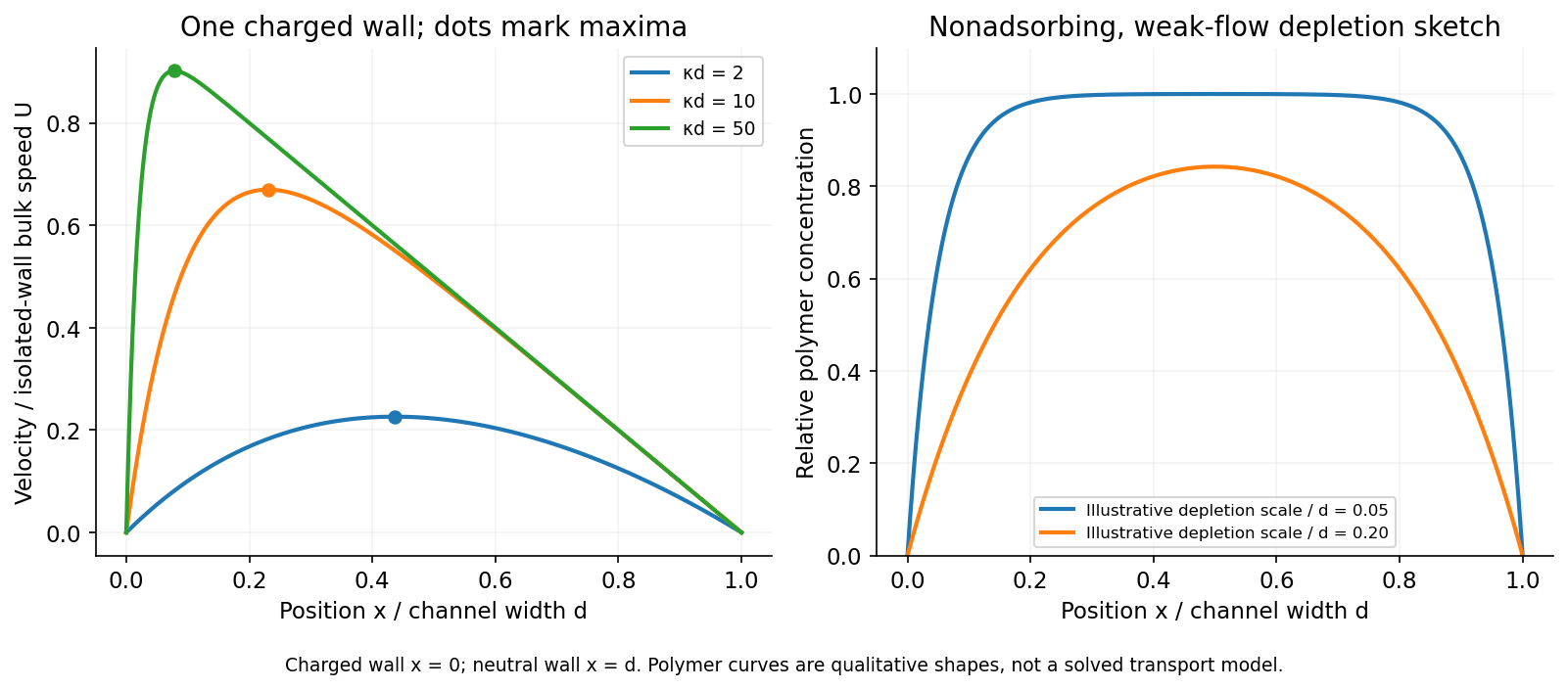
A channel driven at only one wall has an asymmetric velocity maximum; nonadsorbing polymer coils are depleted near either wall
. Source. Details. The generic instrument uses a magnetically responsive bead, a controllable external field and optical tracking of bead position or orientation. A field gradient supplies translational force; rotating an appropriate anisotropic field or bead moment can supply torque. For a permanent dipole,For an isotropic unsaturated induced moment with effective susceptibility contrast and bead volume , the induced magnetic bead force instead follows fromThe factor one-half accounts for inducing the moment. A spatially uniform field alone supplies no translational force; an isotropic induced moment parallel to the field supplies no orienting torque either. Saturation or magnetic anisotropy requires the corresponding magnetization model.
Position tracking needs a length calibration, and force calibration needs measured field gradients, a known reference load, or calibrated thermal fluctuations. For a generic tensioned tether of extension , small transverse displacement costs energy , so under equilibrium, small-angle and single-mode assumptions. Attachment geometry, bead rotation, wall drag and finite acquisition bandwidth can affect this calibration. These equations describe generic magnetic tweezers mechanics, without assigning a biological response.
TODO: biological single-molecule applications are user-deferred; no biological systems or protocols have been researched or solved.
Fluctuation-induced forces arise because separation changes the fluctuations available to a system and therefore changes its free energy. The force is at fixed relevant control variables, not necessarily a force from a permanent charge or dipole.
For two neutral polarizable particles, correlated electromagnetic fluctuations give a short-distance dispersion attraction of the form . Retardation changes the asymptotic distance dependence. Boundaries produce a related Casimir force; for parallel ideal conducting plates at zero temperature,The negative pressure denotes attraction. Material response, nonplanar geometry and finite temperature alter the ideal result. The effect can be described through the separation-dependent electromagnetic mode spectrum rather than by treating a divergent absolute vacuum energy as observable.[ref]
Quantum Field Theory by David Tong. Section2.3.2: Casimir effect and boundary-dependent fluctuation energy
In a classical depletion force, smaller particles or polymer coils are excluded from a region near larger surfaces. Overlap of excluded regions increases their available volume. For ideal dilute depletants of osmotic pressure , ; the resulting attraction is entropic and scales with temperature. Confined interface fluctuations can instead generate repulsion when close approach removes entropy. Near a continuous phase transition, a large correlation length makes boundary-conditioned order-parameter fluctuations produce a critical Casimir force. Its sign depends on the boundary preferences, so fluctuation forces are not universally attractive.
The useful common idea is a free-energy difference with explicit boundary conditions; quantum vacuum, thermal field and excluded-volume mechanisms have different physical fluctuations and different ranges.
A generic chemical reaction–diffusion system couples local kinetics to spatial transport:A homogeneous stationary state satisfies . Let its reaction Jacobian be . Local well-mixed stability requires and . A Fourier perturbation of wavevector magnitude evolves under , whose determinant isSince its trace remains negative, a diffusion-driven stationary instability appears if the determinant becomes negative for some allowed wavevector. In a spatially large domain the conditions areTogether with reaction-only stability, these give a finite unstable wavelength range. Equal diffusion coefficients cannot generate this instability: they simply shift each reaction eigenvalue by . On a finite domain, an admissible spatial eigenmode must actually lie in the unstable band. Nonlinearities then determine saturation and whether a predicted pattern is stable, so a linear unstable band alone does not calculate a final pattern.[ref]
Other kinetics support travelling fronts or oscillatory waves rather than a stationary pattern. For instance, the scalar abstract equation has a pulled-front speed for a sufficiently steep invading initial profile. Here it is used as an abstract kinetics-and-diffusion example, without a biological interpretation. The ratio of diffusion time to reaction time characterizes whether spatial mixing is rapid enough to justify a well-mixed model.
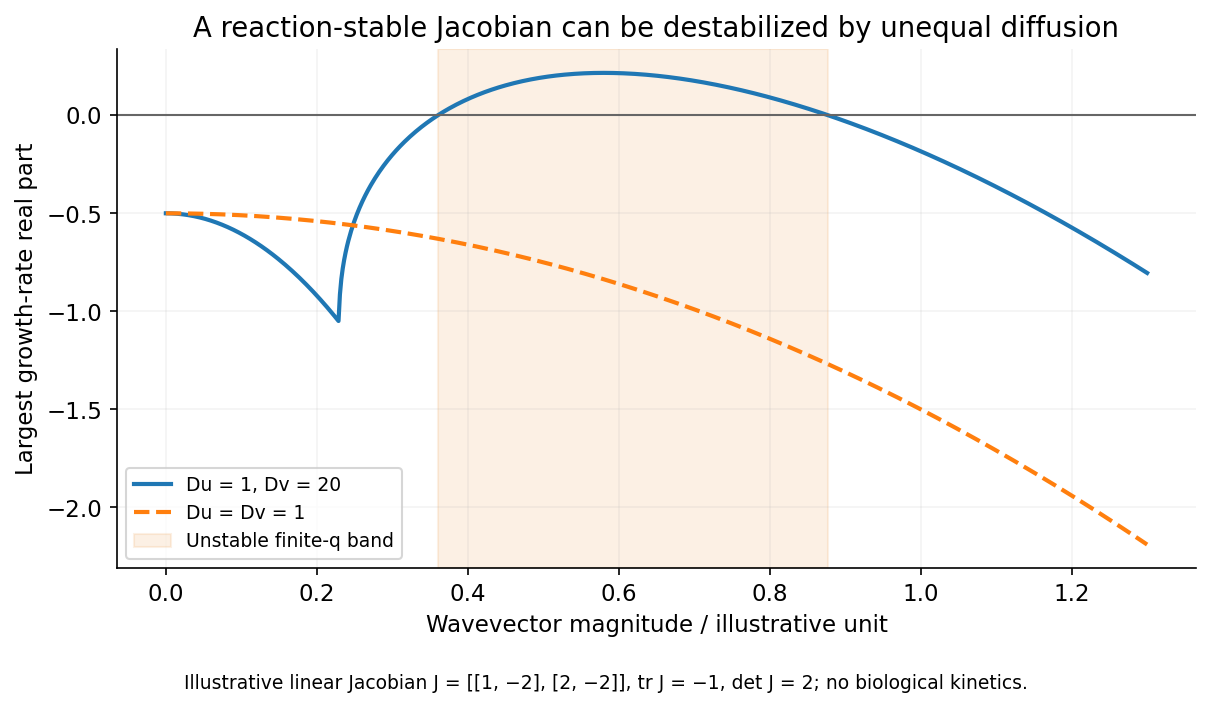
Differential diffusion can destabilize a finite band even when the uniform reaction system is linearly stable
. Source. Details. Only the separable instrument and mechanical tasks are treated here; biological operation and stepping energetics remain deferred.
For generic optical tweezers, a tightly focused laser and objective with high numerical aperture create an intensity gradient that attracts a suitable dielectric bead toward the focus. Momentum transfer also creates a scattering force; stable three-dimensional trapping requires sufficient restoring gradient force. A condenser and photodetector or camera track displacement. Near a stable focus, defines the stiffness and requires both a position calibration and a force calibration.[ref]
Observation of a single-beam gradient force optical trap for dielectric particles by Arthur Ashkin and others. Single-beam gradient trapping of dielectric particles
At thermal equilibrium in a harmonic well, the equipartition trap calibration is . Alternatively, fitting the overdamped harmonic-trap power spectrum gives , hence . Detector noise, finite sampling and exposure time, wall corrections to drag, and drift must be controlled rather than attributed to stiffness.
For an isolated sphere in a Newtonian fluid, define using its diameter. The supplied viscosity converts to . The generic Stokes drag calculation givesHere ; this retains the unspecified fluid density as a parameter rather than treating a density as supplied data. Stokes drag assumes an isolated no-slip sphere; nearby surfaces change the coefficient. TODO: the requested assessment of biological motor operation is deferred.
TODO: the biological stepping-energy and step-detection estimate is deferred in its entirety; no biological energy source or motor mechanism has been researched.
Ignoring biological coupling, the mechanical thermal model is the Langevin equation for a harmonic trap,For independent repeats with the specified initial conditions, the ensemble mean obeys the homogeneous damped-oscillator equation. An average over independent zero-mean force samples reduces its variance by , with a finite detector bandwidth needed to define samples of white noise. High bandwidth alone does not remove random forces; averaging independent records or sufficiently separated samples is the additional operation. A single trajectory retains thermal fluctuations. For stationary overdamped position fluctuations, a long time average over duration has approximately .
The initial-value solution of a damped harmonic trap has characteristic roots . For distinct roots,For critical damping, ,For the underdamped case the same real solution can be written , with . These describe the deterministic response or conditional mean, not the entire noisy trajectory.
For overdamped trap relaxation after an inertial boundary layer, let . The slow and fast roots areAfter , the fast exponential is negligible and the surviving amplitude is . If also , then to leading overdamped orderSmall Reynolds number justifies the linear viscous force; it does not alone prove the separate small inertial-trap parameter . Neglecting requires both rapid momentum relaxation and a negligible slow-mode amplitude shift. If , a nonzero initial velocity can leave a small slow displacement even after its own fast transient decays. The result concerns generic bead mechanics only.
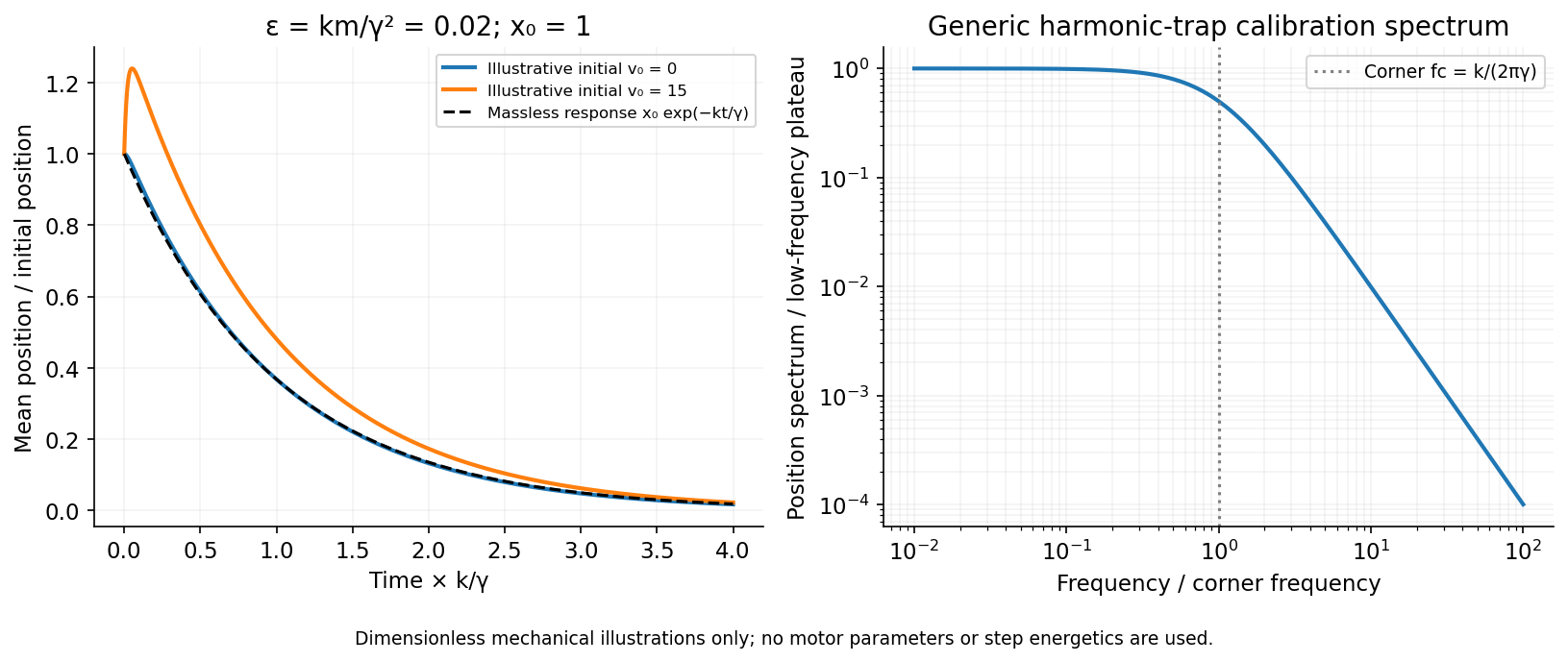
Fast momentum relaxation leaves a slower trap mode, whose amplitude can still remember a sufficiently large initial velocity
. Source. Details. Original paper: 13 January 2014, physical PDF pages 658–660.
velocity , length and diffusivity have dimensions , , and . Their dimensionless Péclet number isdiffusion dominates for , advection for . At fixed , the crossover length is ; neglecting advection requires .
TODO: user-deferred organism-specific swimming-speed and detection-scale estimates. No biological numerical substitution is made.
For the generic equilibrium transport derivation, let an external potential give force and drift . Boltzmann equilibrium has , hence . Substituting in the zero-current condition givesThe Stokes–Einstein relation in the final equality is for an isolated no-slip sphere in a Newtonian liquid at low Reynolds number. Zero flux alone is insufficient: the equilibrium distribution and mechanical mobility law are also needed.
TODO: user-deferred organism-specific absorbing-surface calculation and its biological flux interpretation.
TODO: user-deferred receptor-number, receptor-density and receptor-competition calculations. These continuations have not been solved.
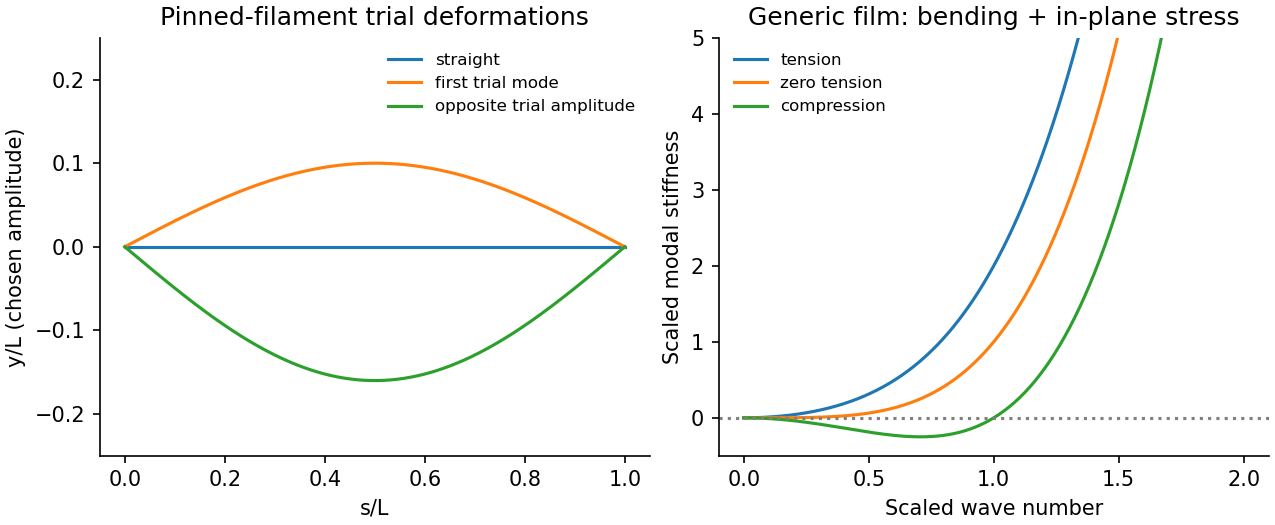
Consider generic synthetic filaments and films. buckling occurs when compression makes a transverse deformation lower the energy. For a straight filament of bending rigidity under compressive force ,Pinned ends admit , giving . The first instability is therefore . True clamping raises this to ; a clamped-free rod has . boundary conditions are part of the threshold, not a minor correction. Above threshold geometric nonlinearities and end constraints determine the buckled amplitude.
For buckling of a synthetic film, let the bending modulus be and the isotropic in-plane tension be . The small-slope quadratic energy isA mode of wave number has stiffness . tension stabilizes it; compression corresponds to and makes modes with unstable. A finite sheet has a smallest allowed , giving a finite threshold. A supporting foundation adds positive stiffness and can select a nonzero wrinkle wavelength.
Approaching either threshold softens a fluctuation mode: its thermal variance is proportional to divided by modal stiffness. The apparent quadratic-theory divergence is rounded by nonlinear geometry, finite size and imperfections. Experimentally vary end shortening or load, measure the transverse profile, and control attachment stiffness and initial curvature. Load control and displacement control need not trace the same postbuckling response. Biological applications are outside this generic mechanics note.
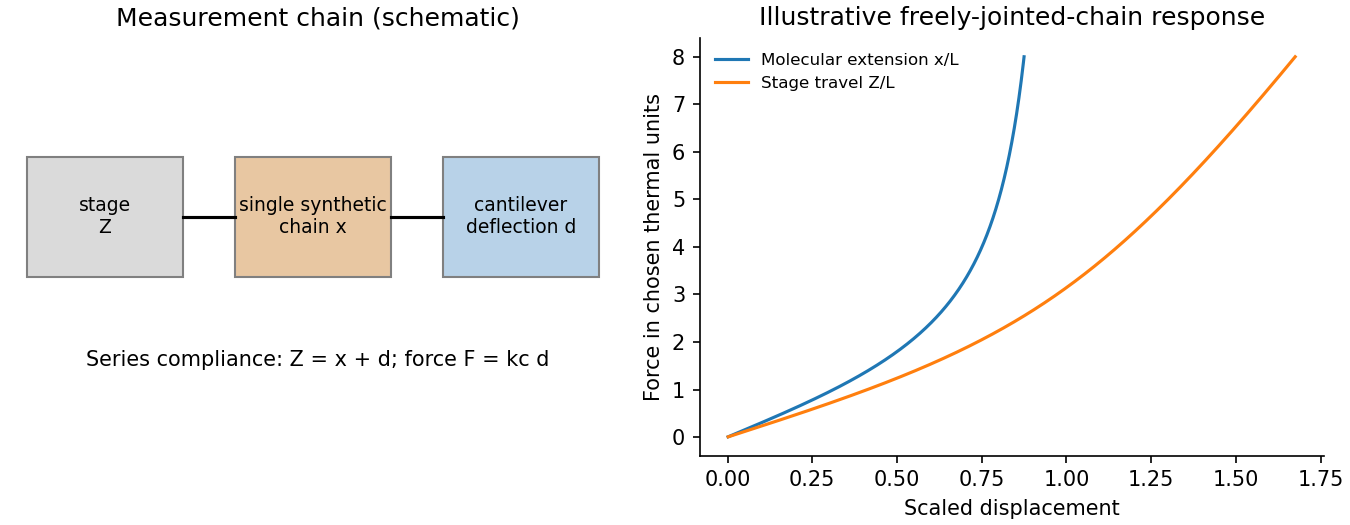
single-molecule force spectroscopy measures force and extension of an individual tether while controlling position or load. In an atomic-force arrangement, a synthetic chain connects a cantilever probe to a translated substrate. For the cantilever compliance correction, a deflection sensor gives , a calibrated spring constant gives , and substrate displacement gives chain extension after geometric offsets are removed. Additional linkers and instrument compliance must be included if appreciable. Thermal deflection calibration uses only after isolating the cantilever's calibrated thermal contribution.
An optical-tweezers implementation detects a tethered bead's displacement from a calibrated trap centre, with in the harmonic regime. Detector calibration, drag and trap linearity determine the usable force and frequency range. These instruments measure individual force–extension curves and distributions; averaging many curves can hide multiple tether populations.
For a synthetic freely jointed chain with Kuhn length ,A strongly stretched worm-like chain instead has before backbone stretching becomes important. Fits can estimate contour and persistence lengths only in their appropriate regimes. Hysteresis and pulling-rate dependence test whether an apparent mechanical transition is quasistatic or activated.
Control single versus multiple attachments, subtract nonspecific adhesion, vary pulling speed, calibrate temperature and stiffness, and correct drift. A rupture peak is not a universal bond strength independent of loading history. A primary nonbiological example measured individual polydimethylsiloxane chains by atomic-force methods; its flexibility interpretation combines those measurements with molecular calculations.[ref]
TODO: user-deferred biological kinetic mechanism and its biochemical pattern-forming applications. The remainder treats generic two-field reaction-diffusion physics only.
Let obey . At a uniform steady state, write its reaction Jacobian as . Without diffusion stability requires and . A Fourier perturbation evolves under , whose determinant isIts trace becomes more negative with increasing . A stationary diffusion-driven instability therefore requireswith an allowed domain mode in the resulting negative-determinant band. Equal diffusivities cannot satisfy this while . The physical mechanism is that transport can destabilize coupled fields even when the local kinetics relaxes a spatially uniform perturbation. Faster diffusion of an inhibitory response is one possible realization.
The selected wave numbers depend on growth rates and boundaries; nonlinear saturation determines the final stripes, spots or other states. Linear instability alone neither supplies a biochemical mechanism nor uniquely predicts a final finite-amplitude pattern.
Let the channel length be and assume uniform solution conductivity. Its Ohmic resistance scales as , whereas access resistance of a reservoir mouth scales as . The fraction of voltage in the entrance regions is therefore of order . Most of the potential drop lies inside the long channel; the small entrance field region is neglected in the model, not asserted identically zero.
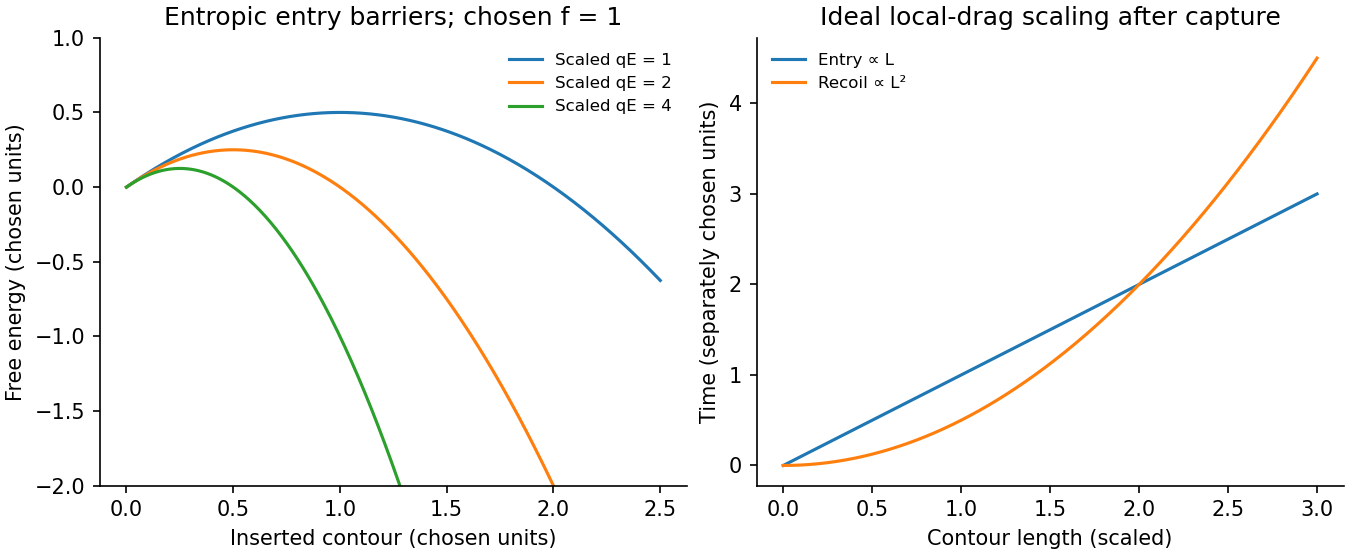
Write for inserted contour length and choose to pull the chain inward. The charge already inside feels force , givingConfinement removes polymer configurations. In the stiff-chain regime, the confinement deflection length obeys , hence . A free-energy cost of order per deflection gives a roughly constant resisting entropic force . The insertion barrier of a charged polymer follows from , with an entry maximum at when that point lies within the insertion interval. Its height is . The field supplies work against this confinement entropy.
Put , so . After capture, neglect the entry barrier, exterior-chain drag and thermal corrections to strong directed motion. ThenThe confined-polymer entry and recoil times have different length dependence; this entry graph is linear through the origin. Charge and drag both grow with inserted length, leaving a constant velocity. The same cancellation explains length-independent mobility in an ideal free-draining electrophoresis model. It does not include a capture waiting time or claim that every free-solution chain has identical hydrodynamic drag.
A measured superlinear entry time can arise when exterior-coil drag, tension propagation, wall adsorption or nonuniform friction adds length dependence absent from this model. For example with the same drive gives for . Under the assumptions of uniform wall charge and polymer entry scaling, a homogeneous thin-double-layer electro-osmotic model adds a length-independent fluid velocity . It changes the drift coefficient, not its length exponent. This does not rule out charge heterogeneity, adsorption or near-cancellation followed by diffusion in a real channel; those are additional mechanisms.
With the field off, the confinement entropy drives outward motion. Assuming the constant force and the same local friction,The small final end region lies outside the long-confined-segment approximation but gives only a small correction. Thus ideal insertion scales as , while recoil scales as .
TODO: user-deferred DNA-specific numerical stopping-voltage estimate and its biological parameter-based inference. No biological quantities are evaluated.
For entropic-trap length separation, a reservoir/channel array can repeat length-dependent capture, confinement and relaxation delays, turning them into different mean residence times. The uniform inside-channel drift speed derived above is itself length independent, so that drift alone cannot separate lengths. Separation must retain length dependence of the barrier or of the capture/recoil dynamics and can be tuned with a forward-biased time-dependent field. For large bulk throughput, pressure-driven advection is preferable to diffusion alone; a pressure gradient can be combined with electric capture control. In the unobstructed continuum limit . Excessive driving erases trapping differences, so throughput and resolution compete; the question supplies no geometry or adsorption law selecting a unique optimal drive.


Original paper: Public original, physical PDF pages 567–569.
For the generic instrument, magnetic tweezers combine a magnetically responsive bead, a controllable magnetic field gradient, a tether attached to a fixed support, and optical tracking of bead coordinates. For a fixed magnetic dipole moment, the force is ; an induced linear isotropic moment instead gives . A uniform magnetic field can orient an anisotropic bead, but a gradient is needed for translation. Magnet height sets the load, while field rotation can impose torque if bead orientation is coupled to the field. Tracking uses lateral images and a calibrated axial image/defocus response; a fixed reference removes stage drift. A sufficiently slowly varying gradient approximates a force clamp over the bead's displacement. TODO: user-deferred biomolecular implementation; DNA-specific attachment, preparation and response are not treated.
For transverse-fluctuation calibration of a tensioned tether, use an ideal tether of vertical extension whose endpoint is displaced by small . Keeping its length fixed to quadratic order lowers its vertical coordinate by , increasing load potential by . The equipartition theorem therefore givesHere fluctuations are about the mean. The height is the effective pendulum length of the measured coordinate, not automatically the polymer contour length. The displayed formula uses the point-endpoint or fixed-bead-orientation idealization; freely rotating large beads can require a bead-radius correction to that lever arm. The finite-exposure correction to fluctuation force calibration restores variance lost through exposure averaging; ignoring it would overestimate force; localization noise increases it and would underestimate force. Drift, wall coupling, finite observation time and magnetic lateral stiffness must be checked. Vertical fluctuations measure longitudinal stiffness and do not obey the same geometrical formula.
For the stretch and twist coefficients of an elastic filament, take as reference contour length and as local axial strain. The three positive quadratic costs represent bending of the tangent, stretching of the material and excess twist about its relaxed orientation. With the paper's coefficient convention, are bending and torsional rigidities with units of energy times length; is an axial force modulus. Thus have units of length and inverse length. Positive quadratic forms describe a stable relaxed filament; odd terms vanish when expansion is about its zero-stress, zero-torque reference configuration.
At weak and intermediate tension, changing thermal bending conformations can extend the filament without appreciably stretching the backbone. Axial strain is , so material stretching must be included when this is no longer negligible. For a long strongly aligned but nearly inextensible three-dimensional worm-like chain, the thermal extension deficit is approximately ; stretch adds approximately to fractional extension. Twist matters whenever torque or imposed end rotation is present, at any tension. A freely swivelling, torque-free tether need not store excess twist. There is no universal force-only threshold for switching on torsional energy.
The circular bending energy of an elastic filament follows because curvature is over contour length . Integrating the bending term givesThis is bending energy alone: imposed tension, stretching and twist would add costs. The dimensionless bending action is . Its tangent propagator in three dimensions obeys rotational diffusion on the unit sphere, . The vector spherical harmonic has angular eigenvalue , givingHence is the persistence length in this three-dimensional convention. A strictly planar filament instead has tangent-correlation length ; one cannot infer the factor merely by setting a loop's energy equal to .
TODO: user-deferred biomolecular applications. Both enzyme-driven unwinding experiments, their experimental sketches, the requested numerical force and plectoneme radius, energy loss per turn and enzyme-specific dissipation mechanisms remain unsolved. None of their biomolecular parameters has been used in a calculation.
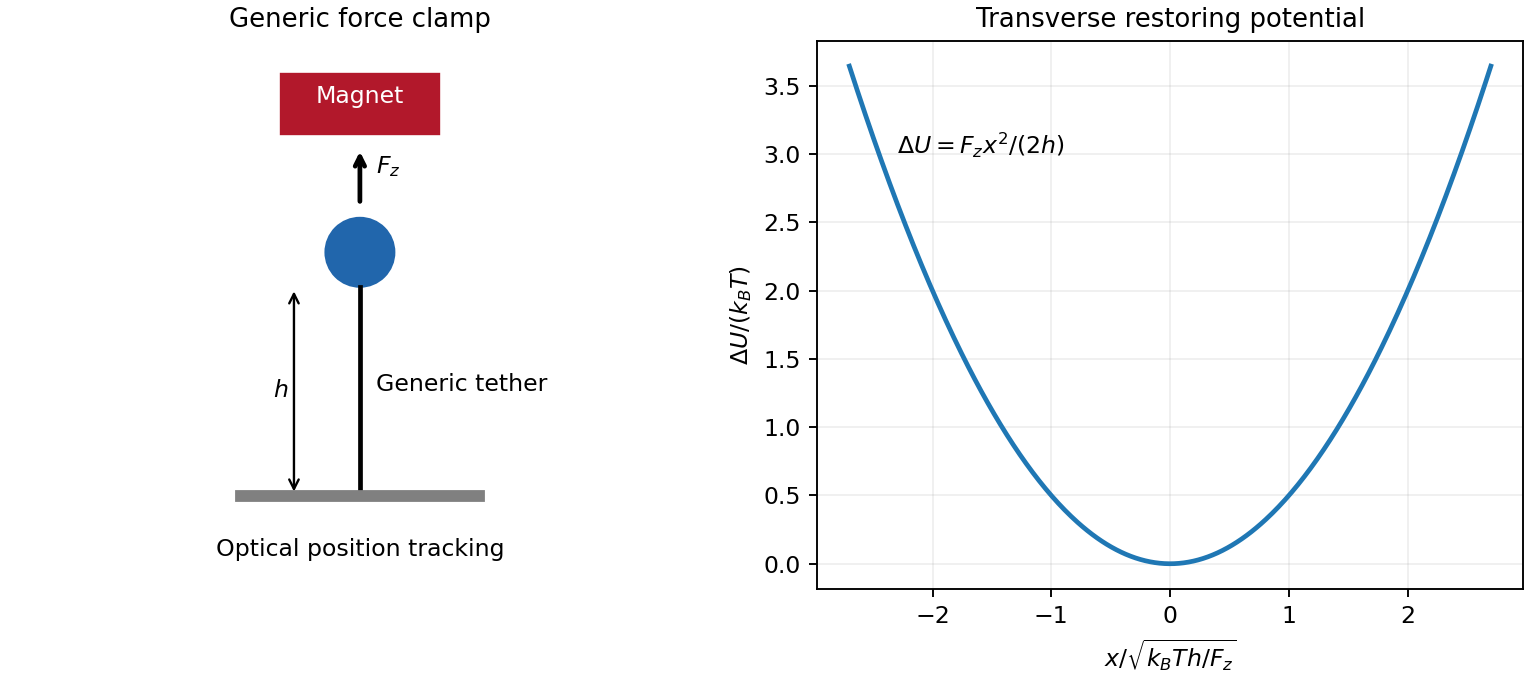
Original generic magnetic-tether instrument and its transverse fluctuation calibration
. Details. 
Use a force-tilted activation barrier for a generic one-coordinate escape model. A tensile force tilts a free-energy landscape to . If is the initial minimum and the saddle, define and the zero-force barrier . The relevant activation barrier is measured relative to the initial minimum, not an arbitrary absolute transition-state energy. To first order in force,The attempt prefactor is assumed force independent, and the saddle displacement is approximated as constant. This single-barrier approximation need not survive large landscape deformations or a change of escape pathway. TODO: user-deferred biomolecular implementation; the protein-specific shear-force arrangement and attachment chemistry are not solved.
For a generic force-ramp measurement, a calibrated atomic force microscope cantilever pulls an attachment while a stage changes separation. cantilever deflection gives force , and the cantilever compliance correction subtracts from imposed separation to give tether extension, with further corrections for other apparatus compliance. A prescribed stage speed does not automatically produce constant force loading rate when tether stiffness varies; the assumed must be measured or controlled. The original schematic below illustrates a generic nonbiological bond/tether geometry. Protein-specific construction is deferred.
The no-rebinding approximation is a physical escape assumption: after the link breaks, separation removes the partners from the capture region before appreciable reassociation. It requires the integrated return/association probability during that separation to be small. If the separated state stays nearby or the force is held without separation, setting can fail. Under the stipulated approximation, with the link initially intact,This survival under a linear force ramp differs from the probability density for rupture. It starts at one, decreases to zero and shifts to larger force as the loading rate increases. For small , ; a slow ramp allows much escape before substantial force is reached.
The median rupture force under a linear ramp satisfies , givingAt high loading rate, the slope of against tends to ; it is not exactly for a slow ramp. Fit the full expression across loading rates to recover and . The rupture-force probability density is , whose most probable rupture force under a linear ramp is if , and zero otherwise. median and mode are different observables and must not be interchanged when fitting.
At known temperature, yields the activation distance ; gives the zero-force mean lifetime in this exponential model. Absolute barrier height additionally requires the attempt prefactor, and neither equilibrium binding free energy nor an association rate follows from dissociation-only data. A loading-rate-dependent rupture force is a kinetic readout, not an intrinsic equilibrium strength. TODO: user-deferred biological conclusions. The protein-specific stability interpretation and cell-adhesion strategy are left unsolved.
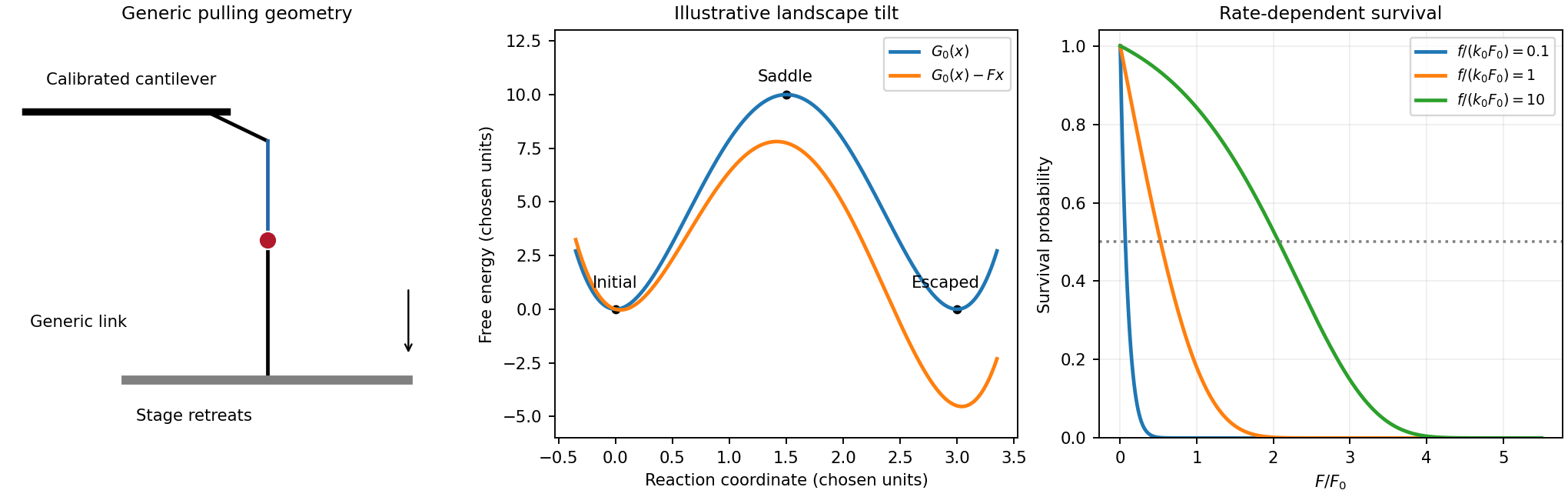
Original generic pulling arrangement, tilted energy landscape and calculated survival under a force ramp
. Details. 
In gel sieving of synthetic polymers, gel electrophoresis combines drift under an electric field with size- and conformation-dependent obstruction by a porous matrix. In weak-field free solution, force balance gives and, in a simple effective-charge/effective-friction model, . The mobility is motion relative to the medium, so fluid motion from electro-osmosis must be accounted for separately. This is the operational mobility convention, not a claim that the bare structural charge is always the effective driving charge.[ref]
IUPAC Compendium of Chemical Terminology, fifth edition (Gold Book) by International Union of Pure and Applied Chemistry. entry E02024, electrophoretic mobility: migration speed divided by electric field strength
For a chain with free-draining polymer friction with approximately constant effective electric charge per segment, both charge and friction scale with . The free-solution mobility can therefore become nearly independent of length, making size separation poor. A gel adds steric constraints. Coils smaller than the mesh can pass relatively easily; larger coils require deformation and pore-to-pore rearrangement. A schematic weak-sieving law is , where matrix concentration and retardation coefficient are defined by a calibration; it is not a universal size law.
When a long flexible charged polymer is confined to a tube of available paths, reptation supplies another regime. An additive-friction model gives contour diffusion and renewal time . For ideal large-scale chain statistics, , so centre-of-mass diffusion scales as . With total effective driving charge proportional to , weak-field mobility can then scale as . This assumes screened/ideal large-scale conformations and linear response; strong-field alignment, trapping and nonideal matrices can alter the scaling.
Operationally, load narrow zones of independently characterized synthetic standards and sample into a controlled gel, apply a known field and detect migration positions after a measured time. Compare with a free-solution measurement, vary matrix concentration and field, and control temperature, ionic strength, pH and matrix charge. Larger gel pores or lower matrix concentration usually reduce sieving within a given calibrated material system. Excessive field causes Joule heating and can change conformation and mobility. adsorption or electro-osmotic drift can mimic a size effect; standards should match charge chemistry and topology as well as nominal mass.
Band centres move as while ordinary diffusion gives . Resolution depends on separation of centres relative to band widths, not travel distance alone. A neutral tracer helps identify bulk flow, and multiple concentrations test adsorption or overloading. A mobility or band position does not uniquely determine size without a regime-specific calibration. TODO: biomolecular examples, sample preparation and biological applications are user deferred; the account here concerns synthetic charged polymers only.
Use SI units, uniform absolute permittivity and a neutral bulk reservoir. Local equilibrium of ideal mobile ions gives . Combining their charge with the Poisson equation yieldsThe reference is in the bulk. Boundary data specify fixed charge, fixed potential or a surface reaction/charge regulation law. These are physically different problems. The mean-field theory assumes point ions, thermal equilibrium and a continuum solvent; ion-size packing, dielectric structure and strong electrostatic correlations can invalidate it.
For a symmetric monovalent electrolyte let count each sign and define , . Outside fixed sources,For , the Debye-Hückel approximation is . A planar wall bounding electrolyte in has ; assuming zero field on the other side, its charge is . A sphere of radius and total charge instead givesThe factors arise from geometry and boundary conditions; planar screening cannot be substituted unchanged for a small sphere. The weak-potential condition must hold where the potential is largest, particularly at the surface.
The nonlinear planar Poisson-Boltzmann profile is also exactly integrable. Multiply by and use at infinity:The sign selects a profile decaying to the bulk for either sign of surface potential. Integration givesFor weak this reduces to the linear solution. Strong surface potentials have a bounded far-field amplitude , while the near-wall ion density still grows strongly. There is no need to permit the negative ion densities produced by an invalid extrapolation of a linearized density formula.
The same first integral yields the Grahame equation and its diffuse-layer differential capacitance per unit area:These describe the diffuse layer. A compact interfacial layer adds a voltage drop and can place its capacitance in series with ; a measured electrode capacitance need not equal the ideal diffuse contribution.[ref]
The Electrical Double Layer and the Theory of Electrocapillarity by David C. Grahame. section VI, printed pp. 470–474, especially equations (31)–(48); diffuse charge and differential versus integral capacitance
For comparison, a planar counterion-only double layer next to a negative plane has positive counterions and no salt reservoir. Its profile is algebraic:Integrating over gives , checking charge neutrality. This problem cannot be obtained by putting a finite reservoir density into the symmetric-electrolyte answer without changing its boundary conditions.
Applications include screening around synthetic colloids, diffuse-layer electrode capacitance and forces between charged plates. In planar geometry, the bulk-subtracted normal stress is constant:At the midpoint of identical plates, symmetry sets , so the remaining excess ionic osmotic pressure determines their repulsion. A comparison with force or capacitance measurements should vary salt and surface potential independently, test charge regulation and adsorption, and distinguish compact-layer effects from failures of diffuse screening. Nonlinear Poisson-Boltzmann theory retains finite-potential Boltzmann populations, but still omits correlations and finite-ion-volume saturation.
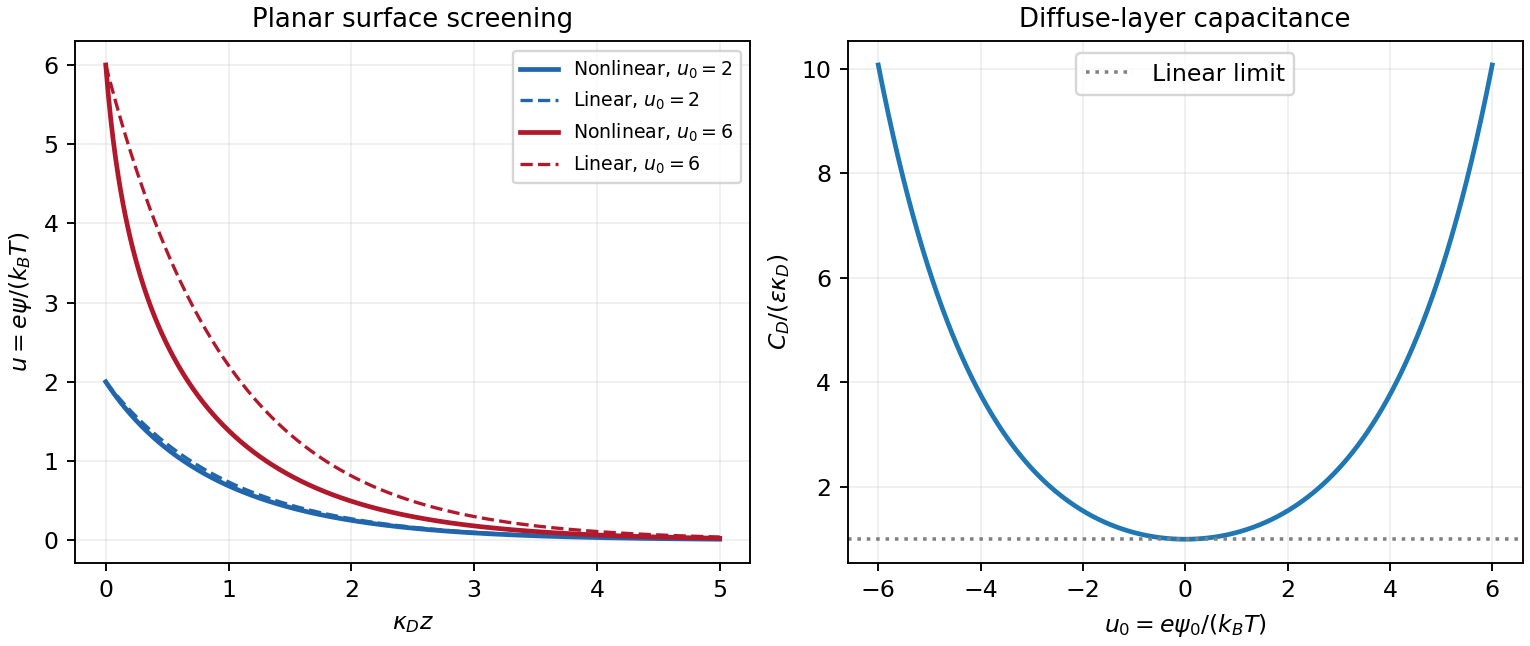
Original linear and nonlinear planar screening profiles and diffuse-layer capacitance
. Details. 
Articles by others on the same topic
There are currently no matching articles.