In gel sieving of synthetic polymers, gel electrophoresis combines drift under an electric field with size- and conformation-dependent obstruction by a porous matrix. In weak-field free solution, force balance gives and, in a simple effective-charge/effective-friction model, . The mobility is motion relative to the medium, so fluid motion from electro-osmosis must be accounted for separately. This is the operational mobility convention, not a claim that the bare structural charge is always the effective driving charge.[ref]
IUPAC Compendium of Chemical Terminology, fifth edition (Gold Book) by International Union of Pure and Applied Chemistry. entry E02024, electrophoretic mobility: migration speed divided by electric field strength
For a chain with free-draining polymer friction with approximately constant effective electric charge per segment, both charge and friction scale with . The free-solution mobility can therefore become nearly independent of length, making size separation poor. A gel adds steric constraints. Coils smaller than the mesh can pass relatively easily; larger coils require deformation and pore-to-pore rearrangement. A schematic weak-sieving law is , where matrix concentration and retardation coefficient are defined by a calibration; it is not a universal size law.
When a long flexible charged polymer is confined to a tube of available paths, reptation supplies another regime. An additive-friction model gives contour diffusion and renewal time . For ideal large-scale chain statistics, , so centre-of-mass diffusion scales as . With total effective driving charge proportional to , weak-field mobility can then scale as . This assumes screened/ideal large-scale conformations and linear response; strong-field alignment, trapping and nonideal matrices can alter the scaling.
Operationally, load narrow zones of independently characterized synthetic standards and sample into a controlled gel, apply a known field and detect migration positions after a measured time. Compare with a free-solution measurement, vary matrix concentration and field, and control temperature, ionic strength, pH and matrix charge. Larger gel pores or lower matrix concentration usually reduce sieving within a given calibrated material system. Excessive field causes Joule heating and can change conformation and mobility. adsorption or electro-osmotic drift can mimic a size effect; standards should match charge chemistry and topology as well as nominal mass.
Band centres move as while ordinary diffusion gives . Resolution depends on separation of centres relative to band widths, not travel distance alone. A neutral tracer helps identify bulk flow, and multiple concentrations test adsorption or overloading. A mobility or band position does not uniquely determine size without a regime-specific calibration. TODO: biomolecular examples, sample preparation and biological applications are user deferred; the account here concerns synthetic charged polymers only.
Use SI units, uniform absolute permittivity and a neutral bulk reservoir. Local equilibrium of ideal mobile ions gives . Combining their charge with the Poisson equation yieldsThe reference is in the bulk. Boundary data specify fixed charge, fixed potential or a surface reaction/charge regulation law. These are physically different problems. The mean-field theory assumes point ions, thermal equilibrium and a continuum solvent; ion-size packing, dielectric structure and strong electrostatic correlations can invalidate it.
For a symmetric monovalent electrolyte let count each sign and define , . Outside fixed sources,For , the Debye-Hückel approximation is . A planar wall bounding electrolyte in has ; assuming zero field on the other side, its charge is . A sphere of radius and total charge instead givesThe factors arise from geometry and boundary conditions; planar screening cannot be substituted unchanged for a small sphere. The weak-potential condition must hold where the potential is largest, particularly at the surface.
The nonlinear planar Poisson-Boltzmann profile is also exactly integrable. Multiply by and use at infinity:The sign selects a profile decaying to the bulk for either sign of surface potential. Integration givesFor weak this reduces to the linear solution. Strong surface potentials have a bounded far-field amplitude , while the near-wall ion density still grows strongly. There is no need to permit the negative ion densities produced by an invalid extrapolation of a linearized density formula.
The same first integral yields the Grahame equation and its diffuse-layer differential capacitance per unit area:These describe the diffuse layer. A compact interfacial layer adds a voltage drop and can place its capacitance in series with ; a measured electrode capacitance need not equal the ideal diffuse contribution.[ref]
The Electrical Double Layer and the Theory of Electrocapillarity by David C. Grahame. section VI, printed pp. 470–474, especially equations (31)–(48); diffuse charge and differential versus integral capacitance
For comparison, a planar counterion-only double layer next to a negative plane has positive counterions and no salt reservoir. Its profile is algebraic:Integrating over gives , checking charge neutrality. This problem cannot be obtained by putting a finite reservoir density into the symmetric-electrolyte answer without changing its boundary conditions.
Applications include screening around synthetic colloids, diffuse-layer electrode capacitance and forces between charged plates. In planar geometry, the bulk-subtracted normal stress is constant:At the midpoint of identical plates, symmetry sets , so the remaining excess ionic osmotic pressure determines their repulsion. A comparison with force or capacitance measurements should vary salt and surface potential independently, test charge regulation and adsorption, and distinguish compact-layer effects from failures of diffuse screening. Nonlinear Poisson-Boltzmann theory retains finite-potential Boltzmann populations, but still omits correlations and finite-ion-volume saturation.
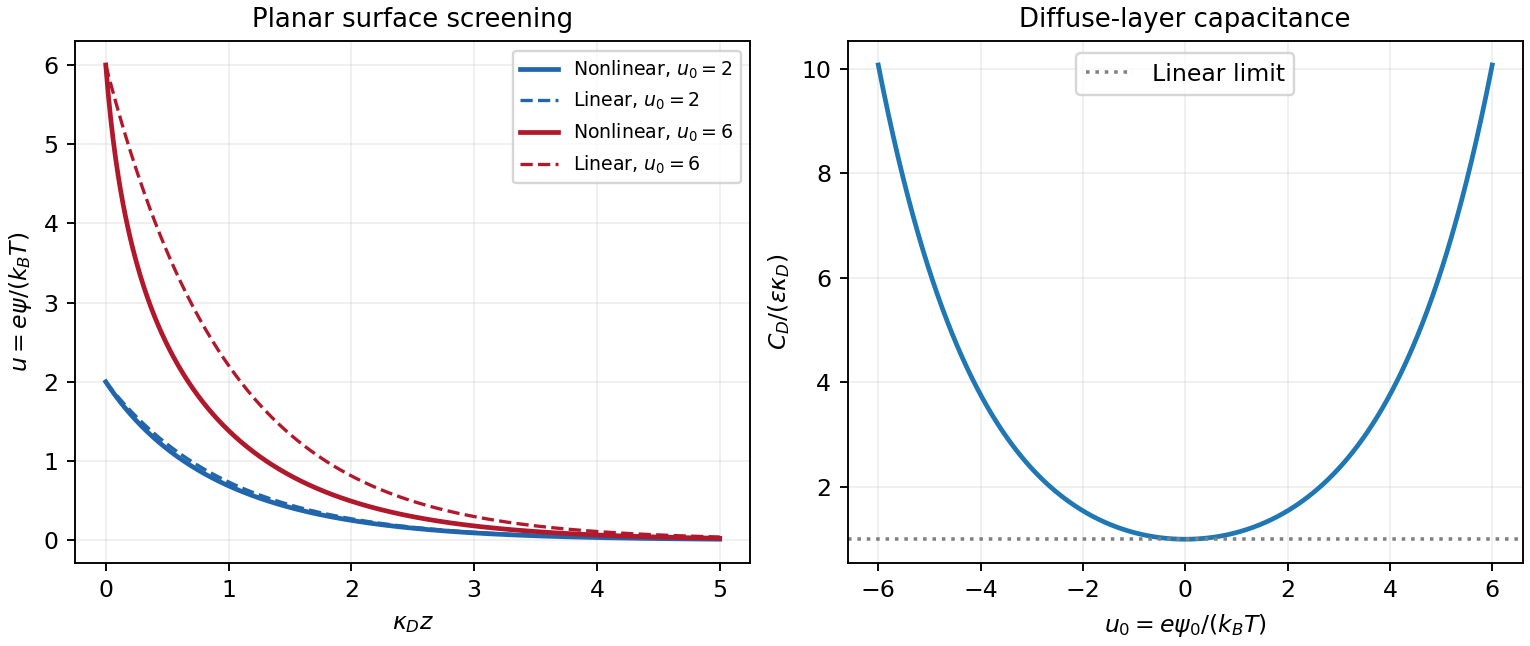
Original linear and nonlinear planar screening profiles and diffuse-layer capacitance
. Details. 
Articles by others on the same topic
There are currently no matching articles.