A deformation maps a material point in the reference body to its current position, , with deformation gradient . A homogeneous deformation has constant gradient and is affine, .
If , the matrix is symmetric positive definite. The matrix-square-root theorem says that any such matrix has a unique symmetric positive definite square root, obtained by taking positive square roots in its orthogonal spectral decomposition. SetThen and , so and . If also , then ; uniqueness of the positive square root gives and then . This proves existence and uniqueness of polar decomposition.
The principal stretches are the positive eigenvalues of , equivalently the singular values of or square roots of the eigenvalues of .
For , differentiation gives and . HenceThe two matrices are the orthogonal projections onto the tangent plane of the reference sphere and its radial line. The gradient multiplies the radial direction by and each tangent direction by . With positive , it is itself symmetric positive definite, so its eigenvalues are its principal stretches:
The determinant condition is , or . Integration gives and the outer boundary value fixes . ThusFor , tends to the positive cavity radius as . Its tangential stretches grow like that radius divided by , so . The deformation is singular at the origin and is interpreted as a finite-energy Sobolev deformation, with a point value irrelevant to its energy.
Since and the determinant penalty is zero almost everywhere,For fixed , the first integrand is near zero and the second is bounded. Thus the energy is finite despite the unbounded gradient. In particular the gradient is square integrable, as required for this competitor.
For large , uniformly on . The first integral is , while . ConsequentlyThe spherical volume factor is what makes the tangential-gradient singularity integrable in three dimensions.
Choose the homogeneous dilation , which has the required endpoint values. For a radial field, put . The radial energy density, after omitting its constant angular factor, is . Its Euler equation simplifies toThe chosen dilation has , constant, and satisfies it. More directly, the full first Piola-Kirchhoff response for the given energy isAt this is , constant throughout the body. Its divergence vanishes, so the deformation satisfies the full force-free equilibrium equations as well.
Its energy isThis grows like , whereas the same-boundary cavitating competitor has energy asymptotic to . Therefore for sufficiently large , the homogeneous equilibrium is not a global energy minimum in the finite-energy class admitting the cavitating deformation.
The admissible class matters: the competitor from the preceding part is not continuous at the center. This comparison is in that Sobolev class, not a claim about minimization restricted to smooth cavity-free deformations.
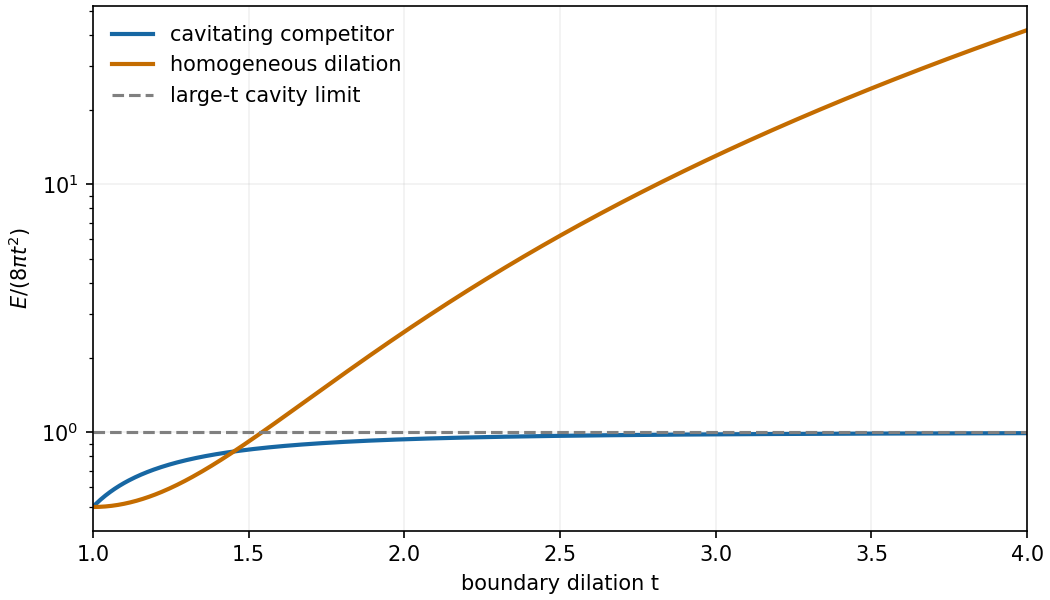
Energy comparison in the finite-energy class: the homogeneous dilation grows like t to the sixth power while the cavitating competitor grows quadratically
. Details. 
Articles by others on the same topic
There are currently no matching articles.