Original solutions to the paper released at the source request. The complete editable transcription is retained in the private examination archive.
A homogeneous hyperelastic material has a stored energy per reference volume depending on the local deformation gradient but not explicitly on the material point. Its first Piola-Kirchhoff response isA superposed rigid rotation changes the observer's description without changing the energy of the deformation. Material frame indifference is thereforeThis left-rotation invariance is distinct from a material isotropy assumption on right rotations. Differentiate it in an arbitrary matrix direction :The Frobenius inner product then gives , proving .
For the converse, that stress covariance makes the derivative in of zero. The positive-determinant matrices form a connected set, as also follows from polar decomposition, so this difference is a constant independent of . Composition gives . For fixed , continuity of and compactness of make bounded. But for every positive integer, forcing . Thus stress covariance and frame indifference of the energy are equivalent. Compactness removes the possible additive energy constant in the converse.
For small displacement gradients write . Taylor expansion around the stress-free reference state givesThe linear term vanishes because . Drop the irrelevant constant and retain the quadratic term:The major symmetry follows from equality of mixed second derivatives. For a skew matrix , stress covariance along givesDifferentiation at zero yields . Thus for every skew matrix, which forces the input minor symmetry . Combining it with the major symmetry gives the output minor symmetry as well:These identify reference and spatial indices at . Decompose into symmetric and skew parts. Since and the major symmetry also eliminates the other cross term,Thus infinitesimal rotations cost no energy in the quadratic approximation.
As a function of the full deformation gradient, use . Let , a proper rotation. Assumed full frame indifference would give . For , its infinitesimal strain is . Quadratic homogeneity therefore givesChoose . ThenThe homogeneous deformation changes volume but has zero energy. This illustrates why a nondegenerate small-strain quadratic energy cannot also be imposed as a fully frame-indifferent finite-deformation energy.
A deformation maps a material point in the reference body to its current position, , with deformation gradient . A homogeneous deformation has constant gradient and is affine, .
If , the matrix is symmetric positive definite. The matrix-square-root theorem says that any such matrix has a unique symmetric positive definite square root, obtained by taking positive square roots in its orthogonal spectral decomposition. SetThen and , so and . If also , then ; uniqueness of the positive square root gives and then . This proves existence and uniqueness of polar decomposition.
The principal stretches are the positive eigenvalues of , equivalently the singular values of or square roots of the eigenvalues of .
For , differentiation gives and . HenceThe two matrices are the orthogonal projections onto the tangent plane of the reference sphere and its radial line. The gradient multiplies the radial direction by and each tangent direction by . With positive , it is itself symmetric positive definite, so its eigenvalues are its principal stretches:
The determinant condition is , or . Integration gives and the outer boundary value fixes . ThusFor , tends to the positive cavity radius as . Its tangential stretches grow like that radius divided by , so . The deformation is singular at the origin and is interpreted as a finite-energy Sobolev deformation, with a point value irrelevant to its energy.
Since and the determinant penalty is zero almost everywhere,For fixed , the first integrand is near zero and the second is bounded. Thus the energy is finite despite the unbounded gradient. In particular the gradient is square integrable, as required for this competitor.
For large , uniformly on . The first integral is , while . ConsequentlyThe spherical volume factor is what makes the tangential-gradient singularity integrable in three dimensions.
Choose the homogeneous dilation , which has the required endpoint values. For a radial field, put . The radial energy density, after omitting its constant angular factor, is . Its Euler equation simplifies toThe chosen dilation has , constant, and satisfies it. More directly, the full first Piola-Kirchhoff response for the given energy isAt this is , constant throughout the body. Its divergence vanishes, so the deformation satisfies the full force-free equilibrium equations as well.
Its energy isThis grows like , whereas the same-boundary cavitating competitor has energy asymptotic to . Therefore for sufficiently large , the homogeneous equilibrium is not a global energy minimum in the finite-energy class admitting the cavitating deformation.
The admissible class matters: the competitor from the preceding part is not continuous at the center. This comparison is in that Sobolev class, not a claim about minimization restricted to smooth cavity-free deformations.
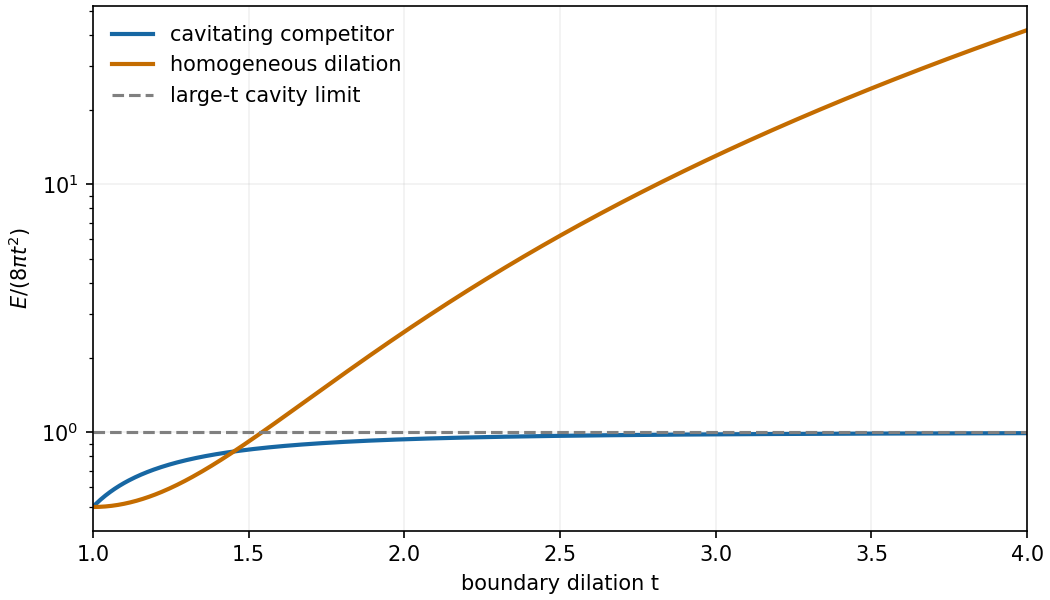
Energy comparison in the finite-energy class: the homogeneous dilation grows like t to the sixth power while the cavitating competitor grows quadratically
. Details. 
An antiplane displacement has the form , independent of the out-of-plane coordinate. Only and are nonzero, so its strain energy per unit out-of-plane thickness is .
The equilibrium minimizes total potential energyHere is the out-of-plane body-force component; the two crack faces have independent traces. For a variation with zero outer-boundary trace, stationarity givesIntegrating by parts first for interior test functions and then for variations free on either crack face yieldsThese are the weak equilibrium equation, prescribed displacement, and zero traction. The tip behavior is selected by finite energy; it is not an additional prescribed tip value.
Use , with the crack along the negative radial axis. In the coefficient convention used here, the leading crack-tip expansion isThe square-root term is harmonic and has zero angular derivative on both crack faces. Regular contributions may include a constant and bounded-gradient terms under smooth loading.
If is the minimized elastic-plus-load potential, the energy release rate is . With this particular square-root coefficient normalization,For example, the small-circle energy flux is . The singular term gives , and . Integration over produces the stated factor. Other stress-intensity normalizations change that factor.
For toughness , local stability against infinitesimal extension means , since the derivative of is nonnegative. Global energetic stability against every extension is the stronger condition for all .
In full isotropic linearized elasticity,For the antiplane field this becomesAhead of the tip, , the singular gradient is . ThusThis is stronger than the printed remainder . If denotes a nonnegative intensity, it has the printed leading coefficient; for a signed singular coefficient its absolute value is essential because the left side is a norm.
For a differentiable crack path, the local quasistatic Griffith laws with constant positive toughness areThey express irreversibility, local stability, and energy balance during growth. A strictly subcritical release rate forces the crack to stop.
Fix a crack parameter and let denote the equilibrium displacement with the prescribed time-dependent loads. The scalar equilibrium problem is linear and has a unique solution for its fixed Dirichlet data. Both body force and boundary displacement scale by , soThe minimized potential energy is quadratic under this scaling: the strain term scales by and so does the load term . Hence andEquivalently the crack-tip coefficient scales by and its squared energy-release formula gives the same result.
Put . Finiteness and continuity of make it bounded by some finite on a neighborhood of . Continuity of supplies a positive interval on which stays in that neighborhood. Shorten it to so that . Then , and complementarity forces throughout. ThereforeNo differentiating an unknown crack path or assuming its length already constant is needed; its continuity first gives the local release-rate bound.
Articles by others on the same topic
There are currently no matching articles.