Condensate depletion means particles outside a macroscopically occupied bosonic single-particle mode. Interactions can deplete that mode even at zero temperature: the Bogoliubov transformation mixes creation and annihilation operators, so its quasiparticle vacuum contains particles at nonzero momentum. A weak homogeneous three-dimensional gas with repulsive scattering length has leading quantum depletion of a Bose condensateThermal quasiparticles add another contribution. Depletion and normal-fluid density are distinct: a Galilean-invariant fluid can have quantum depletion while retaining its full superfluid mass response at zero temperature.
For the fermionic pairing problem, mean-field decoupling of the reduced BCS pairing Hamiltonian introduces the anomalous amplitude . Each paired Nambu block has diagonal entries and off-diagonal pairing entries of magnitude . A phase convention with negative off-diagonal entries gives eigenvalues , where . Its canonical Bogoliubov rotation yields the BCS coherence factorsThe partner transformation has the complementary sign required by fermionic anticommutation. At zero temperature all positive-energy BCS quasiparticle modes are empty. Expanding the supplied electron operator therefore givesSince ,The electron occupation is close to one far below the normal-state Fermi surface, equals one half at , and decays toward zero above it. Pairing smooths the Fermi step over an energy range of order . The positive-energy quasiparticle occupation is instead zero everywhere at this temperature; the electron sea and the quasiparticle vacuum are different descriptions of the same state. At finite temperature, in the same mean-field model.
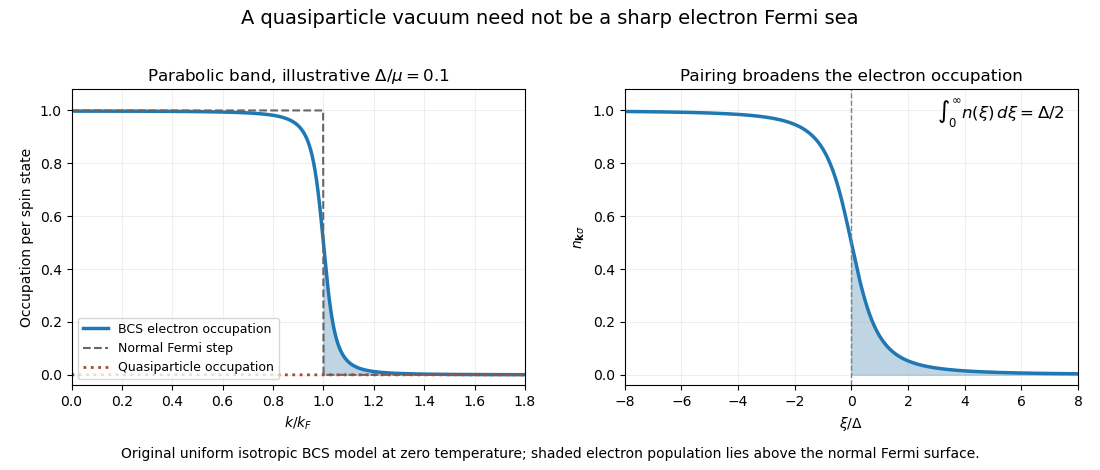
Zero quasiparticle occupation coexists with electron population above the normal-state Fermi surface
. Original isotropic BCS calculation. The left panel uses an illustrative gap-to-chemical-potential ratio of 0.1; it is not measured mercury or cuprate data. Details.
For a three-dimensional parabolic normal band, the total density of states including both spins is . In the weak-gap limit, replace it by this constant across the narrow pairing region and use . The number of electrons above the normal-state Fermi surface isThe integral is . Therefore the BCS population above the normal-state Fermi surface isThe constant-density-of-states approximation and a small gap relative to the chemical potential are essential. This is the question's explicitly defined fermionic population measure; it is not the fraction of electrons outside a single bosonic condensate orbital.
For an order-of-magnitude mercury estimate, use and the weak-coupling scale , with a representative metallic . These input approximations give , of order . The use of a weak-coupling gap is an estimate, not an assertion of mercury's exact measured gap.
For a copper oxide, an illustrative gap and effective chemical-potential scale give about three per cent in this formula. Choosing – instead gives roughly – per cent. These are explicit example inputs: the paper specifies no compound, doping or band parameters from which a unique number follows. A real cuprate's anisotropic gap, quasi-two-dimensional band and strong correlations require a band-resolved occupation integral, so the reliable contrast is the much larger gap-to-electronic-energy scale, rather than a universal cuprate percentage.
Articles by others on the same topic
There are currently no matching articles.