Original public paper: Physical PDF pages 765–767. All questions and all optional notes are answered. The population above a normal-state Fermi surface is distinguished from a bosonic condensate depletion and from a quasiparticle population.
A Josephson junction converts a relative condensate phase into a measurable current. For superconductors the relevant coherent object is a Cooper pair, with electric charge . Its Gauge-invariant Josephson phase isWith a consistent directed-current convention, the weak-link relation is . A voltage gives , so a constant voltage produces the AC Josephson effect at frequency . For neutral atom reservoirs the phase evolution instead follows their chemical-potential difference, with the displayed phase labeling. The current transfers atoms rather than electric charge, but still probes coherent matter-wave amplitudes.
A DC SQUID provides two coherent paths around a superconducting loop. Neglect loop self-inductance, take equal junction critical currents , and let be the enclosed flux. The relative junction phase differs by , with superconducting flux quantum . Adding the two sinusoidal currents and maximizing over their common phase givesFor unequal junctions the corresponding result is . Finite inductance and junction asymmetry alter the ideal modulation, so a measured minimum need not be zero. Flux changes a phase difference between the paths; the detector reads the resulting critical-current or voltage modulation. The Jaklevic Josephson interference experiment established superconducting interference experimentally.[ref]
Quantum Interference Effects in Josephson Tunneling by R. C. Jaklevic and others. 1964 primary report
A bosonic Josephson junction uses two weakly linked Bose-Einstein condensates. In the Albiez double-well Josephson experiment, the population distribution was measured in situ and the relative phase inferred from interference fringes. The apparatus therefore tests both number transfer and phase coherence, rather than interpreting a density oscillation alone as a phase measurement. Interactions make the dynamics nonlinear: large imbalance can produce self-trapping instead of simple tunneling oscillations.[ref]
Direct Observation of Tunneling and Nonlinear Self-Trapping in a Single Bosonic Josephson Junction by Michael Albiez and others. 2005 abstract: double-well implementation, density measurement, phase from fringes and nonlinear self-trapping
The usefulness is interferometric sensitivity: a small phase perturbation can change a measurable current. It requires a coherent weak link, controlled phase noise and the appropriate particle's phase evolution; a generic insulating barrier between incoherent reservoirs is not already a matter-wave interferometer.
The superconducting critical current depends on temperature, magnetic field, sample geometry and the chosen dissipation criterion. For a magnet, a large superconducting critical current density matters because it permits a useful winding current with manageable conductor volume. The intrinsic depairing limit is an upper bound, but many practical type-II conductors become dissipative first through vortex motion.
A current exerts a transverse force per unit vortex length . Moving flux produces an electric field and dissipation. Flux pinning holds vortices at energetically favorable defects, allowing a larger transport current before motion. Useful conductors therefore need pinning as well as a sufficiently high transition temperature and upper critical field. Simply increasing disorder indefinitely is not a prescription: it can damage connectivity or superconductivity. High-angle grain boundaries in some copper-oxide materials also act as weak links, motivating controlled texture and connected current paths.
Conventional magnet conductors include niobium-titanium and niobium-tin; high-temperature coated conductors offer other operating regimes. Their performance must be compared on a superconducting critical surface in temperature, field and current density, with strain and thermal constraints also relevant. A high self-field current measured in a short sample does not by itself establish the current available throughout a high-field coil.
A superconducting magnet produces a strong, stable field without the normal winding's steady resistive power loss. Applications include magnetic resonance imaging, nuclear magnetic resonance and charged-particle beam steering or focusing in accelerators. A persistent-current loop is valuable when field stability matters. Refrigeration still requires power, and the magnet stores magnetic energy, approximately in a linear inductance model. A local transition to a resistive state can release that stored energy as heat, so superconducting quench detection and protection are essential to operation. These requirements connect the microscopic vortex physics with useful engineering performance.
The superconducting order is a coherent pair amplitude, schematically . Under a global fermion phase change , it acquires phase . A symmetry-broken thermodynamic description selects a pair phase. This must be distinguished from electromagnetic gauge freedom: a local gauge transformation changes the phase and potentials together and is a redundancy of the description, not an observable symmetry that the material literally violates.
A conventional centrosymmetric s-wave superconductor usually has an even-parity orbital pair state and a spin singlet state, consistent with the antisymmetry of two fermions. Its ordinary zero-field equilibrium state preserves time reversal. The electromagnetic coupling makes phase dynamics and screening part of the Anderson-Higgs mechanism in a superconductor; the Meissner effect is a measurable consequence. The condensate phase description does not imply that electric charge is no longer conserved.
In an unconventional superconductor, the gap can transform nontrivially under the crystal point group or have other nonstandard pairing structure. A common example is d-wave superconductivity, with sign changes and possible nodes in the gap. This does not automatically imply an additional observable fourfold-rotation breaking: a rotation that reverses the gap's sign can be accompanied by a gauge phase change. A nematic superconducting state instead breaks an actual crystal rotation symmetry in its gauge-invariant responses.
A chiral combination such as can break time reversal, while a spin-triplet order parameter can also distinguish spin directions when the applicable spin-rotation and spin-orbit constraints permit it. Helium-3 superfluidity illustrates paired-fermion order with richer spin and orbital structure. These possibilities must be tested rather than equated: unconventional pairing does not by itself mean spin-triplet pairing, time-reversal breaking, or nematicity. Gap angular dependence, phase-sensitive interference, spin response and spontaneous magnetic signatures probe different symmetry questions. The phase-sensitive test of d-wave pairing is more specific than inferring a gap sign merely from its magnitude.
For a neutral condensate with order parameter , the superfluid velocity away from singularities is . Single-valuedness around a closed contour gives , hence quantization of circulation:The mass is that of the condensed object: an atom for a bosonic atomic superfluid, or a pair for a paired-fermion condensate. A nonzero winding cannot be continuously removed while the order parameter remains nonzero throughout a spanning region. A vortex allows its phase to wind while its amplitude vanishes in a core.
For a charged condensate, minimal coupling gives . ThusUsing and gives the fluxoid and flux quantization in a superconductor relation . The signs of oriented flux and winding depend on the signed pair charge; the magnitude of the elementary superconducting flux quantum is . Flux alone is quantized when the current term is negligible on a contour deep in the bulk. A thin ring or a contour near a core can instead require the full fluxoid.
In a neutral superfluid, vortex flow carries kinetic energy and angular momentum. Rotation can favor vortices because equilibrium minimizes the rotating-frame quantity . The core size is set by a coherence or healing scale. In a type-II superconductor, an Abrikosov vortex carries quantized magnetic flux and circulating supercurrent; its core scale is the coherence length and its magnetic screening scale is the penetration depth. Between the lower and upper critical fields, a vortex lattice can be favored. Flux pinning affects how that structure responds to current. Type-I bulk superconductors instead favor macroscopic normal/superconducting separation rather than the usual stable dilute Abrikosov-vortex regime.
Condensate depletion means particles outside a macroscopically occupied bosonic single-particle mode. Interactions can deplete that mode even at zero temperature: the Bogoliubov transformation mixes creation and annihilation operators, so its quasiparticle vacuum contains particles at nonzero momentum. A weak homogeneous three-dimensional gas with repulsive scattering length has leading quantum depletion of a Bose condensateThermal quasiparticles add another contribution. Depletion and normal-fluid density are distinct: a Galilean-invariant fluid can have quantum depletion while retaining its full superfluid mass response at zero temperature.
For the fermionic pairing problem, mean-field decoupling of the reduced BCS pairing Hamiltonian introduces the anomalous amplitude . Each paired Nambu block has diagonal entries and off-diagonal pairing entries of magnitude . A phase convention with negative off-diagonal entries gives eigenvalues , where . Its canonical Bogoliubov rotation yields the BCS coherence factorsThe partner transformation has the complementary sign required by fermionic anticommutation. At zero temperature all positive-energy BCS quasiparticle modes are empty. Expanding the supplied electron operator therefore givesSince ,The electron occupation is close to one far below the normal-state Fermi surface, equals one half at , and decays toward zero above it. Pairing smooths the Fermi step over an energy range of order . The positive-energy quasiparticle occupation is instead zero everywhere at this temperature; the electron sea and the quasiparticle vacuum are different descriptions of the same state. At finite temperature, in the same mean-field model.
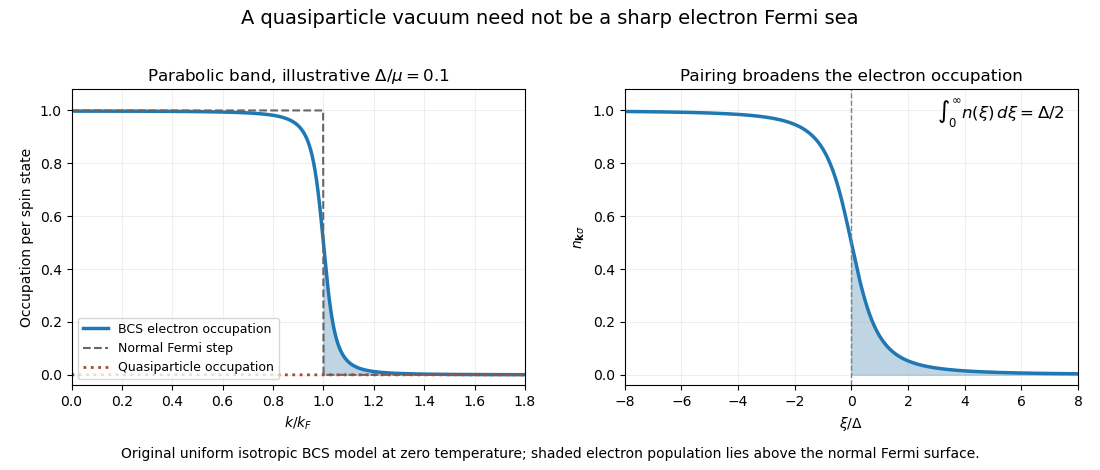
Zero quasiparticle occupation coexists with electron population above the normal-state Fermi surface
. Original isotropic BCS calculation. The left panel uses an illustrative gap-to-chemical-potential ratio of 0.1; it is not measured mercury or cuprate data. Details.
For a three-dimensional parabolic normal band, the total density of states including both spins is . In the weak-gap limit, replace it by this constant across the narrow pairing region and use . The number of electrons above the normal-state Fermi surface isThe integral is . Therefore the BCS population above the normal-state Fermi surface isThe constant-density-of-states approximation and a small gap relative to the chemical potential are essential. This is the question's explicitly defined fermionic population measure; it is not the fraction of electrons outside a single bosonic condensate orbital.
For an order-of-magnitude mercury estimate, use and the weak-coupling scale , with a representative metallic . These input approximations give , of order . The use of a weak-coupling gap is an estimate, not an assertion of mercury's exact measured gap.
For a copper oxide, an illustrative gap and effective chemical-potential scale give about three per cent in this formula. Choosing – instead gives roughly – per cent. These are explicit example inputs: the paper specifies no compound, doping or band parameters from which a unique number follows. A real cuprate's anisotropic gap, quasi-two-dimensional band and strong correlations require a band-resolved occupation integral, so the reliable contrast is the much larger gap-to-electronic-energy scale, rather than a universal cuprate percentage.
A bosonic coherent state is an eigenstate of its annihilation operator,Its mean occupation is and its number variance is also , giving a Poisson number distribution. It has a well-defined complex mean field but fluctuating particle number. Its overlap with another coherent state is , so distinct amplitudes need not be orthogonal. For large occupation, a phase-space wave packet has small relative number fluctuations; this does not require an exact self-adjoint phase operator conjugate to a number bounded below.
For a bosonic field, a useful coherent-field condensate variational state isIt obeys . For a contact-interacting dilute Bose gas, its normal-ordered energy expectation isMinimizing gives the stationary Gross–Pitaevskii equation, . Its phase gradient determines superfluid flow, while weak-link phase differences give Josephson currents. The complex microscopic expectation supplies the order field used by a mean-field description of a bosonic superfluid.
An exactly fixed-number condensate can instead use the Hartree product state . Its one-point field expectation vanishes by number conservation, but its one-body density matrix has a macroscopic eigenvalue. Off-diagonal long-range order expresses that number-conserving criterion. Selecting a phase is a useful thermodynamic symmetry-broken description; it is not a claim that every finite isolated condensate literally has indefinite total number. A plain coherent product also misses interaction-induced quantum depletion, which needs correlations such as those in the Bogoliubov quasiparticle vacuum.
In a spin-singlet superconductor, the corresponding variational state is the BCS ground stateEach block superposes an empty and an occupied pair state. Where , it can be rewritten as , treating any fully occupied blocks separately. The exponential truncates within each block because a fermionic pair cannot be created twice in the same two modes. This is a Cooper-pair pseudospin coherent state, rather than a coherent state of unrestricted ideal bosons.
The one-electron expectation remains zero in a fermion-parity-even BCS state. Its nonzero microscopic order is the BCS anomalous average . For an attractive interaction written with matrix elements , the gap is . Minimization yields the coherence factors and gap equation. Fermionic coherent states using Grassmann variables are valuable integration tools, but they are not ordinary complex-eigenvalue electron states replacing this physical paired wavefunction.[ref]
Theory of Superconductivity by John Bardeen and others. 1957, variational paired ground state and elementary excitations
Near the transition, a slowly varying pair field connects the microscopic anomalous average to Ginzburg-Landau theory of superconductivity. The phenomenological complex field has pair charge , a phase that controls supercurrent and a magnitude whose normalization is model dependent. It is not the expectation of a single-electron field. Microscopic derivation of Ginzburg-Landau theory supplies this connection under its stated near-critical assumptions. Pair phase coherence, Josephson interference and flux quantization then become different manifestations of the same macroscopic paired order. Paired-fermion superfluids likewise use a pair order field, while bosonic atomic superfluids can use a one-particle condensate field.
Articles by others on the same topic
There are currently no matching articles.