2016 paper: Public original PDF, physical page 839. Student-answer availability for this paper remains unverified.
Original public paper: Physical PDF pages 839–841. All four alternatives in question 1 and both later questions are answered. We distinguish collective order-parameter oscillations from individual quasiparticles, and use the dimensionless units of question 2 only in that question.
An Abrikosov vortex combines a core of suppressed superconducting order parameter, circulating electric current and a winding of the quantum phase. In the bulk limit a singly wound vortex carries the superconducting flux quantum . More precisely it is the fluxoid that is quantized; appreciable current on the integration contour prevents identifying enclosed flux alone with the integer.
For a type-II superconductor, the Ginzburg-Landau parameter is . The superconducting mixed state allows vortices between the lower critical magnetic field and upper critical magnetic field. A short superconducting coherence length permits a high orbital upper field,Thus surviving a large applied field generally requires accommodating many vortices, not excluding flux everywhere. The Abrikosov vortex lattice provides their equilibrium arrangement in the simplest isotropic model. Material anisotropy, disorder and thermal fluctuations can change that arrangement and its stability. Spin-polarization limits can also constrain an actual upper field, beyond this orbital estimate.
Carrying a large transport current density is a separate problem. For a straight vortex with tangent , the driving Lorentz force per unit length is . Vortex motion produces a mean electric field and hence dissipative power density . A large alone therefore does not imply a large usable superconducting critical current.
Flux pinning holds vortices at favorable defects: suppressing the order parameter costs less where superconductivity is already weakened. Precipitates, dislocations, grain boundaries and deliberately introduced damage can provide pinning, subject to material-specific trade-offs. A defect scale comparable with a core size can be effective; a defect that destroys connected superconducting paths is harmful. In a coarse force balance, a maximum pinning force density gives for transverse transport. Vortex depinning and thermally activated flux creep can produce a voltage below an ideal static threshold.
High-field magnet conductors consequently need both a large upper field and strong, persistent pinning while retaining mechanical integrity and electrical connectivity. Niobium-titanium and niobium-tin conductors illustrate why superconducting composition and microstructural processing are developed together. A critical-current measurement should specify field, temperature and voltage criterion; it is not simply a measurement of the temperature at which resistance first vanishes.
The superconducting gap function is a momentum-dependent pairing amplitude , including a phase as well as a magnitude. A fully gapped isotropic state and a state with symmetry-required nodes can have different low-temperature responses. Heat capacity, thermal transport, London penetration depth and tunnelling spectra probe the low-energy quasiparticle spectrum. Activated behavior suggests a nonzero minimum gap; power laws can indicate nodes. For example, clean line nodes give a penetration-depth correction linear in temperature, whereas disorder can change the apparent power.
Such magnitude-sensitive probes require care: impurities, several bands, anisotropic full gaps and surface states can imitate or modify simple expectations. A node does not by itself establish a particular sign pattern, and the absence of a coherence peak is not a complete symmetry determination. The strongest identification combines momentum-sensitive spectra with phase-sensitive superconducting gap experiments.
For an illustrative state, changes sign under a rotation. A Josephson junction to a conventional s-wave reference can turn that sign into an intrinsic phase shift. In a corner DC SQUID with junctions on orthogonal crystal faces, one branch can acquire an extra relative to the other. For equal junctions and negligible loop inductance,Changing from zero to shifts the interference pattern by half a flux period. The 1993 YBCO–Pb experiment compared phase-coherent junction geometries and found evidence for that sign reversal, while explicitly discussing SQUID asymmetry and trapped vortices. Those controls matter: an arbitrary shifted trace is not by itself a proof of pairing symmetry.[ref]
Experimental determination of the superconducting pairing state in YBCO by D. A. Wollman and others. 1993, phase coherence of YBCO–Pb dc SQUIDs; abstract identifies asymmetry and vortex-trapping qualifications
A tricrystal half-flux experiment arranges grain-boundary junctions so that a sign-changing order parameter produces an odd total shift around a ring. Fluxoid consistency then favors a half-integer flux state, with the detailed spontaneous flux depending on loop inductance and junction strengths. Choosing comparison geometries without that frustration and controlling trapped external flux separates the pairing-phase effect from ordinary flux trapping.[ref]
The conclusion is strongest when the same candidate symmetry explains nodes, crystal-axis dependence and these phase-sensitive interference results. The phase-sensitive observation distinguishes a sign-changing gap from a merely anisotropic positive gap; no single temperature power law supplies that distinction.
The two-fluid model of superfluidity separates mass current into a superfluid fraction and a normal component of a superfluid:The normal component carries entropy and responds to shear viscosity; an ideal superfluid flow is entropy-free. These are interpenetrating hydrodynamic responses, not two permanently distinguishable sets of atoms. Thermal elementary excitations carry momentum relative to the condensate and generate the normal response.
The Andronikashvili experiment gives an operational picture. A closely spaced stack of disks oscillates torsionally in He-II. Viscous coupling entrains the normal response between disks, changing the oscillator's inertia, while vortex-free superfluid need not follow the rotation. The temperature-dependent inertia measures the normal component under the apparatus's coupling conditions. Counterflow also permits second sound, primarily an entropy/temperature wave rather than the ordinary density wave of first sound.
Condensate depletion is a different quantity. The condensate fraction counts occupation of a single-particle mode, while measures the response to phase gradients or motion. In a weak three-dimensional homogeneous Bose gas at zero temperature,so interactions produce quantum depletion even without thermal excitations. In a translation-invariant Galilean system at zero temperature, the superfluid mass density can nevertheless equal the total density. He-II has strong interaction-induced depletion but a nearly complete zero-temperature superfluid response. Lattices, disorder and finite temperature require their own response calculation; condensate and superfluid fractions should not be equated in general.
The Landau criterion follows by considering an excitation of momentum in a moving fluid. Its laboratory-frame creation cost can be . A necessary energetic condition against this decay channel isFor the low-momentum Bogoliubov spectrum of a weakly interacting Bose gas, , giving the sound-speed threshold for that channel. The phonon–roton spectrum of He-II can instead have its minimum ratio near the roton region. Vortex nucleation, boundaries and a moving obstacle can lower a measured critical velocity; the ideal excitation criterion is not a guarantee of dissipation-free flow at every smaller speed in every apparatus. An ideal noninteracting Bose gas has a condensate but quadratic excitations with , another distinction between condensation and robust superfluidity.
A cold-gas test moved a blue-detuned laser beam through a trapped condensate and measured heating as its speed changed. The repulsive optical obstacle supplies a controlled perturbation; strong heating appeared above a threshold. Its interpretation must account for the inhomogeneous cloud and excitation/nucleation mechanism, rather than identify every observed threshold with the central sound speed.[ref]
Evidence for a Critical Velocity in a Bose-Einstein Condensed Gas by C. Raman and others. 1999 abstract: moving blue-detuned laser beam and onset of strong heating
A Josephson junction weakly couples two superconducting condensates. In a consistent orientation convention, its Gauge-invariant Josephson phase obeysThe DC Josephson effect permits a current at zero voltage; the AC Josephson effect gives oscillations at frequency . The junction's energy is . Adding a capacitance gives a charging scale and, in the simplest isolated-island model, Hamiltonian . Competition between phase locking and charge fluctuations permits quantized circuit dynamics, rather than an ordinary linear resistor.
Two junctions in a loop form a DC SQUID. When junctions are equal and loop self-inductance is negligible, their phase difference is fixed by external flux and their currents interfere:This supplies sensitive magnetometry and flux-tunable circuit elements. Unequal junctions leave nonzero minima; finite inductance and screening change the simple pattern. The phase-sensitive gap test in the preceding alternative adds an internal pairing-phase offset to this same interference principle.
Matter-wave interference also compares coherent complex amplitudes. For overlapping condensates with local densities ,An atomic interferometer can split a trapped condensate, evolve its two components, release them and image the overlapping density by absorption of a probe beam. For two initially separated sources a distance apart, free expansion for time gives an approximate far-field fringe spacing . The measured fringe phase encodes relative phase and accumulated dynamical phase; population imbalance lowers visibility. Interference between expanding condensates was an important demonstration of atomic coherence.[ref]
Nobel lecture: When atoms behave as waves: Bose-Einstein condensation and the atom laser by Wolfgang Ketterle. Condensate interference and absorption images of overlapping expanding clouds
Josephson oscillation requires an ongoing weak link that exchanges particles; interference after release need not have such a link. Independent condensates can show fringes with a different relative phase in each realization, so a single image is not evidence of a reproducible phase reference over many runs. In both settings the useful object is relative phase, but superconducting circuits also couple electrically to magnetic flux and charge, while neutral-atom devices accumulate matter-wave phase from motion and external potentials.
An elementary excitation is an approximately independent low-energy normal mode above a many-body equilibrium state. A Bogoliubov transformation mixes creation and annihilation operators to diagonalize a quadratic fluctuation Hamiltonian. For weakly interacting bosons,interpolating between sound and particle-like motion. Bosonic canonical commutators require . In BCS theory, fermionic particle–hole mixtures instead have and excitation energies . These fermionic quasiparticles must be distinguished from collective amplitude and phase oscillations of the pair field.
For the stated dimensionless first-order equation, a nonzero uniform static solution obeys . Thus . The zero field is also stationary, but is not the condensed minimum of the local potential .
Choose . To linear order, , so . Substitution and separation of real and imaginary parts giveDifferentiating the first relation and using the second yieldsThe same elimination holds for . A plane wave therefore givesThe density and phase components share this frequency because of density-phase conjugacy. They are coupled components of one positive-frequency Bogoliubov mode, not two independent excitations that happen to have equal energies. At , a constant phase change is a zero mode; the nonzero- elimination should not be used to assign an independent oscillation to a uniform density change.
Replacing the first-order time derivative by changes the number and structure of dynamical degrees of freedom. The linearized real and imaginary equations now decouple:The amplitude and phase modes of a second-order complex field consequently haveThe amplitude mode has a nonzero gap ; the phase mode is gapless with speed . Frequencies are nonnegative, so the printed expression is understood for or replaced by .
In the complex plane, an amplitude oscillation moves radially relative to the chosen equilibrium , and a phase oscillation moves tangentially, or along a short unit-circle arc beyond linear order. A first-order coupled mode combines them in quadrature. For a fixed spatial factor and , one possible parametrization isso traces a small ellipse about . Choose small enough that both components remain within the linear approximation.
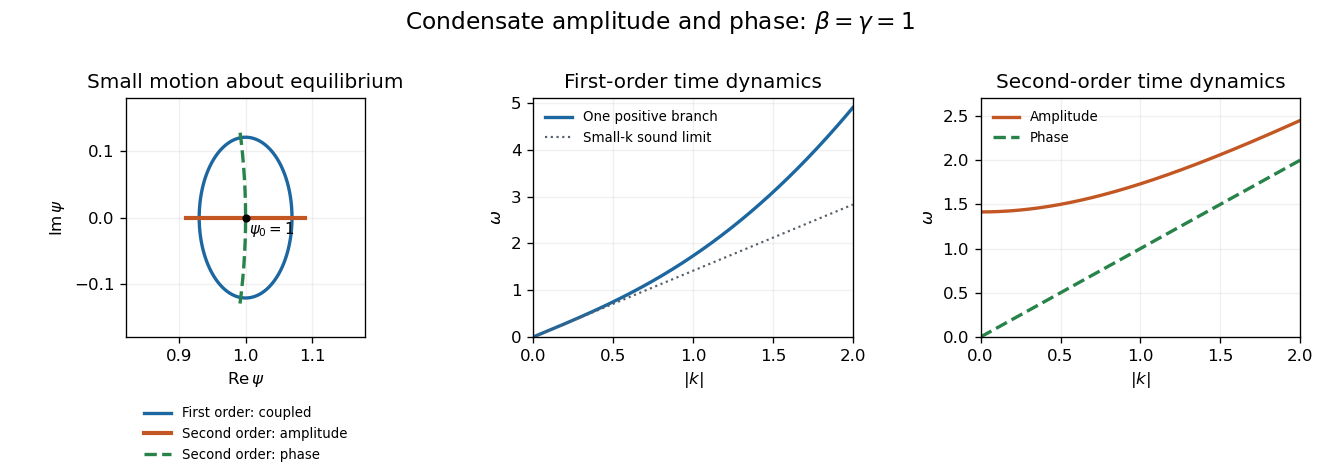
A weak neutral Bose condensate realizes the first-order structure and its sound-like Bogoliubov spectrum. A particle–hole-symmetric effective complex field can realize the second-order structure, with a gapless Goldstone mode and a distinct amplitude mode. A neutral BCS superfluid likewise has collective phase and amplitude responses, although the amplitude response near pair-breaking energy need not be a sharp undamped particle; its fermionic quasiparticles are separate excitations.
In a charged bulk superconductor, long-range Coulomb interactions and electromagnetic dynamics remove the neutral sound-like phase branch from the low-frequency spectrum. The Anderson-Higgs mechanism in a superconductor produces a longitudinal plasma mode, schematically in an appropriate long-wavelength model. The amplitude scale is typically associated with in a simple BCS regime, with damping and mixing dependent on material and symmetry. One should not simply retain the neutral Goldstone dispersion after charging the field, nor identify the static Ginzburg-Landau functional alone with a complete time-dependent microscopic theory.
Ginzburg-Landau theory of superconductivity organizes a continuous superconducting transition through a slowly varying complex order parameter. In the simplest isotropic single-component SI model,Here , , changes sign at , and fixes a charge/phase convention. The phenomenological normalization of determines the coefficient values; it should not be confused without qualification with a literal density of independently identifiable pairs.
Microscopic derivation of Ginzburg-Landau theory expands the BCS response near in small gap amplitude and slow spatial gradients. It identifies the complex order parameter with a scaled pair amplitude, supplies the coefficients from the electronic microscopic parameters, and explains the pair charge in the gauge coupling. The agreement is a controlled near-transition limit, not a statement that the truncated local functional remains exact at all temperatures. Lev Gor'kov established this connection explicitly in 1959.[ref]
Microscopic Derivation of the Ginzburg-Landau Equations in the Theory of Superconductivity by Lev Gor'kov. 1959 abstract and derivation: near- reduction and twice-electron charge
Below the transition, minimization gives and condensation-energy density . A variation with respect to givesVariation with respect to gives the supercurrentcoupled to the magnetostatic Ampère law. For nearly uniform amplitude this reduces to London screening and the Meissner effect. The theory supplies two different length scales:The amplitude can vary over the superconducting coherence length, whereas the magnetic field is screened over the London penetration depth.
The surface-energy distinction at explains why type-I and type-II behavior are possible within the same framework. In the type-II regime, quantized winding produces an Abrikosov vortex with a finite core and circulating current. Periodic solutions yield an Abrikosov vortex lattice. Linearization about the normal state gives , while core and field energetics determine the lower entry field. These predictions connect a spatial field theory to measurable vortex patterns and critical fields, beyond a spatially uniform BCS gap equation. Thin-film critical-field observations helped motivate the large- regime; magnetic-decoration experiments subsequently made vortex positions visible.[ref]
Nobel Lecture: Type-II superconductors and the vortex lattice by Alexei Alexeyevich Abrikosov. pp.975–977, film motivation, mixed-state solutions and experimental vortex evidence
These phenomena also enable applications. Type-II conductors support high-field magnets, but flux pinning is needed to limit vortex-motion losses. Phase coherence and fluxoid quantization permit persistent-current loops and interference devices. A weak link supplies Josephson coupling energy, allowing SQUID magnetometry and nonlinear quantum circuits; a junction's detailed current–phase law requires a weak-link model, rather than following automatically from the spatially uniform bulk functional. Microstructure can raise a useful critical current without greatly changing the equilibrium upper field, illustrating the difference between thermodynamic stability and transport performance.
The simple functional has identifiable limits. Far below , the small-gap expansion is uncontrolled; rapidly varying fields can require nonlocal microscopic electrodynamics. Very near a transition in a fluctuating low-dimensional or strongly anisotropic material, mean-field minimization can miss important thermal or quantum fluctuations. Unconventional or multiband pairing can require several order-parameter components and additional gradient couplings. Strong fields can introduce spin-polarization pair breaking omitted by the orbital model. Finally, the static functional predicts equilibrium extrema, not quasiparticle spectra, dissipation, vortex velocities or a unique amplitude-mode frequency without further dynamical input. These are reasons to choose an appropriate extension or a microscopic calculation, not reasons to discard the successful near-transition predictions.
Original public paper: Physical PDF pages 765–767. All questions and all optional notes are answered. The population above a normal-state Fermi surface is distinguished from a bosonic condensate depletion and from a quasiparticle population.
A Josephson junction converts a relative condensate phase into a measurable current. For superconductors the relevant coherent object is a Cooper pair, with electric charge . Its Gauge-invariant Josephson phase isWith a consistent directed-current convention, the weak-link relation is . A voltage gives , so a constant voltage produces the AC Josephson effect at frequency . For neutral atom reservoirs the phase evolution instead follows their chemical-potential difference, with the displayed phase labeling. The current transfers atoms rather than electric charge, but still probes coherent matter-wave amplitudes.
A DC SQUID provides two coherent paths around a superconducting loop. Neglect loop self-inductance, take equal junction critical currents , and let be the enclosed flux. The relative junction phase differs by , with superconducting flux quantum . Adding the two sinusoidal currents and maximizing over their common phase givesFor unequal junctions the corresponding result is . Finite inductance and junction asymmetry alter the ideal modulation, so a measured minimum need not be zero. Flux changes a phase difference between the paths; the detector reads the resulting critical-current or voltage modulation. The Jaklevic Josephson interference experiment established superconducting interference experimentally.[ref]
Quantum Interference Effects in Josephson Tunneling by R. C. Jaklevic and others. 1964 primary report
A bosonic Josephson junction uses two weakly linked Bose-Einstein condensates. In the Albiez double-well Josephson experiment, the population distribution was measured in situ and the relative phase inferred from interference fringes. The apparatus therefore tests both number transfer and phase coherence, rather than interpreting a density oscillation alone as a phase measurement. Interactions make the dynamics nonlinear: large imbalance can produce self-trapping instead of simple tunneling oscillations.[ref]
Direct Observation of Tunneling and Nonlinear Self-Trapping in a Single Bosonic Josephson Junction by Michael Albiez and others. 2005 abstract: double-well implementation, density measurement, phase from fringes and nonlinear self-trapping
The usefulness is interferometric sensitivity: a small phase perturbation can change a measurable current. It requires a coherent weak link, controlled phase noise and the appropriate particle's phase evolution; a generic insulating barrier between incoherent reservoirs is not already a matter-wave interferometer.
The superconducting critical current depends on temperature, magnetic field, sample geometry and the chosen dissipation criterion. For a magnet, a large superconducting critical current density matters because it permits a useful winding current with manageable conductor volume. The intrinsic depairing limit is an upper bound, but many practical type-II conductors become dissipative first through vortex motion.
A current exerts a transverse force per unit vortex length . Moving flux produces an electric field and dissipation. Flux pinning holds vortices at energetically favorable defects, allowing a larger transport current before motion. Useful conductors therefore need pinning as well as a sufficiently high transition temperature and upper critical field. Simply increasing disorder indefinitely is not a prescription: it can damage connectivity or superconductivity. High-angle grain boundaries in some copper-oxide materials also act as weak links, motivating controlled texture and connected current paths.
Conventional magnet conductors include niobium-titanium and niobium-tin; high-temperature coated conductors offer other operating regimes. Their performance must be compared on a superconducting critical surface in temperature, field and current density, with strain and thermal constraints also relevant. A high self-field current measured in a short sample does not by itself establish the current available throughout a high-field coil.
A superconducting magnet produces a strong, stable field without the normal winding's steady resistive power loss. Applications include magnetic resonance imaging, nuclear magnetic resonance and charged-particle beam steering or focusing in accelerators. A persistent-current loop is valuable when field stability matters. Refrigeration still requires power, and the magnet stores magnetic energy, approximately in a linear inductance model. A local transition to a resistive state can release that stored energy as heat, so superconducting quench detection and protection are essential to operation. These requirements connect the microscopic vortex physics with useful engineering performance.
The superconducting order is a coherent pair amplitude, schematically . Under a global fermion phase change , it acquires phase . A symmetry-broken thermodynamic description selects a pair phase. This must be distinguished from electromagnetic gauge freedom: a local gauge transformation changes the phase and potentials together and is a redundancy of the description, not an observable symmetry that the material literally violates.
A conventional centrosymmetric s-wave superconductor usually has an even-parity orbital pair state and a spin singlet state, consistent with the antisymmetry of two fermions. Its ordinary zero-field equilibrium state preserves time reversal. The electromagnetic coupling makes phase dynamics and screening part of the Anderson-Higgs mechanism in a superconductor; the Meissner effect is a measurable consequence. The condensate phase description does not imply that electric charge is no longer conserved.
In an unconventional superconductor, the gap can transform nontrivially under the crystal point group or have other nonstandard pairing structure. A common example is d-wave superconductivity, with sign changes and possible nodes in the gap. This does not automatically imply an additional observable fourfold-rotation breaking: a rotation that reverses the gap's sign can be accompanied by a gauge phase change. A nematic superconducting state instead breaks an actual crystal rotation symmetry in its gauge-invariant responses.
A chiral combination such as can break time reversal, while a spin-triplet order parameter can also distinguish spin directions when the applicable spin-rotation and spin-orbit constraints permit it. Helium-3 superfluidity illustrates paired-fermion order with richer spin and orbital structure. These possibilities must be tested rather than equated: unconventional pairing does not by itself mean spin-triplet pairing, time-reversal breaking, or nematicity. Gap angular dependence, phase-sensitive interference, spin response and spontaneous magnetic signatures probe different symmetry questions. The phase-sensitive test of d-wave pairing is more specific than inferring a gap sign merely from its magnitude.
For a neutral condensate with order parameter , the superfluid velocity away from singularities is . Single-valuedness around a closed contour gives , hence quantization of circulation:The mass is that of the condensed object: an atom for a bosonic atomic superfluid, or a pair for a paired-fermion condensate. A nonzero winding cannot be continuously removed while the order parameter remains nonzero throughout a spanning region. A vortex allows its phase to wind while its amplitude vanishes in a core.
For a charged condensate, minimal coupling gives . ThusUsing and gives the fluxoid and flux quantization in a superconductor relation . The signs of oriented flux and winding depend on the signed pair charge; the magnitude of the elementary superconducting flux quantum is . Flux alone is quantized when the current term is negligible on a contour deep in the bulk. A thin ring or a contour near a core can instead require the full fluxoid.
In a neutral superfluid, vortex flow carries kinetic energy and angular momentum. Rotation can favor vortices because equilibrium minimizes the rotating-frame quantity . The core size is set by a coherence or healing scale. In a type-II superconductor, an Abrikosov vortex carries quantized magnetic flux and circulating supercurrent; its core scale is the coherence length and its magnetic screening scale is the penetration depth. Between the lower and upper critical fields, a vortex lattice can be favored. Flux pinning affects how that structure responds to current. Type-I bulk superconductors instead favor macroscopic normal/superconducting separation rather than the usual stable dilute Abrikosov-vortex regime.
Condensate depletion means particles outside a macroscopically occupied bosonic single-particle mode. Interactions can deplete that mode even at zero temperature: the Bogoliubov transformation mixes creation and annihilation operators, so its quasiparticle vacuum contains particles at nonzero momentum. A weak homogeneous three-dimensional gas with repulsive scattering length has leading quantum depletion of a Bose condensateThermal quasiparticles add another contribution. Depletion and normal-fluid density are distinct: a Galilean-invariant fluid can have quantum depletion while retaining its full superfluid mass response at zero temperature.
For the fermionic pairing problem, mean-field decoupling of the reduced BCS pairing Hamiltonian introduces the anomalous amplitude . Each paired Nambu block has diagonal entries and off-diagonal pairing entries of magnitude . A phase convention with negative off-diagonal entries gives eigenvalues , where . Its canonical Bogoliubov rotation yields the BCS coherence factorsThe partner transformation has the complementary sign required by fermionic anticommutation. At zero temperature all positive-energy BCS quasiparticle modes are empty. Expanding the supplied electron operator therefore givesSince ,The electron occupation is close to one far below the normal-state Fermi surface, equals one half at , and decays toward zero above it. Pairing smooths the Fermi step over an energy range of order . The positive-energy quasiparticle occupation is instead zero everywhere at this temperature; the electron sea and the quasiparticle vacuum are different descriptions of the same state. At finite temperature, in the same mean-field model.
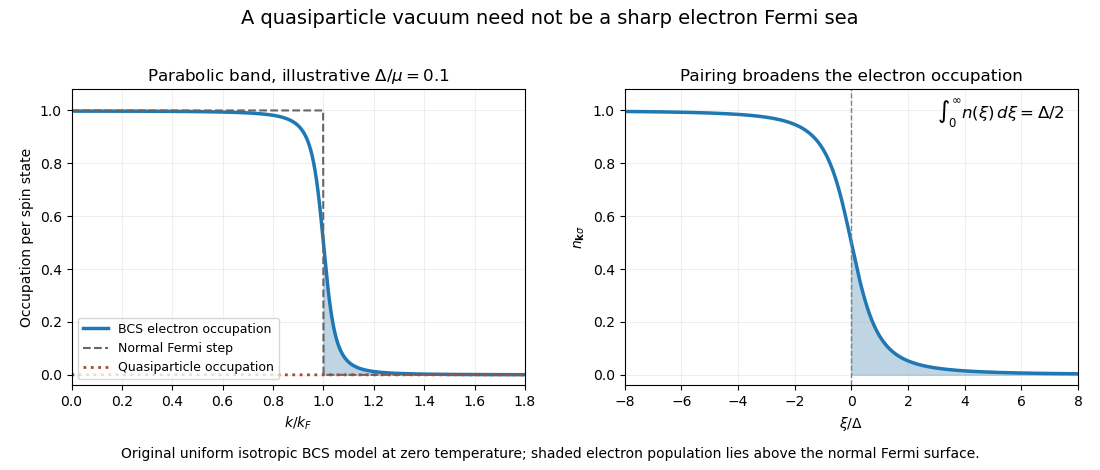
Zero quasiparticle occupation coexists with electron population above the normal-state Fermi surface
. Original isotropic BCS calculation. The left panel uses an illustrative gap-to-chemical-potential ratio of 0.1; it is not measured mercury or cuprate data. Details.For a three-dimensional parabolic normal band, the total density of states including both spins is . In the weak-gap limit, replace it by this constant across the narrow pairing region and use . The number of electrons above the normal-state Fermi surface isThe integral is . Therefore the BCS population above the normal-state Fermi surface isThe constant-density-of-states approximation and a small gap relative to the chemical potential are essential. This is the question's explicitly defined fermionic population measure; it is not the fraction of electrons outside a single bosonic condensate orbital.
For an order-of-magnitude mercury estimate, use and the weak-coupling scale , with a representative metallic . These input approximations give , of order . The use of a weak-coupling gap is an estimate, not an assertion of mercury's exact measured gap.
For a copper oxide, an illustrative gap and effective chemical-potential scale give about three per cent in this formula. Choosing – instead gives roughly – per cent. These are explicit example inputs: the paper specifies no compound, doping or band parameters from which a unique number follows. A real cuprate's anisotropic gap, quasi-two-dimensional band and strong correlations require a band-resolved occupation integral, so the reliable contrast is the much larger gap-to-electronic-energy scale, rather than a universal cuprate percentage.
A bosonic coherent state is an eigenstate of its annihilation operator,Its mean occupation is and its number variance is also , giving a Poisson number distribution. It has a well-defined complex mean field but fluctuating particle number. Its overlap with another coherent state is , so distinct amplitudes need not be orthogonal. For large occupation, a phase-space wave packet has small relative number fluctuations; this does not require an exact self-adjoint phase operator conjugate to a number bounded below.
For a bosonic field, a useful coherent-field condensate variational state isIt obeys . For a contact-interacting dilute Bose gas, its normal-ordered energy expectation isMinimizing gives the stationary Gross–Pitaevskii equation, . Its phase gradient determines superfluid flow, while weak-link phase differences give Josephson currents. The complex microscopic expectation supplies the order field used by a mean-field description of a bosonic superfluid.
An exactly fixed-number condensate can instead use the Hartree product state . Its one-point field expectation vanishes by number conservation, but its one-body density matrix has a macroscopic eigenvalue. Off-diagonal long-range order expresses that number-conserving criterion. Selecting a phase is a useful thermodynamic symmetry-broken description; it is not a claim that every finite isolated condensate literally has indefinite total number. A plain coherent product also misses interaction-induced quantum depletion, which needs correlations such as those in the Bogoliubov quasiparticle vacuum.
In a spin-singlet superconductor, the corresponding variational state is the BCS ground stateEach block superposes an empty and an occupied pair state. Where , it can be rewritten as , treating any fully occupied blocks separately. The exponential truncates within each block because a fermionic pair cannot be created twice in the same two modes. This is a Cooper-pair pseudospin coherent state, rather than a coherent state of unrestricted ideal bosons.
The one-electron expectation remains zero in a fermion-parity-even BCS state. Its nonzero microscopic order is the BCS anomalous average . For an attractive interaction written with matrix elements , the gap is . Minimization yields the coherence factors and gap equation. Fermionic coherent states using Grassmann variables are valuable integration tools, but they are not ordinary complex-eigenvalue electron states replacing this physical paired wavefunction.[ref]
Theory of Superconductivity by John Bardeen and others. 1957, variational paired ground state and elementary excitations
Near the transition, a slowly varying pair field connects the microscopic anomalous average to Ginzburg-Landau theory of superconductivity. The phenomenological complex field has pair charge , a phase that controls supercurrent and a magnitude whose normalization is model dependent. It is not the expectation of a single-electron field. Microscopic derivation of Ginzburg-Landau theory supplies this connection under its stated near-critical assumptions. Pair phase coherence, Josephson interference and flux quantization then become different manifestations of the same macroscopic paired order. Paired-fermion superfluids likewise use a pair order field, while bosonic atomic superfluids can use a one-particle condensate field.
Original public paper: Physical PDF pages 687–688. All five optional notes and both longer questions are covered. The density plot uses the prescribed fixed-coupling model, with its low-density limitations stated.
A neutral superfluid can select a phase of its complex order parameter, breaking a global symmetry. A spatially uniform change of that phase costs no energy. Slowly varying changes therefore produce a gapless Goldstone mode. For a dilute weakly repulsive Bose gas, the Bogoliubov quasiparticle dispersion isso at long wavelengths, with . Density and phase fluctuations are canonically coupled components of this sound branch, rather than two independent positive-frequency modes. Superfluid helium and dilute atomic condensates supply neutral examples, although the dilute-gas formula is not quantitatively valid for strongly interacting liquid helium.
In a superconductor, the pair field is charged and its phase couples to the electromagnetic gauge field. Only combinations such as are physically meaningful. The Anderson-Higgs mechanism in a superconductor produces electromagnetic screening and removes the neutral sound mode as an independent gapless charged-density oscillation. In a homogeneous three-dimensional continuum, long-range Coulomb forces give a longitudinal plasma gap, approximately at small . The static transverse response gives the Meissner effect andwhen counts superconducting electrons of effective mass . Counting pairs instead uses density , charge and mass , giving the same stiffness. The condensate amplitude may also have a gapped Higgs mode, but that amplitude oscillation is distinct from the electromagnetic Higgs mechanism. Local gauge transformations remain a redundancy; this is not spontaneous breaking of an observable local symmetry in the same sense as the neutral global phase symmetry.
A bosonic coherent state is an annihilation-operator eigenstate,It has , a selected complex amplitude, and Poisson-distributed particle number. A coherent-field condensate variational state extends this construction to a spatial field with . Evaluating a normal-ordered interacting Bose Hamiltonian in that state gives a classical-field energy functional; its variational equation is the Gross–Pitaevskii equation. This connects a macroscopic phase to interference, quantized circulation and neutral Josephson effects. A fixed-number condensate instead has vanishing one-point field expectation; off-diagonal long-range order identifies the condensate without requiring exact number fluctuations.
The BCS ground state has the pair-coherent formIt is a product of Cooper-pair pseudospin coherent states: each paired momentum sector mixes its empty and doubly occupied configurations. The anomalous pair expectation is , while an ordinary single-electron expectation vanishes by fermion parity. Pair operators are not unrestricted canonical boson operators, so this state must not be identified with a naive oscillator coherent state of individual electrons. Number projection gives a fixed-even-number description with pair correlations. Phase differences between condensates enter the Josephson effect; in a charged condensate that phase difference must be gauge invariant.
For a one-component superfluid with nonzero order-parameter magnitude on a closed loop, the phase defines a map from the loop into the circle. Its winding number isThe fundamental group means that smooth deformations preserving nonzero amplitude cannot change this integer. With superfluid velocity , it gives quantized circulation . A vortex core permits the order parameter to vanish and carries the winding; a superfluid phase slip changes a loop's winding when a core crosses it. For paired neutral fermions, the relevant condensed-object mass is the pair mass.
For charged pairs, gauge-covariant phase rigidity gives fluxoid and flux quantization in a superconductor:The magnitude of the pair flux quantum is . Magnetic flux alone approaches an integer multiple of this value when the circulating-velocity term on a bulk contour is negligible. The topological condition is not a claim that an arbitrary finite loop has exactly quantized magnetic flux independent of its screening current.
There are also momentum-space invariants, distinct from real-space vortex winding. A fully gapped two-dimensional Bogoliubov--de Gennes Hamiltonian can have a Chern number obtained from its occupied quasiparticle bands' Berry curvature. In a chiral paired model it can protect edge modes while the bulk gap and relevant symmetry class are maintained. Such an invariant can change only when those assumptions fail, for example through a bulk gap closing. A nodal d-wave state requires a different analysis; it is not automatically a fully gapped Chern superconductor.
The t-J model approximates the low-energy sector of a repulsive Hubbard model with near one electron per site. Large on-site repulsion suppresses double occupancy. Virtual hopping out of and back into that low-energy sector produces antiferromagnetic superexchange with . One conventional effective Hamiltonian iswith projected electron operator . At half filling, nearest-neighbor hopping cannot move an electron without entering a forbidden doubly occupied state, leaving the leading spin-exchange model. Doped holes can move and couple the charge dynamics to these spin correlations. Additional terms, including three-site processes at order , are omitted in this simplified Hamiltonian.
The exchange term energetically favors a nearest-neighbor spin singlet. With in the no-double-occupancy subspace, . A square-lattice pairing ansatz can therefore use bond singlets with opposite signs along the two axes. This d-wave bond order hasIt changes sign under a quarter-turn and vanishes along the zone diagonals. It is an even-parity, spin-singlet pairing pattern, not a statement of triplet pairing or necessarily broken time reversal. Phase-sensitive interference experiments distinguish this sign structure from a merely anisotropic nonnegative gap in cuprate superconductors.[ref]
Pairing symmetry and flux quantization in a tricrystal superconducting ring by C. C. Tsuei and others. 1994 phase-sensitive tricrystal test
The model captures strong local repulsion, antiferromagnetism and mobile doped carriers. Its interacting phase diagram is not solved by writing down the Hamiltonian: a mean-field d-wave ansatz is a proposed approximation, not a proof that every parameter choice has that exact ground state or a complete microscopic explanation of every high-temperature superconductor.
A SQUID converts magnetic flux into a periodic interference response of superconducting weak links. A DC SQUID has two Josephson junctions in a loop. For equal junction critical currents and negligible loop self-inductance, their Gauge-invariant Josephson phases differ by , with . Adding and maximizing over the common phase givesThus the critical current repeats for every added flux quantum. A suitable current bias and dissipative junction dynamics convert the changing critical current into an observable voltage modulation. Junction asymmetry prevents exact zero minima, and appreciable self-inductance makes the flux include the circulating current's contribution; these require a modified response model. The Jaklevic Josephson interference experiment supplies an early experimental realization of the interference principle.
An RF SQUID instead uses one junction in a loop inductively coupled to a radio-frequency resonator. In either design, a pickup coil and flux transformer can couple a small external field into the sensor, and flux feedback can keep it near a sensitive operating point over a larger measurement range. Applications include weak-field magnetometry, measurements of magnetic susceptibility and persistent currents, geophysical surveys and precision low-current detection. Gradiometers suppress common external fields, while thermal, junction and environmental noise set practical sensitivity. The instrument measures a flux-dependent electrical response; sensitivity is not established solely by the small size of .
The electron-phonon interaction lets one electron polarize the ionic lattice and another interact with that delayed deformation. Phonon-mediated electron attraction acts over energy transfers below a characteristic phonon scale. Pairing additionally requires a net attractive interaction in some allowed pairing channel after screened Coulomb repulsion is included. In the conventional weak-coupling situation, retardation separates the low phonon scale from the much larger electronic scale, reducing the effective repulsion. The Cooper instability then makes a Fermi surface unstable to an arbitrarily weak net attraction in the idealized channel; finite temperature cuts off its logarithmic enhancement.
In BCS theory, a momentum-independent pairing amplitude within the cutoff obeys a self-consistency equation containing , with quasiparticle energy . At a continuous transition, take . A constant effective density of states and coupling combine into , while the band bottom truncates the negative-energy side at , with . This gives the supplied linearized gap equation. Its integrand is even, so withit becomes . If both cutoffs are much larger than , the given large-cutoff integral gives . Consequently the asymmetric-cutoff BCS transition temperature isFor , this reduces to ; for , it is . The second limit requires as well as . Weak at fixed nonzero supplies that limit, but taking afterward need not preserve it.
For a three-dimensional spin-degenerate parabolic electron band in the degenerate regime,DefineHolding the other model parameters fixed givesThus the log-log slope is below the cutoff-density scale and zero above it. For the specified parameters,This density crossover of a fixed-coupling BCS cutoff model is the requested prescribed model. A real three-dimensional parabolic band also has a changing density of states, so keeping constant as density varies is an additional imposed assumption, not a consequence of that dispersion.
For noninteracting spinless bosonic pairs, mass and density , homogeneous ideal Bose gas condensation givesUsing the supplied integral gives . Its slight difference from the more precise is consistent with the rounded integral. Write . On the low-density branch,Since , no part of the high-density plateau exceeds . The formal crossing condition isThe crossing occurs near and .
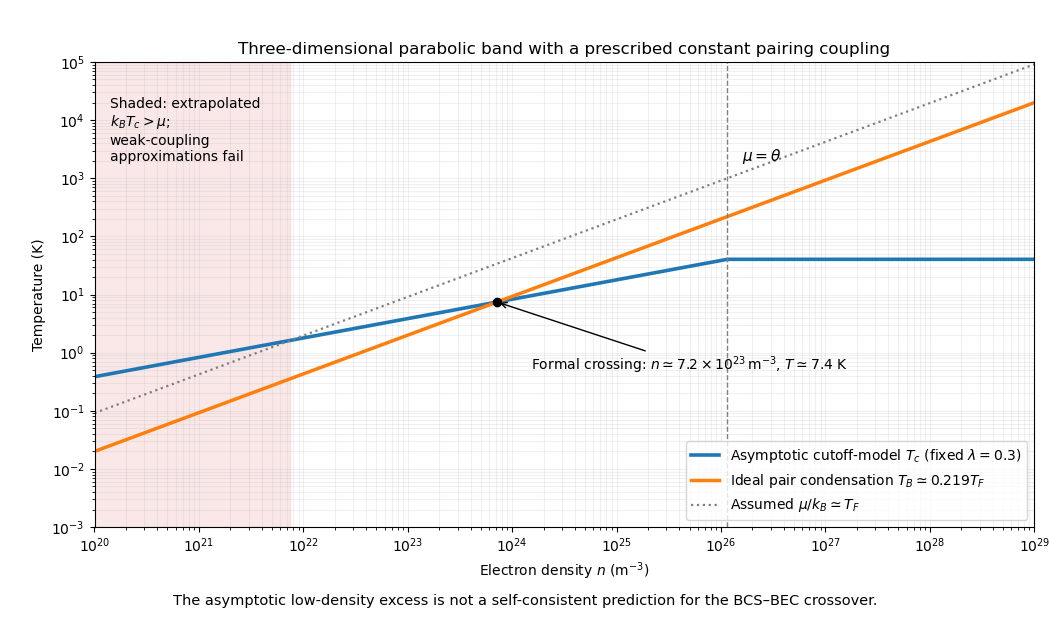


The apparent low-density excess should not be read as a reliable transition above the ideal condensation scale of preformed pairs. On this extrapolation grows without bound, violating the degenerate-gas and large-lower-cutoff approximations. It reaches one already near ; well before using an arbitrarily small density, the chemical potential, pairing, density of states and pair fluctuations need a self-consistent treatment. The asymptotic formula and ideal-boson curve compare two stipulated models, rather than solving the full BCS-BEC crossover.
A complex order parameter captures both the amplitude and phase rigidity of a superfluid. A local isotropic Ginzburg-Landau theory writes its free-energy functional, to fourth order in amplitude and second order in gradients, asThe uniform minimum has for and for . Its phase remains arbitrary under a global transformation. Minimizing with respect to gives . The phenomenological description specifies the allowed structures and coefficients; microscopic input is needed to identify the normalization of and calculate those coefficients. A static functional by itself does not fix the dynamical equation or mode frequencies.
For a dilute three-dimensional Bose gas with short-range repulsion and particle mass , the microscopic low-energy Hamiltonian isThe interaction parameter is expressed through the low-energy s-wave scattering length , rather than an unrenormalized bare delta potential. In a symmetry-selected description, and is condensate density. Equivalently, fixed-number off-diagonal long-range order identifies the macroscopically occupied natural orbital and its amplitude without a nonzero one-point expectation.
Evaluating in a coherent-field condensate variational state gives the Ginzburg-Landau functional of a dilute Bose gas, with the mean-field microscopic identificationsIts stationary variational equation is the Gross–Pitaevskii equation. The time-dependent variational action additionally contains , givingThis term expresses density-phase conjugacy. It is the missing microscopic dynamical input; a purely dissipative relaxation law would describe a different approximation.
Bogoliubov theory writes and retains quadratic fluctuations. In a uniform condensate, and the fluctuation matrix isIts eigenvalues are . The positive branch is the gapless sound mode, continuously crossing over to particle-like excitations at larger . The same result follows by linearizing the time-dependent Gross–Pitaevskii equation about its uniform solution. Thus the microscopic condensate amplitude, scattering interaction and mass determine the mean-field static coefficients and the collective mode. Quadratic quantum fluctuations also produce quantum depletion of a Bose condensate, which a pure coherent-state product omits.
These identifications are controlled for a dilute weakly interacting gas away from a fluctuation-dominated critical region. They are not a universal statement that the exact finite-temperature GL coefficient is always or that its quartic coefficient never receives corrections. Integrating out noncondensed and short-wavelength modes produces effective temperature-dependent coefficients and can change their near-critical behavior. The phase rigidity described by and the thermodynamic order-parameter expansion remain the shared organizing structure.
For BCS theory, the microscopic order parameter is instead an anomalous pair amplitude, commonly normalized as an energy gap . It is not an ordinary single-electron field expectation or automatically the square root of a pair number density. Integrating out fermions and expanding in small and slow gradients near gives the microscopic derivation of Ginzburg-Landau theory. The BCS pairing-field effective action supplies its coefficients through normal-state pair-response functions and thermal fermion sums.
For example, a clean isotropic three-dimensional weak-coupling s-wave model, with the density of states per spin at the Fermi energy and measured in energy units, giveswith microscopic Ginzburg-Landau coefficients from BCS theoryThe numerical factors arise from fermionic Matsubara sums and the isotropic velocity average; they depend on the stated gap and density-of-states conventions. Rescaling the order parameter rescales all three coefficients. The expansion applies near the transition with sufficiently slow spatial variation; disorder, anisotropic pairing and strong coupling alter the coefficients or require additional components. Microscopic derivation also fixes the pair charge in the covariant gradient, producing the superconducting screening current and the Meissner effect.[ref]
Microscopic Derivation of the Ginzburg-Landau Equations in the Theory of Superconductivity by Lev Gor'kov. 1959, near-transition gap expansion and twice-electron charge
The neutral Bose and charged Fermi theories therefore share a complex order parameter and a phase-stiffness functional, while deriving that field from different microscopic objects. The Bogoliubov transformation mixes particle and hole fluctuations of the bosonic condensate in one case and paired fermionic excitations in the other. The static GL limit organizes long-distance behavior; the full microscopic theories retain excitation spectra and temperature dependence beyond that local near-transition expansion.
Original public paper: Physical PDF pages 589–591. All four optional notes and both long questions are covered.
A neutral superfluid has a complex order parameter whose phase describes coherent particle transport. For a Bose condensate it is represented by a field amplitude; for a paired Fermi superfluid it is a pair amplitude. In a symmetry-breaking description, selecting its phase breaks the global particle-number symmetry. A common phase shift leaves the energy unchanged, while a phase gradient costs energy and produces superfluid velocity. Long-wavelength phase oscillations give a gapless Goldstone mode, generally a sound wave when density fluctuations provide the conjugate dynamics. A finite isolated state with exact particle number need not have a nonzero field expectation: the phase-selected language describes the ordered limit and relative-phase coherence.
In a superconductor, the paired order parameter carries charge of magnitude and couples to the electromagnetic field. The meaningful spatial phase combination is , with signed pair charge . Gauge symmetry is a redundancy, so “breaking local gauge symmetry” is not a literal breaking of a measurable physical symmetry. The gauge-invariant electromagnetic response includes the Meissner effect and a finite London penetration depth. Long-range Coulomb forces move the would-be neutral phase mode to a plasma scale through the Anderson-Higgs mechanism in a superconductor.
Additional symmetries can be broken by particular pairing states. Conventional isotropic spin-singlet pairing need not break spatial rotations or time reversal. A d-wave superconductor has a gap transforming nontrivially under crystal symmetries, and some triplet or multicomponent states can also break spin-rotation or time-reversal symmetries. These additional choices are not required by superconductivity itself. A nonzero pairing amplitude, phase coherence and electromagnetic screening describe related but distinct aspects of the ordered state.
In BCS theory, pairing mixes an electron state with a hole in its opposite-momentum partner. For a uniform spin-singlet gap, the uniform Bogoliubov--de Gennes Hamiltonian gives the momentum-pair eigenproblemHere . A fermionic Bogoliubov quasiparticle is a coherent particle–hole combination, withFar above the Fermi surface the excitation is mostly particle-like; far below it is mostly hole-like; at the two weights agree. The transformation preserves the fermionic canonical anticommutation relations. Its mean-field particle-number mixing does not mean that the full physical theory violates charge conservation.
For a fully gapped isotropic state, the minimum single-quasiparticle energy is , while creating a pair of quasiparticles costs at least . This produces suppressed low-temperature thermal populations, an activated electronic heat capacity and a gap feature in superconducting tunneling. Gap nodes in an unconventional state instead allow low-energy excitations, changing the temperature dependence. These fermionic excitations are distinct from collective phase and amplitude oscillations of the paired condensate.
A neutral superfluid's broken global phase symmetry produces a Goldstone mode. Coupling phase to density fluctuations generally gives a long-wavelength phonon with , rather than the quadratic dispersion of a noninteracting condensate. In a dilute interacting Bose gas, the Bogoliubov quasiparticle dispersion isFor a heavy weak obstacle moving at speed , emitting an excitation of momentum changes the available energy by . The Landau criterion therefore givesThe dilute-gas spectrum has . In liquid helium, a roton minimum can make the minimum ratio smaller than the sound speed; the slope of a line from the origin tangent to the full dispersion determines the kinematic bound. A neutral paired Fermi superfluid also has a fermionic pair-breaking bound of order in weak coupling. The smallest relevant branch bound must be considered. Actual flow can fail earlier through vortex nucleation, surface defects or other instabilities: the excitation-energy criterion is not a complete dynamical guarantee of dissipation-free flow.
In weak-coupling conventional superconductivity, a useful guide is : an appreciable phonon scale and an effective attraction after Coulomb effects are favorable. A large density of states at the Fermi level can strengthen pairing, while light constituent masses can raise relevant phonon frequencies. Increasing electron–phonon coupling without limit is not a general strategy: lattice instabilities, competing order and changes to the phonon spectrum constrain it, and stronger coupling requires treatment beyond the simple exponential expression.
For unconventional high-temperature superconductivity, strong electronic interactions and magnetic fluctuations can support sign-changing pairing, as in d-wave superconductivity. Layered structures and proximity to magnetic order may enhance useful correlations, but can also promote competing insulating or density-wave states. Sufficient mobile-carrier phase stiffness is needed to turn pairing into coherent superconductivity; strong pairing alone does not guarantee a large transition temperature. Disorder that is relatively harmless to an isotropic conventional pair state can be pair-breaking for sign-changing gaps. There is no universal recipe established by these qualitative conditions: the pairing interaction, symmetry, carrier density, competing phases and phase coherence must all be considered.
In three dimensions an ideal Bose gas can saturate its excited-state population at chemical potential zero, with the remaining particles forming a Bose-Einstein condensate. The transition follows from the Bose-Einstein distribution integrated against its density of states; below the ideal-gas transition, . Condensation alone does not supply the finite Landau critical velocity of an interacting superfluid: the ideal quadratic spectrum has .
By contrast, a weak attractive interaction near a Fermi surface produces the Cooper instability and the BCS gap equation. Its logarithmic enhancement permits pairing at arbitrarily weak attraction in the ideal model. The low-temperature excitations have , and in weak coupling . This transition is controlled by pair formation when phase fluctuations are small; deeply bound pairs instead motivate a Bose-condensation description with their own density and effective mass.
For the given ellipsoidal dispersion, set , and . Then while the integration measure is . Thus the anisotropic ideal-gas density of states per unit volume and per internal state isThe full continuum momentum range is assumed; this is an anisotropic three-dimensional gas, not yet a discrete stack of two-dimensional bands.
At the Bose transition, substitute :The integral is . Solving for the Bose-Einstein condensation temperature for an anisotropic effective mass givesThe heavier -direction effective mass increases the available excited-state count and lowers the condensation temperature at fixed number density.
For a balanced two-spin Fermi gas, let denote total fermion number density and take to be the single-spin density of states used in the conventional gap equation. Counting the filled ellipsoid givesIf a spin-summed density of states is used instead, the coupling convention in the supplied integral must change accordingly; inserting a factor two into only one side would change the exponent incorrectly.
For , replace the density of states across the interaction window by . Writing , the zero-temperature integral becomesand thereforeThe second expression additionally requires . The explicit density dependence is . This mass-anisotropy enhancement of a weak-coupling BCS gap initially raises the pairing scale, while the ideal Bose condensation scale decreases as .
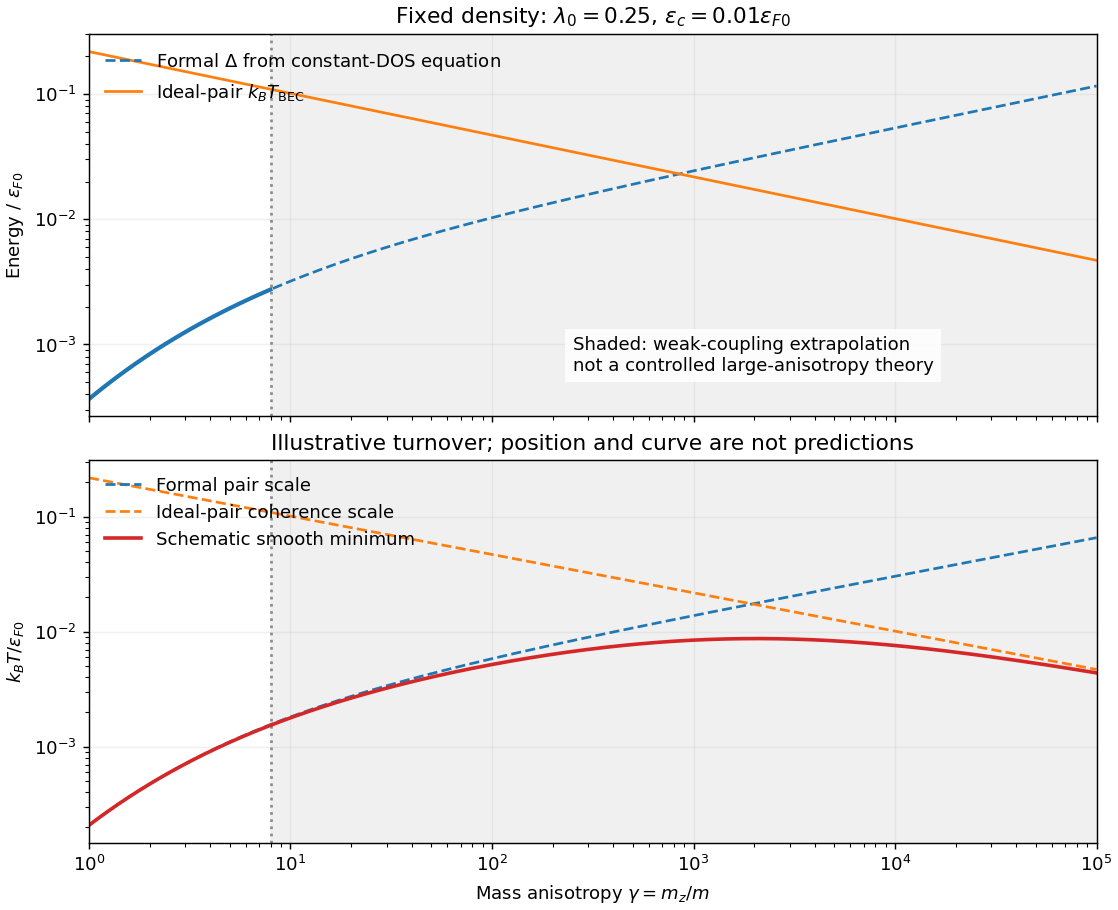
Formal anisotropy-dependent gap and Bose scales, with a schematic coherence-limited transition
. Details. 
Large anisotropy weakens transport and coherence in the heavy direction. The separation of pair formation and phase ordering then matters, so a large mean-field gap need not imply a large actual . A qualitative sketch has initially rising with the pairing scale and eventually turning down when coherence is the smaller scale. If preformed fermion pairs behave as bosons, use and pair mass about ; in this continuum model this gives .
The turnover cannot be located reliably by taking the weak-coupling formulas to : falls, grows, the narrow-window assumption fails and the pair chemical potential and mass require a self-consistent treatment. The smooth curve in the figure is explicitly an illustrative interpolation of two extrapolated scales, not such a calculation. If actual decoupled two-dimensional layers are approached, ordinary ideal-gas finite-temperature condensation is absent and interacting phase order requires a different analysis, including the Berezinskii–Kosterlitz–Thouless transition when appropriate.
The cuprates make the distinction between pairing and phase coherence relevant: they are layered and have anisotropic motion, but their strong correlations, lattice band structure and predominantly d-wave superconductivity are outside this attractive continuum -wave model. Anisotropy by itself is therefore not an explanation or quantitative fit of cuprate transition temperatures.
Use a complex pair order parameter with signed charge , . A local isotropic Ginzburg-Landau theory of superconductivity has free energyFor , , the uniform amplitude is . Variation gives the static field equation and supercurrentThe vector potential obeys Maxwell's equations, including and , with and . The static approximation drops the displacement current. A common dissipative near-transition dynamical extension is the time-dependent Ginzburg-Landau equationIt is a phenomenological relaxation law in its applicable regime, not a universal microscopic Schrödinger equation for every superconductor. Its covariant time derivative and the covariant spatial derivative ensure consistent phase and electromagnetic gauge transformations.
The amplitude and screening lengths areFor the ideal model is type II. An Abrikosov vortex has a phase winding, a core with suppressed of size , and circulating screening currents over . Single-valuedness implies fluxoid and flux quantization in a superconductor:The sign of depends on the chosen circulation and charge convention. Far from the core, where the contour current term is negligible, each singly wound vortex carries one flux quantum in magnitude.
The equilibrium lower critical magnetic field marks favorable entry of the first vortex; for , with an order-one core correction . The upper critical magnetic field follows by linearizing the order-parameter equation in the field:Between these fields lies the superconducting mixed state, often with an Abrikosov vortex lattice. The ideal equilibrium entry and exit fields need not yield large irreversible loops. Flux pinning and surface barriers impede vortex motion; field sweeps then retain history-dependent flux and produce magnetic hysteresis and dissipative losses.
A superconducting weak link, such as a tunnel junction or narrow constriction, couples the phases of two superconductors. With consistent choices of phase and voltage orientation, the Josephson effect givesThe Gauge-invariant Josephson phase includes the line integral of across the link. A zero voltage can sustain a phase-dependent steady current; a constant nonzero voltage makes that contribution oscillate. Microwave irradiation can lock this oscillation to an applied frequency, giving voltage steps at , an experimental test of coherent pair transport rather than an ordinary resistive current law.
A DC SQUID places two weak links in a loop. For identical junction critical currents and negligible self-inductance, flux quantization fixes their relative phase difference to . Adding the two sinusoidal currents and maximizing over their common phase givesThe flux-periodic response provides sensitive magnetic measurements. Junction asymmetry or appreciable loop inductance changes the ideal contrast and can introduce additional hysteresis; the phase-coherent interference principle remains. The Jaklevic Josephson interference experiment is a motivating experimental realization of this link between a superconducting loop, weak links and magnetic flux.
Articles by others on the same topic
There are currently no matching articles.