For the electric-dominated crossed-field orbit, choose a boost along . Since , it is subluminal. The Lorentz transformation of electromagnetic fields gives and , where . The initially stationary electron has , not zero velocity in this frame.
Let , and . Neglect radiation reaction, as in the prescribed external-field model. Integrating the relativistic Lorentz force in this purely electric frame gives the exact trajectoryIndeed , , and satisfy both the force equation and . The constant transverse momentum must be retained.
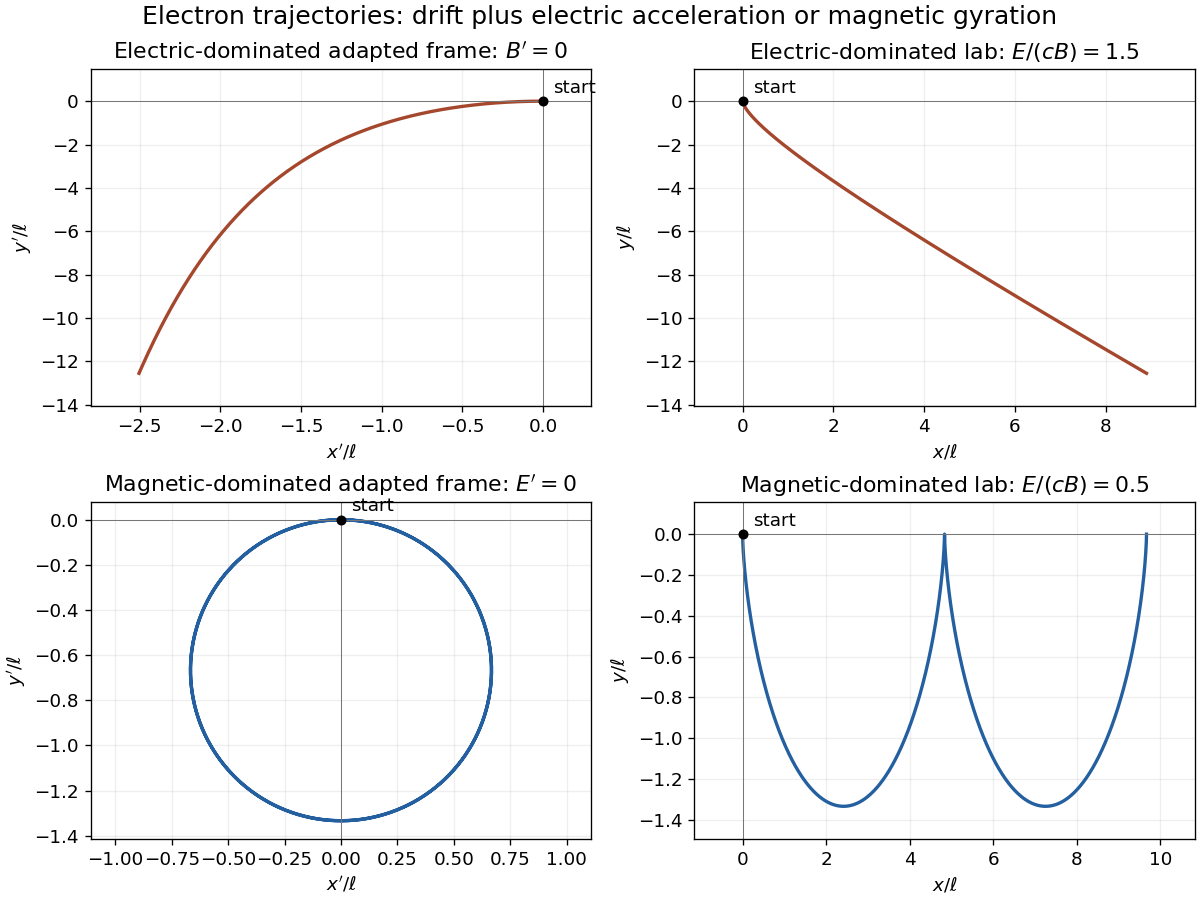
The inverse boost gives a useful exact laboratory parametrization as well:For , the lab electron starts accelerating toward negative and bends toward positive , the direction of . It never acquires a cyclotron orbit in this electric-dominated case. At late times, and , so its speed approaches along an oblique asymptote. Reversing field signs reverses the appropriate directions. The zero- limit is the ordinary electric-field hyperbolic motion.
For the magnetic-dominated crossed-field orbit, choose along , which is subluminal when . Then and . The initial velocity in this frame is , and the constant particle Lorentz factor is because a magnetic field does no work.
Define the signed relativistic cyclotron frequency , retaining . With as parameter, the exact primed trajectory isIt is a circle of radius with centre ; its initial velocity is as required. Transforming back givesIn the laboratory this is a stretched cycloidal trajectory with cusps where the electron is instantaneously at rest. Its average drift is , along for the positive field orientation. Its energy oscillates as the electric field exchanges energy with it; it does not accelerate without bound. If , the initially stationary electron remains stationary. At , neither of these finite boosts exists; that separate null-field limit is not one of the two strict cases requested.

Articles by others on the same topic
There are currently no matching articles.