For a vacuum electromagnetic wave, the four-wavevector is with and . Its phase can be writtenBecause and transform as Lorentz four-vectors, their contraction is a Lorentz scalar. This proves phase invariance, with the same phase convention in both frames.
For a hypothetical free emission , four-momentum conservation gives . The initial and final electrons have , and . Squaring gives . In the final electron's rest frame, however, for a nonzero future-directed photon. ThusAn external field, another body or a medium can exchange momentum and change this conclusion; those are different systems.
Let and . A spacelike separation obeysUnder a boost with velocity , the time separation is . ChooseThen , while follows from the spacelike inequality. Therefore an inertial simultaneity frame exists. This choice has no transverse boost component and is not claimed to be the unique such frame. If the events are already simultaneous, suffices.
Put . The total four-momentum of the perpendicular photons isAlthough each constituent is massless, the sum has . Its invariant mass is thereforeThe rest energy is the total energy in the frame where the two photon momenta cancel, not the sum of individual photon rest energies.
The centre-of-mass velocity follows from the total energy and momentum:A boost in this direction with gives zero total spatial momentum and total energy . The constituent photons remain moving at in that frame.
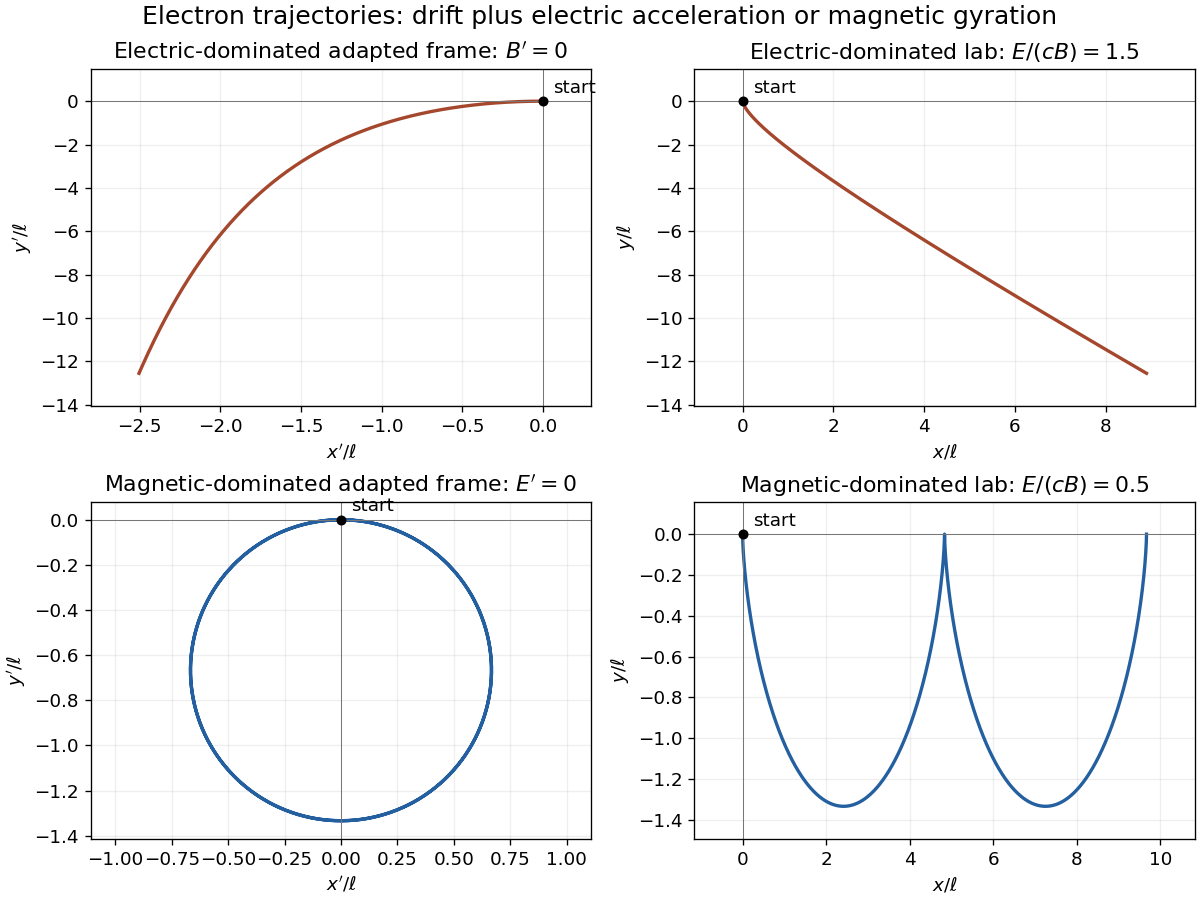
For the electric-dominated crossed-field orbit, choose a boost along . Since , it is subluminal. The Lorentz transformation of electromagnetic fields gives and , where . The initially stationary electron has , not zero velocity in this frame.
Let , and . Neglect radiation reaction, as in the prescribed external-field model. Integrating the relativistic Lorentz force in this purely electric frame gives the exact trajectoryIndeed , , and satisfy both the force equation and . The constant transverse momentum must be retained.
The inverse boost gives a useful exact laboratory parametrization as well:For , the lab electron starts accelerating toward negative and bends toward positive , the direction of . It never acquires a cyclotron orbit in this electric-dominated case. At late times, and , so its speed approaches along an oblique asymptote. Reversing field signs reverses the appropriate directions. The zero- limit is the ordinary electric-field hyperbolic motion.
For the magnetic-dominated crossed-field orbit, choose along , which is subluminal when . Then and . The initial velocity in this frame is , and the constant particle Lorentz factor is because a magnetic field does no work.
Define the signed relativistic cyclotron frequency , retaining . With as parameter, the exact primed trajectory isIt is a circle of radius with centre ; its initial velocity is as required. Transforming back givesIn the laboratory this is a stretched cycloidal trajectory with cusps where the electron is instantaneously at rest. Its average drift is , along for the positive field orientation. Its energy oscillates as the electric field exchanges energy with it; it does not accelerate without bound. If , the initially stationary electron remains stationary. At , neither of these finite boosts exists; that separate null-field limit is not one of the two strict cases requested.

With , the total four-momentum is . A sum of Lorentz four-vectors transforms as a four-vector, sois a Lorentz invariant. Its value is the squared invariant mass of the complete system, irrespective of whether its constituents interact. Isolation makes the total four-momentum constant in time.
For a photon gas, write with . Its individual null norms do not make the total norm vanish:For an isotropic gas in its momentum rest frame, and . Zero is possible only when all nonzero photons propagate in the same direction. Two equal-energy photons at right angles, for example, give , rather than zero. Without an angular distribution, the pairwise expression is the general answer; isotropy is an additional assumption.
Articles by others on the same topic
There are currently no matching articles.