Integrate each steady one-dimensional conservation law across a thin region enclosing the shock. Mass conservation gives constant mass flux . Momentum conservation includes both advected momentum and pressure force, so is constant. The total energy flux is , where . For a genuine shock , division by the mass flux and the equation of state give the conserved stagnation enthalpyThus the Rankine-Hugoniot conditions for a perfect gas areThe velocities here are measured in the stationary shock frame; a moving-shock problem must first be transformed to that frame.
Let state zero be the undisturbed gas and state one the uniform gas between piston and shock. Their laboratory velocities are zero and . In the shock frame their speed magnitudes are and . Mass and momentum jumps giveEnergy conservation gives . Substitute the preceding relations and , then divide by the nonzero . The result isThe right-moving root isThe other root is negative and does not describe the outgoing shock. For , the quadratic is negative at , hence its positive root obeys : the shock stays ahead of the piston and the density ratio is positive.
The second law requires the specific entropy to increase along the fluid's passage through a nontrivial physical shock: . For a perfect gas this selects a compressive shock, whose upstream shock-frame Mach number is greater than one and whose downstream shock-frame flow is subsonic.
Here the upstream Mach number is . The quadratic gives , so . Density and pressure both rise. With , one also has . For example, put and use the normal-shock identityThe characteristic geometry is therefore . The plus-family characteristics from the gas ahead are overtaken by the shock, while those behind catch up with it; they converge into the discontinuity. The minus-family speeds are ahead and behind. The piston is the line and the shock is the steeper-in- line .
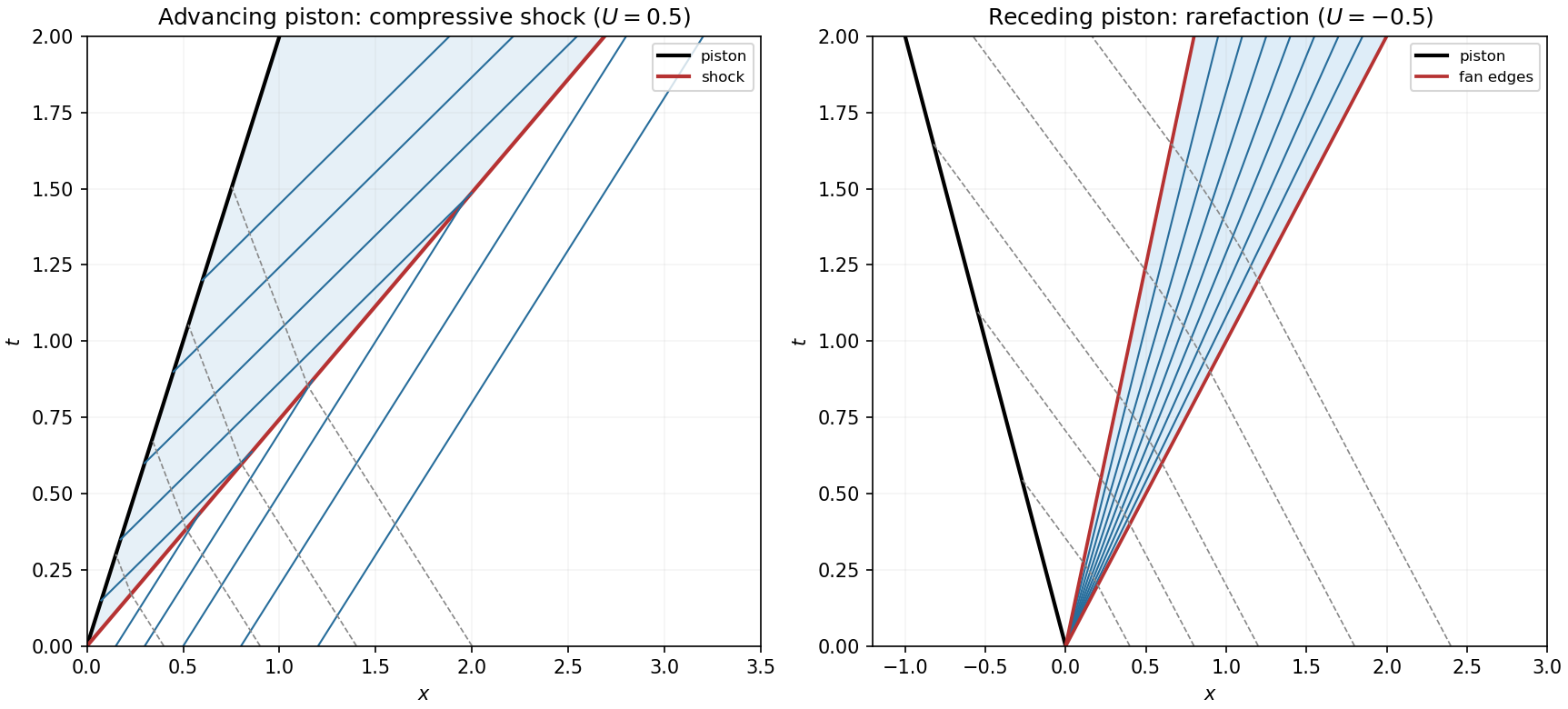

For the same positive algebraic root remains real and satisfies , because . The jump relations then give a density decrease, , and a pressure decrease. Where both states remain thermodynamically positive, this is an expansion shock: its upstream shock-frame flow is subsonic and its entropy change has the forbidden sign. At sufficiently large negative the formula even predicts nonpositive pressure, an additional reason it cannot represent a physical gas state.
The observed outgoing wave is instead a continuous isentropic rarefaction wave. Its plus-family rays spread from the initial piston corner rather than coalescing. The fan head enters the undisturbed gas at ; for moderate recession the tail is , with the uniform gas next to the piston moving at and . The appropriate Riemann invariant is , so inside the fan, with ,These expressions show the spreading characteristics in the right panel of the preceding figure. If , the gas cannot follow the piston with positive sound speed; a vacuum gap forms, bounded by the limiting rarefaction wave edge. Thus the fan description also identifies the strong-recession limit.
Articles by others on the same topic
There are currently no matching articles.