Write the bead position in Cartesian coordinates as . Differentiation gives , while the free particle has . Thus the kinetic energy is the sum of these squared speeds weighted by half the respective mass. The squared spring length isA spring obeying Hooke's law with zero natural length has potential energy . Consequently , and deleting the additive constant givesThe spring length is the straight separation of its endpoints, not distance measured along the helix. The fixed frictionless constraint is already incorporated by using the generalized coordinate ; it supplies no extra potential energy.
Set and . Applying the Euler-Lagrange equations separately to givesFor example, whereas ; these signs also follow from equal and opposite spring forces projected on the permitted bead motion. The angular particle equation can equivalently be written . The factor is the bead's inertia with respect to the helical coordinate, rather than its moment of inertia about the axis alone.
The continuous transformation , , , moves both endpoints by the same screw motion and preserves the fixed helix. Both and are unchanged, so . Noether theorem therefore givesThis is the Noether conserved quantity for a mechanical point symmetry applied to helical symmetry. In physical Cartesian terms it equals total angular momentum plus times total linear momentum: the bead contributes . Neither pure axial translation nor pure axial rotation preserves the fixed coil separately. Their conserved combination is a consequence of the helical symmetry, not two independently conserved momenta. Substitution of the four equations of motion verifies .[ref]
In the negligible bead-mass limit the bead contribution to vanishes. Since the particle starts at rest, , and hence . Assume and a regular massless limit. Integrating along the trajectory giveswhere is the closed projection onto the plane perpendicular to the coil axis. The given final and ensure that this projection closes. Green's theorem identifiesThus is the signed area enclosed by the transverse projection, positive for counterclockwise traversal viewed from positive . Self-intersecting projections contribute their winding-weighted areas; it is neither an unsigned area nor an area of a surface in three dimensions. For , a positive signed area gives negative axial displacement. This is signed-area displacement under a helical constraint: returning to the same projected coordinates can leave a nonzero axial displacement.
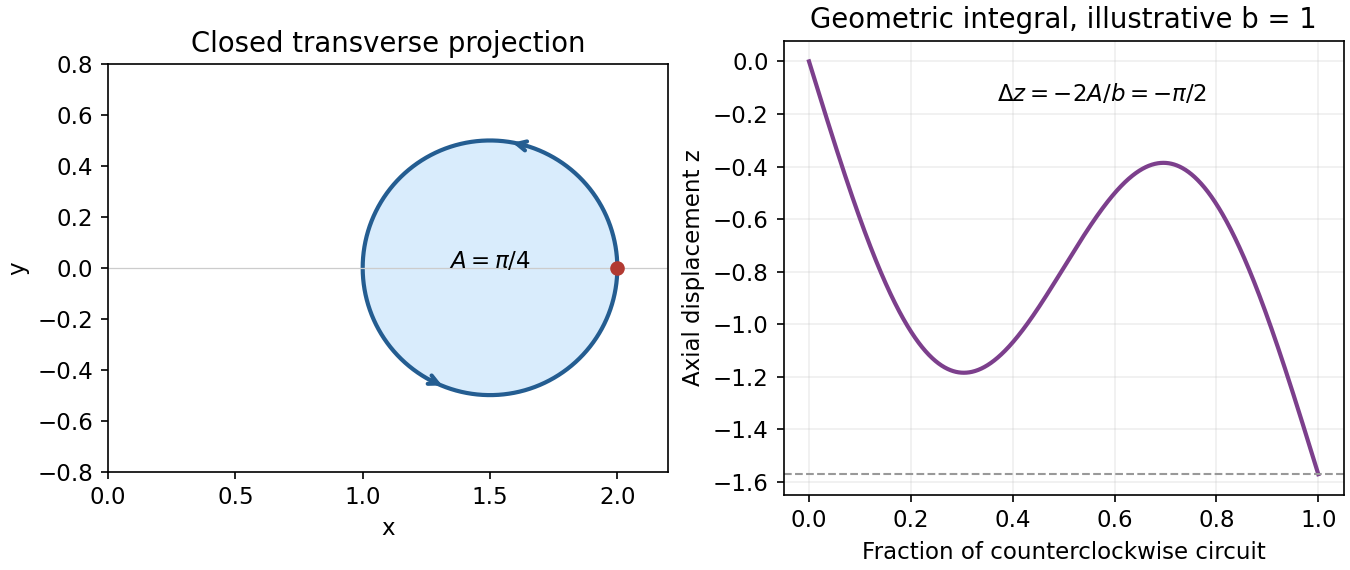
Signed transverse area and the associated axial displacement for an illustrative closed projection
. Details. 
The plotted loop illustrates the geometric integral only; it is not asserted to be a particular spring trajectory.
Articles by others on the same topic
There are currently no matching articles.