Use metric signature and the model's rescaled units . Its exponential implicitly uses dimensionless rescaled field and coupling combinations; the numerical coefficients of the potential are those supplied. Treat and as independent variables in taking canonical derivatives:The Hamiltonian density isThe kinetic and gradient terms are nonnegative, so a static homogeneous minimum is obtained by minimizing the potential. Put . For , is unbounded below. For , the exponential decays while tends to minus infinity. Thus a stable vacuum requires .
For positive ,The exponential complex-scalar potential consequently hasFor , the minima form a circle , with and . For the minimum has . The symmetry remains global phase rotation in either phase, but a chosen nonzero vacuum breaks it spontaneously. At the origin is a unique minimum with vanishing quadratic curvature and a positive leading quartic term; this critical masslessness should not be confused with a Goldstone mode.
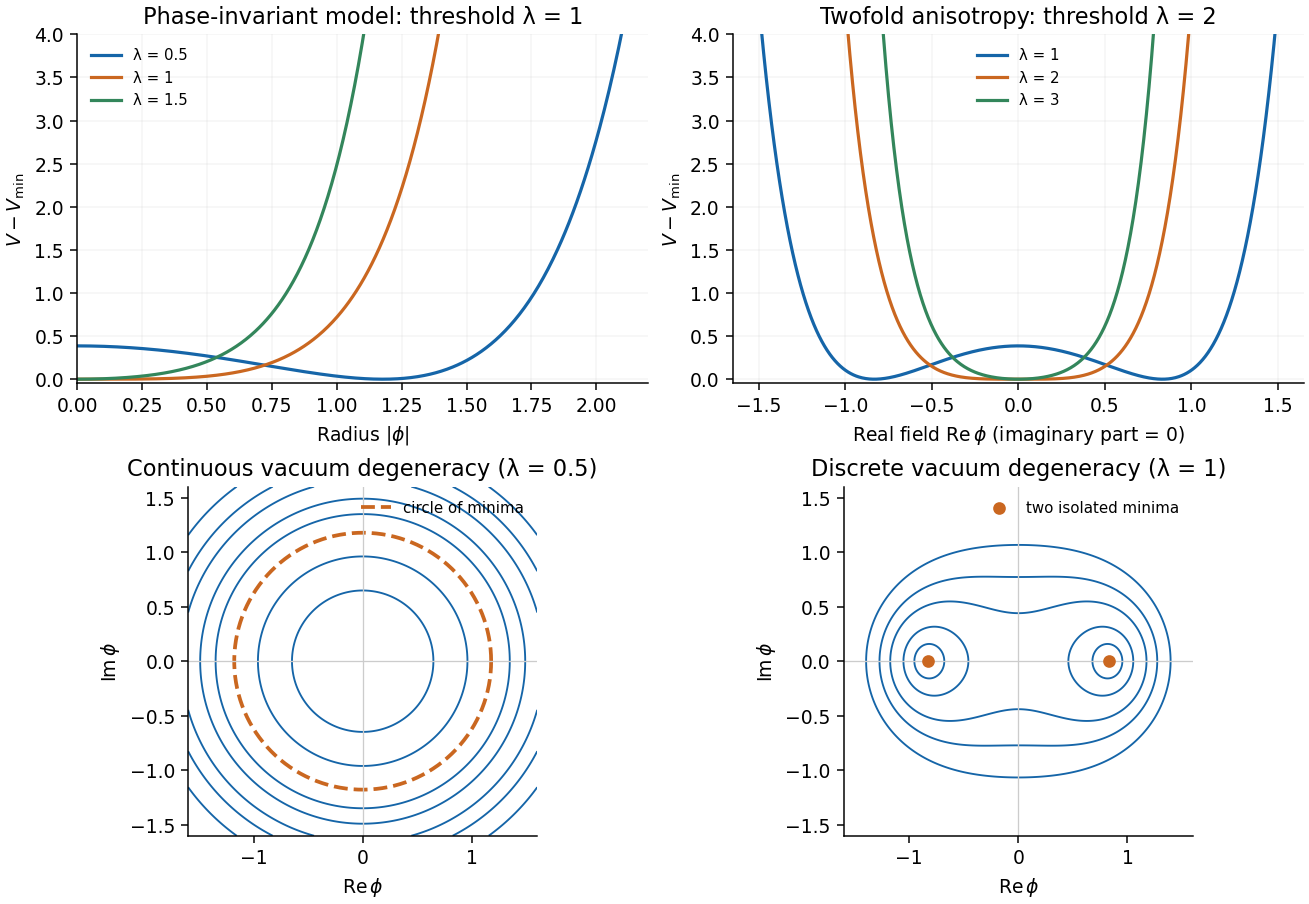
Original radial potentials showing the continuous and explicitly twofold vacuum structures and their thresholds
. Details. 
Let and write . ThenSince and , the quadratic potential isThereforeThe constant can be dropped from the fluctuation equations. For canonical real fields, use :These are the radial and angular masses of a phase-invariant scalar potential. The radial Higgs mode changes the field magnitude and costs energy to second order. The angular Goldstone boson changes the phase along the vacuum circle without a quadratic restoring force. Its linear dispersion is , whereas the radial mode has . The zero angular mass follows the continuous broken global symmetry, not from an accidental cancellation in a particular coordinate choice.
Write . The covariant kinetic term containsA local U(1) gauge symmetry can remove in unitary gauge. The angular fluctuation no longer appears as an independent physical massless Goldstone boson; its degree of freedom supplies the longitudinal polarization of the massive vector field. At quadratic order,The factor of two follows from the convention that is the complex field's vacuum value. This Higgs mechanism changes a two-polarization massless electromagnetic field into a three-polarization massive Proca field; the remaining radial scalar keeps . Static fields in the homogeneous broken phase are screened on a scale of order in these units. The gauge symmetry is a redundancy of the description; the physical statement is the changed spectrum and disappearance of an independent massless angular mode.
Write . The added term is , so the full potential simplifies toThe phase-rotation subgroup is reduced from U(1) to the two-element symmetry . More fully, the kinetic term and potential are invariant under independent reflections and , a internal symmetry generated by and complex conjugation. There is no continuous internal rotation symmetry for the explicit twofold anisotropy of a complex scalar field.
For fixed , positive makes the exponential grow with , so every global minimum has . On the real axis,ThusFor , the nonzero stationary points are the two global minima; the origin is unstable along the real direction. For the origin is the unique minimum, with zero real-direction quadratic curvature at the critical value . Selecting breaks the sign reversal that exchanges the two vacua, while complex conjugation remains unbroken.
Set , . Since , expansion givesEquivalently, in canonical fields , ,Both masses are positive throughout the broken phase . A broken discrete symmetry does not demand a massless Goldstone boson. At the radial mass tends to zero at a phase boundary, so a claim of strictly positive mass there would be incorrect. For completeness, expanding around the symmetric origin gives squared masses and for the canonical real and imaginary fields.
Articles by others on the same topic
There are currently no matching articles.