The derivatives of the Lagrangian density are , , and . The Euler-Lagrange field equation is thereforeThis is the one-dimensional wave equation with wave speed . Both signs of propagation are allowed: for sufficiently regular profiles.
Use and Minkowski metric , with the wave speed equal to one. Regarding as a scalar field, the symmetric canonical stress-energy tensor isIt obeys on the wave equation. For a scalar field the intrinsic spin current vanishes. The total orbital Lorentz current and its integrated angular-momentum tensor areBecause there is only one spatial dimension, its only independent possibly nonzero component iswhere . The corresponding flux is . Symmetry and conservation of giveThus is conserved provided the boundary flux vanishes and the integrals exist. For example, localized wave packets on an infinite line have this property. One can also check directly that , so the two terms in have cancelling derivatives.
The significance is the boost charge of a one-dimensional scalar field. There is no independent spatial rotation or ordinary spatial angular-momentum component in one dimension. Instead, the action has the mathematical Lorentz invariance of a massless wave field with invariant speed , and generates its boost. Its conservation says that the center of energy moves uniformly. This is a symmetry of the ideal wave-field model, rather than an assertion of fundamental vacuum Lorentz symmetry for a material rod. Fixed boundaries can break it, and a general solution with nonvanishing boundary flux need not conserve the integrated charge.
With the PDF's inverse Fourier transform convention, the derivatives act asso its forced differential operator becomes . ThusFor the physical impulse response choose the retarded fundamental solution, vanishing before . For and , its poles lie in the lower half-plane. The retarded Fourier pole prescription specifies the zero mode and the zero-damping limit as well; a Green function without a temporal or boundary prescription would otherwise permit homogeneous additions.
This is the Kelvin-Voigt rod Green function. Multiplying the homogeneous real-space equation by givesA spatial Fourier mode therefore satisfies : positive really damps the motion. For sufficiently decaying fields its energy satisfiesThis checks the sign of the imaginary term in independently of the transform calculation.
For , defineThe simple poles are . In the inverse transform , close the contour below for . Its clockwise orientation gives times the sum of residues. That sum isFor , close above; there are no poles. The residue theorem therefore givesHere is the Heaviside step function. At the continuous retarded limit is . At critical damping, likewise replaces by ; beyond the stated oscillatory range an imaginary converts it to a hyperbolic sine. These continuations retain decaying temporal exponents.
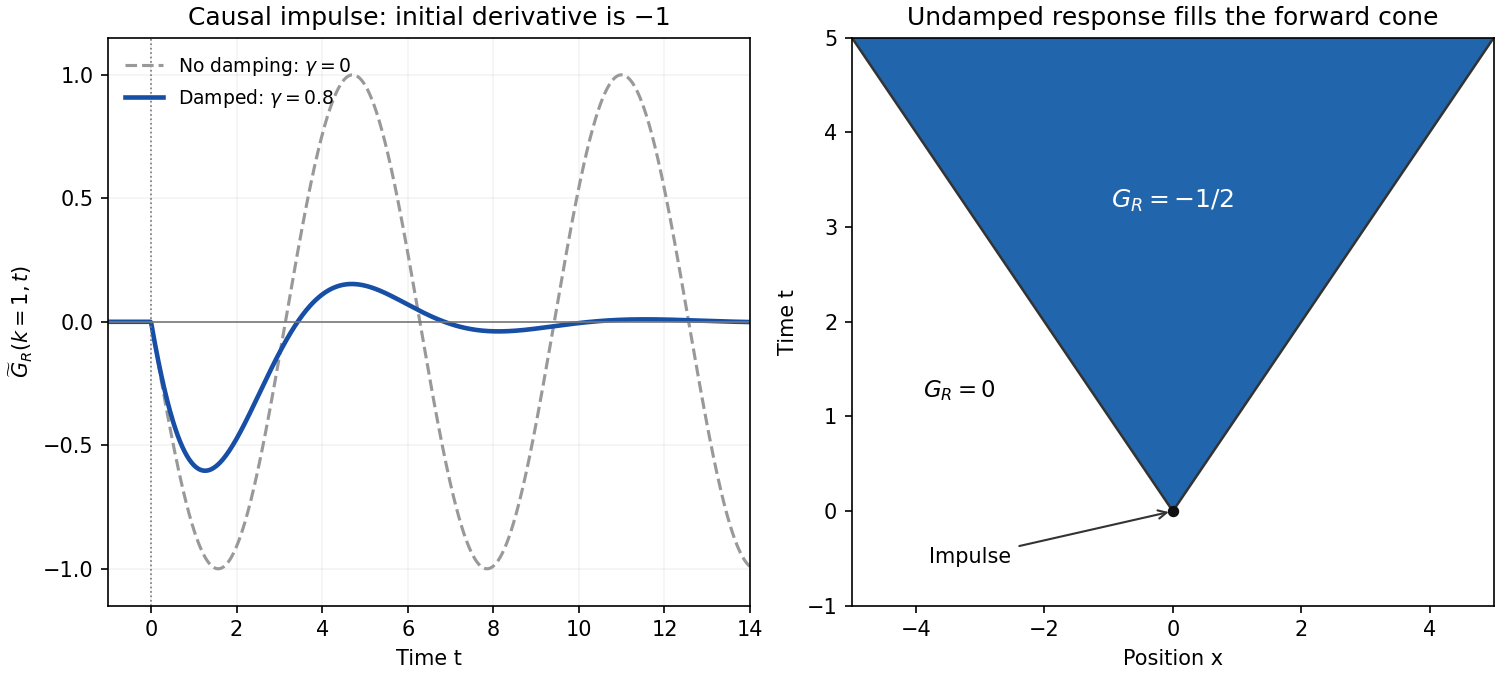
For each fixed , taking givesFor , invert in space and set :The correctly normalized sinc function transform isFor instance, , and Fourier inversion immediately gives the factor . The PDF's prefactor is inconsistent with its top hat of unit height; it would give height . Using the normalized identity yieldsas a distribution. The values assigned precisely at a wave front do not change that distribution. This is the negative of the standard one-dimensional retarded wave Green function, because the PDF's differential operator is .
The sign and initial data can be checked without any contour calculation. Integrating the spatial-Fourier equation through the impulse givesIn real space these are and . In particular,for a smooth test function , confirming the negative delta-function initial velocity. Before the impulse the displacement and velocity are zero. The disturbance fills the forward causal cone for the constant-speed wave equation, whose fronts move at unit speed, consistent with . The final question's printed is interpreted as , referring to the elastic constant, not to the Fourier wavevector. No initial conditions were otherwise specified, so the causal choice has been made explicitly.

Articles by others on the same topic
There are currently no matching articles.