Let be the free real-scalar Feynman propagator and the free complex-scalar one. Expanding the interaction exponential once and applying Wick's theorem gives the connected decay Green's functionThere is one allowed contraction of each external field with the appropriate vertex field, so no factorial remains. Fourier transformation gives the momentum-conserving delta factor times , and amputation of external propagators gives the decay vertex . An on-shell physical decay additionally requires .
If one literally asks for the full three-point correlation function without a connected restriction or a tadpole condition, it also containsthe product of the induced heavy-field one-point function and the free light-field two-point function. This disconnected tadpole diagram does not describe a three-particle decay and drops out of its connected amputated amplitude.
For two equally charged daughters the corresponding Green's function vanishes to every perturbative order:Every interaction contains equal numbers of and , so the two excess conjugate fields can never be paired. Equivalently the exact global U(1) symmetry , leaves the vacuum and action invariant, whereas this insertion has charge . Charge conservation forbids the decay of a neutral particle into two particles of the same nonzero charge.
The first-order Dyson series contains . For an amputated three-point Feynman diagram, each of the three distinct field types contracts in exactly one way. Writing each external plane wave in momentum space producesThus the momentum-space Feynman rule, with all four-momenta incoming, isAfter stripping the conservation delta factor, it is simply . There is no combinatorial factor because the interaction has three distinct field slots. The charged lines carry opposite charge-flow orientations and the real heavy line is neutral.
Put . The heavy-field equation of motion isThis solution describes the low-energy sector without an independent incoming heavy-particle wave. It is valid when all external momentum invariants and light masses squared are small compared with .
After an integration by parts, the terms involving the heavy field are . Substituting the solution into both terms, rather than the source term alone, givesHence, with the question's sign convention for the local quartic interaction,This is integrating out a field followed by a derivative expansion. The negative quartic means attraction. It also makes the truncated potential unbounded at large fields; minimizing the original potential over reveals the same negative quartic. Thus neither displayed model, without extra stabilizing interactions, supplies a globally stable nonperturbative vacuum. The matching describes perturbative low-energy scattering about the local vacuum. The simple equation-of-motion matching fixes the leading tree-level coefficient; precision quantum matching requires consistent loop renormalization and the additional effective operators at the requested accuracy.
Label the initial particle and antiparticle and the corresponding final momenta , with and . Charge flow permits an -channel heavy-scalar annihilation graph and a -channel heavy-scalar exchange graph. It excludes a third -channel graph for these fixed charge assignments. The effective theory has one contact graph.
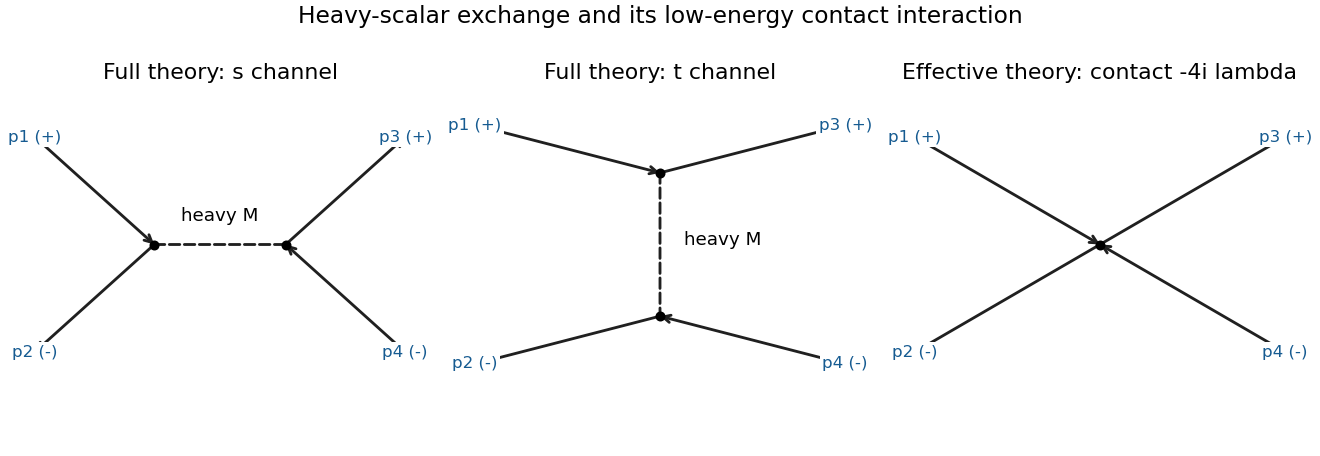
Particle-antiparticle scattering by heavy scalar annihilation and exchange, compared with its low-energy quartic contact interaction; external charge labels are held fixed
. Details. 
The two cubic Feynman vertices and the heavy propagator giveFor ,This independently checks the sign and the factor in solution. The next difference is the derivative correction of order in the amplitude.
Let denote the total center-of-mass energy, with . The final particle and antiparticle are distinct, so no identical-particle factor is needed. The leading isotropic differential scattering cross-section and total cross section areCorrections are relatively of order and, in a high-energy expansion, , in addition to loop corrections when they matter. If instead denotes each beam particle's energy, substitute before comparing numerical prefactors.
Articles by others on the same topic
There are currently no matching articles.