This is a birth-death master equation: is the transition rate and is the transition rate . The first two terms are incoming probability flows from the adjacent states; the last removes probability at the total escape rate . Rates must be nonnegative. For a population on the nonnegative integers, take and no incoming flux from negative states.
Summing over all states and shifting the two incoming indices givesThus an initially normalized probability distribution remains normalized. The cancellation assumes no boundary flux and legitimate summation; on an infinite state space this means the nonexplosive process or a boundary prescription that conserves total probability. All rates used in the later parts satisfy this requirement.
Multiply the master equation by and sum over . Shifting indices producesThe apparent negative power causes no problem at when . Let , so . If the rates are polynomials in , replace their arguments by to obtain a finite-order partial differential equation:For arbitrary rates the weighted sums still give an exact generating-function evolution, but need not reduce to a finite-order differential operator. The probability generating function obeyswhich is the normalization condition. The evolution has when the rate sums converge, so an initially normalized distribution stays normalized. Its derivatives at also give the factorial moments, and expansion around recovers individual probabilities.
For the Poisson process, and , soThis is an ordinary differential equation in time for each fixed , with solutionConsequentlyThe initial condition is interpreted as , with all other initial probabilities zero. Normalization follows from . The mean and variance are both , as expected for independent events arriving at constant rate.
With individuals, each of the can reproduce at rate and independently die at rate . Thus the total birth and death rates are . The gain into state comes from a birth in state and a death in state , while its loss rate is . ThereforeAt , the birth inflow from negative states is absent and . The empty state is absorbing: once the population reaches zero, neither process can restart it. Equal birth and death rates make this a critical branching process.
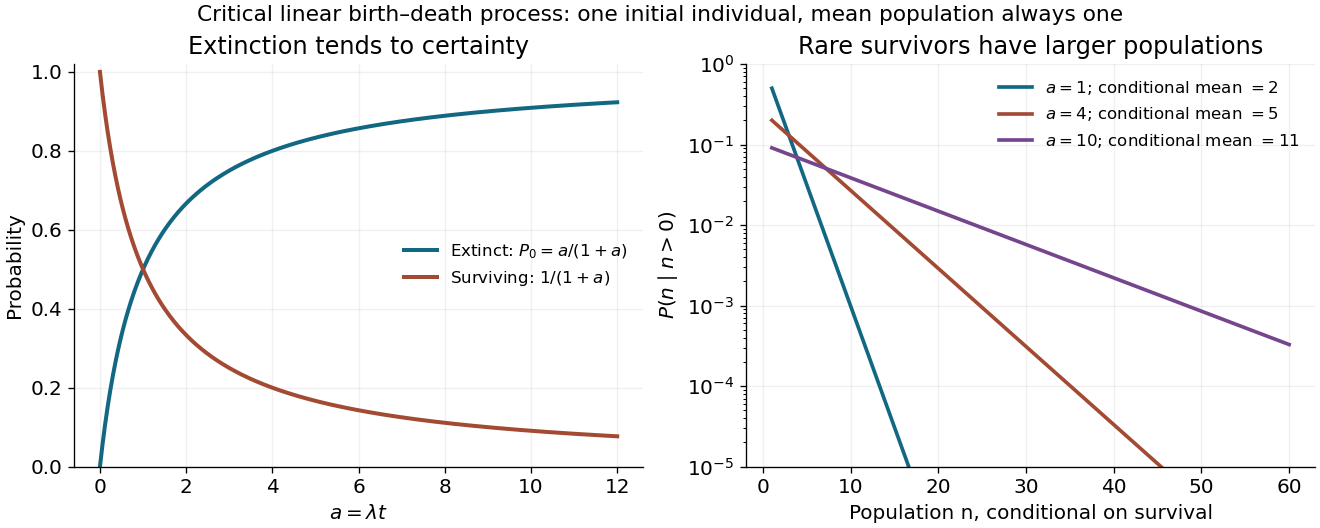
The rates in part d turn the generating-function equation intoFor the distribution of a critical linear birth-death population, the method of characteristics gives and . Setting gives , so the initial characteristic coordinate is . HenceIt has the correct initial value and . With , rewrite the denominator as and expand its geometric series. The probabilities areAt this is understood by continuity: and all other probabilities vanish. Summing the positive-state probabilities gives , which together with verifies normalization directly.
There is eventual extinction with probability one, because . Nevertheless at every finite time, while . There is no contradiction: the increasingly rare surviving populations have conditional mean . This is the distinction between a constant ensemble mean and survival of a typical realization.

Articles by others on the same topic
There are currently no matching articles.