In the classical equilibrium circuit, the capacitor stores . Equipartition assigns this quadratic term mean energy , soThe mean voltage is zero and its variance is . Resistance determines the equilibration time and noise spectrum, not this full-band equilibrium variance. A finite-bandwidth or appreciably loading readout can measure less than the ideal result.
Let and choose the nondegenerate energy levels as 0 and . For N independent identical units, ; set N=1 for a single two-level system. Differentiating its logarithm givesAt low temperature, and : the upper level is frozen out. At high temperature, the two levels approach equal populations, giving while . The energy therefore rises monotonically to a plateau, while the heat capacity has a Schottky peak:Unequal degeneracies would change the populations and peak; the usual equal-degeneracy model is stated here. Shifting both energy levels changes the energy baseline but not heat capacity.
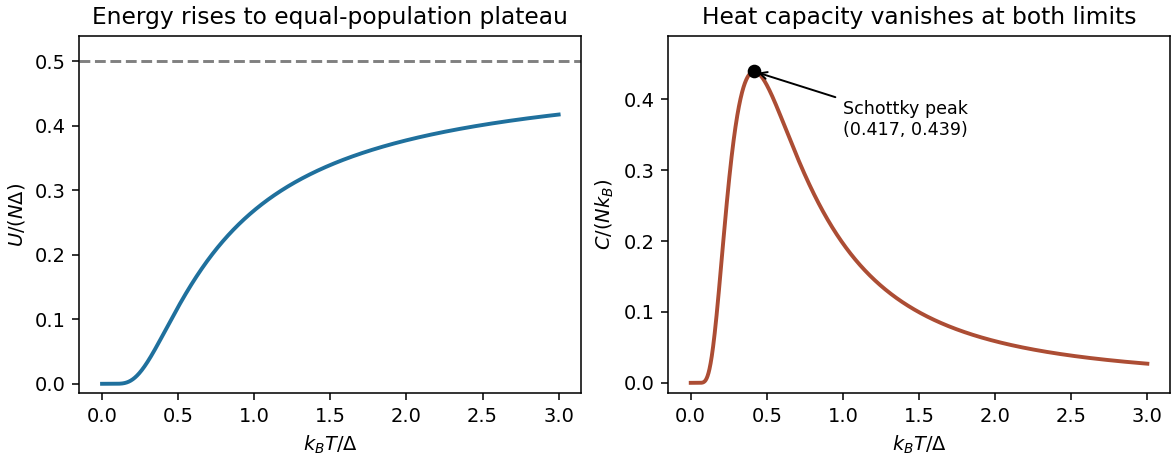
Original equal-degeneracy two-level internal-energy and heat-capacity curves, with the high-temperature plateau and Schottky peak marked
. Details. 
Use a three-dimensional ideal gas at the same number density n for both isotopes. An unpolarized helium-3 gas has spin degeneracy two, henceHelium-4 has a single spin state, and the ideal Bose-gas saturation condition givesEliminating n, using and , yieldsThe fermionic spin degeneracy must be included. This is an ideal-gas estimate; strong interactions in liquid helium prevent identifying it with an exact experimental transition temperature.
Articles by others on the same topic
There are currently no matching articles.